


Bull shark - Carcharhinus leucas
External Characteristics, Body Structure & Anatomy
External Characteristics of the Bull Shark
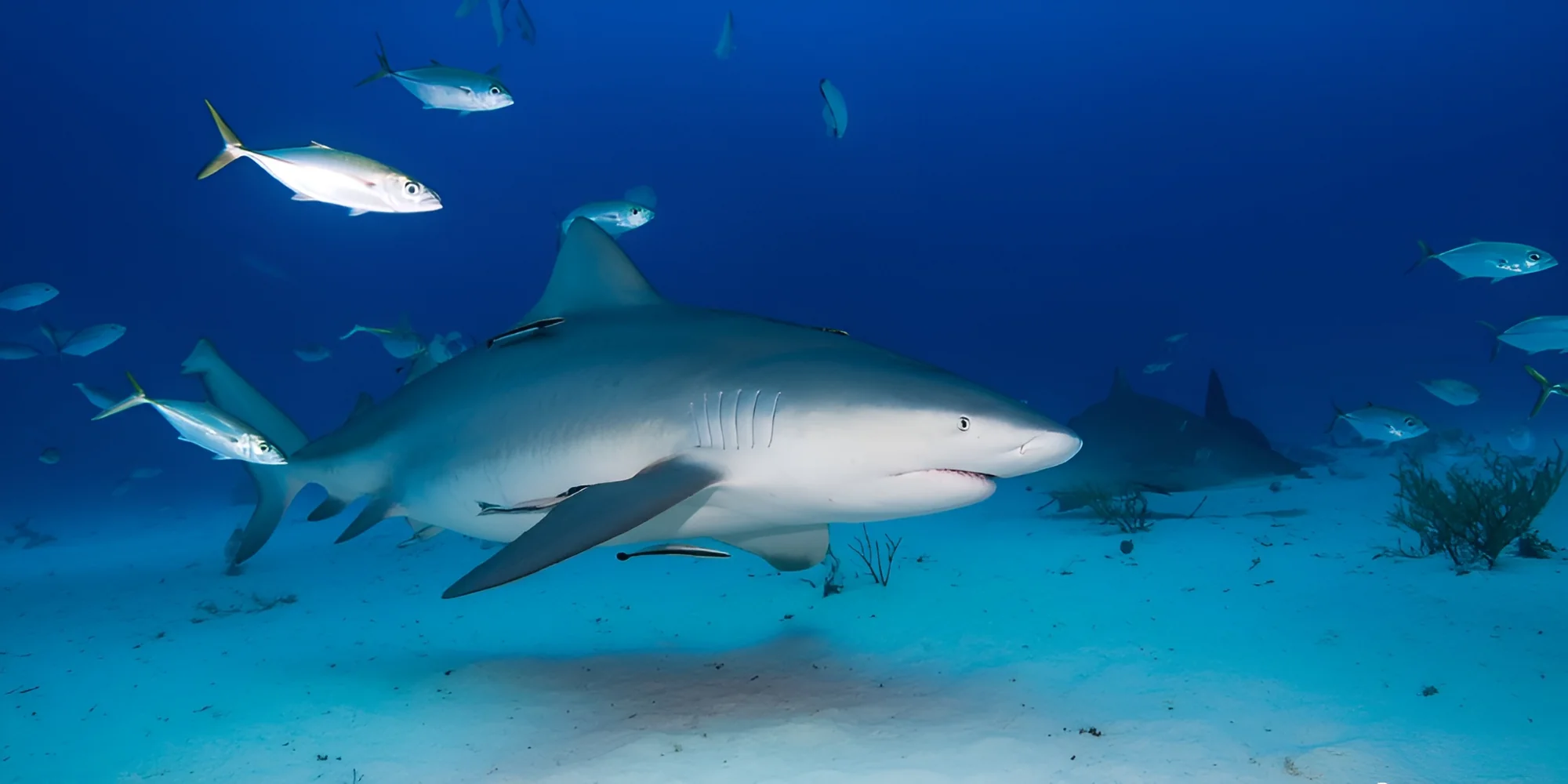
The bull shark is characterised by its robust appearance, which gives it its name. With an average length of 2.1 to 3.5 metres and a weight of up to 230 kilograms, it is a massive marine inhabitant. Its external characteristics are perfectly adapted to its way of life.
Body Structure and Shape
The bull shark has a stocky, muscular body that gives it enormous strength and agility. Its head is broad and flattened, with a short, blunt snout reminiscent of a bull. This head shape makes it easier to manoeuvre in murky waters where visibility is often limited. The eyes are relatively small, suggesting that the bull shark relies less on its vision than on other senses.
The skin of the bull shark is covered with placoid scales, which have a rough, sandpaper-like texture. These scales reduce water resistance and protect against injury. The colouration varies depending on the habitat, but is usually grey with a white underside, known as “countershading”, which helps the shark to camouflage itself from prey and predators.
Fins and Tail
The bull shark’s dorsal fins are distinctive: the first dorsal fin is large and triangular, while the second is significantly smaller. The tail fin is powerful and enables fast, powerful swimming movements. This fin structure supports the shark in making sudden changes of direction, making it an efficient hunter.
Anatomy of the Bull Shark
The anatomy of the bull shark is a prime example of evolutionary adaptation. Its internal and external structures enable it to thrive in a wide range of environments, from coastal regions to river estuaries.
Skeleton and Musculature
Like all sharks, the bull shark’s skeleton is made of cartilage, which makes it lighter and more flexible than a bony skeleton. This structure is ideal for the quick, agile movements necessary for hunting. The musculature is particularly well developed, especially along the torso and tail fin, giving the bull shark its impressive swimming power.
Sensory Systems
The bull shark has highly developed senses that help it to detect prey even in murky waters. Its sense of smell is exceptional: it can detect blood in the water at concentrations of just one part per million. The lateral line, a sensory system along the body, registers vibrations and pressure changes in the water, while the ampullae of Lorenzini detect electrical fields emitted by prey.
Dentition and Jaw
The jaw of the bull shark is powerful and equipped with sharp, triangular teeth arranged in several rows. These teeth are regularly replaced, allowing the shark to crush even hard prey such as turtles or large fish. The bull shark’s bite force is among the strongest of all shark species.
Adaptation to Different Environments
A remarkable feature of the bull shark is its ability to survive in different salinity levels. Its kidneys and glands efficiently regulate the salt balance, allowing it to move between the sea and rivers. This adaptation is also reflected in the robust anatomy, which withstands the physical demands of such transitions.
Differences Between Males & Females
Although male and female bull sharks share many similarities, there are some physical differences.
Size and Weight
Female bull sharks are generally larger and heavier than their male counterparts. While males often reach a length of about 2.1 to 2.8 metres, females can grow up to 3.5 metres long. These size differences are typical of many shark species and are related to reproductive biology, as larger females can carry more offspring.
Reproductive Organs
The most obvious difference between males and females is, of course, the reproductive organs. Male bull sharks have so-called claspers, modified pelvic fins that are used for sperm transfer. These are externally visible and a clear distinguishing feature. Females, on the other hand, do not have claspers but have a cloaca, which serves both reproduction and excretion.
Behaviour and Body Structure
While the body structure is generally similar, female bull sharks often have a slightly broader body shape, which is related to their role during gestation. Males, on the other hand, may have a more streamlined silhouette, which possibly gives them greater manoeuvrability. Behavioural differences, such as territorial behaviour or aggressiveness, are less related to body structure than to hormonal factors.
Distribution & Habitat
The bull shark is one of the most versatile and widely distributed shark species in the world. Its extraordinary ability to survive in both salt and freshwater enables it to inhabit a variety of environments that are inaccessible to other shark species.
Habitat of the Bull Shark
The bull shark is known for its ability to thrive in a wide range of aquatic environments. From tropical coastal waters to estuaries and deep river systems, it demonstrates remarkable adaptability.
Coastal Waters and Oceans
The preferred habitat of the bull shark includes warm, shallow coastal waters, typically less than 30 metres deep. These regions offer abundant food, such as fish, rays, and crustaceans, and are ideal for hunting. Bull sharks are often found in murky waters, such as near coral reefs, lagoons, or mangroves, where their robust body structure and keen senses give them an advantage. Tropical and subtropical seas, particularly near continental shelves, are their main areas of distribution.
Estuaries and Freshwater
A unique feature of the bull shark is its ability to survive in freshwater, which distinguishes it from most other shark species. Thanks to a special osmoregulatory system that regulates the body’s salt content, the bull shark can inhabit estuaries and even rivers far inland. Well-known river systems where bull sharks have been sighted include the Amazon in South America, the Mississippi in North America, and the Ganges in India. In some cases, bull sharks have been discovered hundreds of kilometres upstream, highlighting their extraordinary adaptability.
Adaptation to Different Environments
The bull shark’s ability to switch between salt and freshwater is due to its physiological adaptations. Its kidneys, liver, and rectal gland work together to regulate water and salt balance, allowing it to survive in environments with widely varying salinity levels. This flexibility makes the bull shark an opportunistic hunter, successful in diverse ecosystems.

Global Distribution of the Bull Shark
The bull shark is a cosmopolitan species found in many parts of the world. Its distribution extends across tropical and subtropical regions, where it can be found in all major oceans.
Atlantic Ocean
In the Atlantic Ocean, the bull shark is widely distributed, particularly along the coasts of North and South America. On the east coast of the United States, it can be found from Massachusetts to the Gulf of Mexico, with a particularly high presence in the warm waters of Florida. In the Caribbean, it is a permanent resident of coastal waters and estuaries. Along the South American coast, its range extends from Venezuela to Argentina, with regular sightings in the Amazon delta.
Pacific Ocean
In the Pacific Ocean, the bull shark is found along the coasts of Central and South America, as well as in parts of Asia and Australia. In Central America, it is commonly found in the waters of Panama and Costa Rica, while in South America, it is primarily found in the coastal areas of Peru and Ecuador. In Australia, the bull shark is present in the tropical waters of Queensland and the Northern Territory, often in rivers such as the Fitzroy River.
Indian Ocean
In the Indian Ocean, the distribution of the bull shark extends from the east coast of Africa to Southeast Asia. In South Africa, it is commonly found in the warm waters of KwaZulu-Natal province, particularly near Durban. In India and Bangladesh, the bull shark has been sighted in large river systems such as the Ganges and Brahmaputra, underscoring its ability to venture far inland.
Island Regions and Remote Areas
Bull sharks are also found in remote island regions such as the Maldives, the Seychelles, and the islands of the Pacific, including Fiji and Hawaii. This distribution shows that the bull shark is capable of covering vast oceanic distances to colonise new habitats.
Influencing Factors on Distribution
The distribution of the bull shark is influenced by several factors, including water temperature, food availability, and reproductive needs. Bull sharks prefer water temperatures between 20 and 28 degrees Celsius, which explains why they are mainly found in tropical and subtropical regions. Estuaries and coastal waters offer abundant food and protection, making them preferred locations for reproduction and rearing juveniles.
Reproduction
Reproductive Strategy of the Bull Shark
The bull shark is one of the viviparous shark species, meaning that the young are born live. This reproductive strategy, known as viviparous placental nourishment, distinguishes it from oviparous species that lay eggs. The reproduction of the bull shark is closely linked to its habitats, as the choice of birth locations plays a crucial role in the survival of the juveniles.
Viviparity and Placental Nourishment
In viviparous reproduction, the embryos develop in the mother’s womb, where they are nourished via a placenta-like structure known as the yolk-sac placenta. This structure supplies the young with nutrients and oxygen, similar to mammals. The gestation period of the bull shark is approximately 10 to 11 months, with females typically giving birth every two years, as they require a resting phase after birth.
Mating Behaviour
The mating behaviour of the bull shark is often aggressive. Male bull sharks frequently bite the females during mating to secure them, which can result in visible bite marks on the females’ skin. This behaviour is typical of many shark species. Mating usually takes place in coastal waters or estuaries, where both sexes come together. Males use their claspers, modified pelvic fins, to transfer sperm.
Reproductive Cycle
The reproductive cycle of the bull shark is heavily dependent on environmental factors such as water temperature and food availability. In tropical regions, reproduction can occur year-round, whereas in subtropical areas, it is often seasonal.
Gestation Period and Litter Size
After fertilisation, female bull sharks carry their young for about 10 to 11 months. A litter typically consists of 1 to 13 juveniles, with 6 to 8 being the most common number. The juveniles are about 60 to 80 centimetres long at birth and fully developed, enabling them to swim and hunt independently immediately.
Rearing of Juveniles
After birth, the juveniles often seek out shallow, protected waters such as estuaries or lagoons, which serve as so-called “nurseries.” These areas provide protection from predators and abundant food, promoting the survival of the juveniles. Unlike some other shark species, mother sharks do not care for their offspring after birth, as the juveniles are independent from the start.
Known Birth Locations
The choice of birth locations is a decisive factor for the reproductive success of the bull shark. Due to its ability to survive in both fresh and saltwater, it utilises a variety of ecosystems as birth locations.
Estuaries and Lagoons
Estuaries are particularly popular birth locations for bull sharks, as they offer protection and food. In North America, the Gulf of Mexico, particularly the coastal waters of Florida, is a well-known birth location. The lagoons and estuaries along the Atlantic coast, such as those of the Indian River in Florida, serve as important nurseries. In South America, the mouths of the Amazon and Orinoco rivers are significant birth locations.
Tropical Coastal Waters
In tropical regions, bull sharks use shallow coastal waters and mangroves as birth locations. In the Caribbean, the waters around Cuba, the Bahamas, and Jamaica are known for their high populations of juveniles. In Australia, the coastal areas of Queensland, particularly the waters around the Great Barrier Reef region, serve as important breeding grounds.
Freshwater Systems
A remarkable feature of the bull shark is its use of freshwater systems for reproduction. In Central America, the waters of Lake Nicaragua, which is connected to the Caribbean Sea via the San Juan River, are a well-known birth location. In Asia, bull sharks have been sighted in the river systems of the Ganges and Brahmaputra, where they give birth to their young. This ability to utilise freshwater habitats makes the bull shark unique among shark species.
Influencing Factors on Reproduction
The reproduction of the bull shark is influenced by several factors, including environmental conditions and human activities. Warm water temperatures between 20 and 28 degrees Celsius promote reproduction, as they provide optimal conditions for the development of the embryos. The availability of food in birth locations is also crucial, as juveniles rely on food immediately after birth.
Human interventions such as overfishing, pollution, and the destruction of coastal habitats can endanger the reproduction of the bull shark. In particular, the pollution of estuaries and mangroves can impair nurseries, which could affect populations in the long term.
Evidence and importance of nursery areas
A global literature review published in 2026 recorded 89 areas described as bull shark nurseries across seven FAO marine regions. These records vary in the strength of their supporting evidence. Under a stricter definition, juveniles must occur more frequently than in comparison areas, remain for extended periods or return, and repeatedly use the area over several years. Individual sightings of juveniles are insufficient. The described areas also contribute differently to population recruitment; their number alone therefore measures neither their conservation benefit nor the security of the population. Review.
Bull Sharks in Freshwater
Bull sharks have been sighted in numerous freshwater systems worldwide, often hundreds of kilometres from the coast. A well-known example is Lake Nicaragua in Central America, which is connected to the Caribbean Sea via the San Juan River. In this lake, bull sharks live permanently in freshwater, distinguishing them from their marine counterparts. Similar populations have been documented in the Amazon in South America, the Ganges in India, and the Zambezi in Africa. These populations often spend their entire lives in freshwater but occasionally return to the sea, particularly for reproduction.
The freshwater populations show no significant morphological differences from their marine counterparts, suggesting that they are the same species adapting to different environments. Their diet in freshwater includes freshwater fish, crustaceans, and occasionally small mammals, highlighting their opportunistic nature.
Subspecies of the Bull Shark: Scientific Perspective
The question of whether there are subspecies of the bull shark is controversial within the scientific community. Currently, *Carcharhinus leucas* is classified as a single species without recognised subspecies, although its wide distribution and adaptability fuel speculation about possible genetic differentiations.
Genetic Studies and Classification
Genetic analyses have shown that bull sharks worldwide exhibit high genetic diversity, attributable to their wide distribution and mobility. Despite this diversity, there is no clear evidence of the existence of subspecies. Freshwater populations, such as those in Lake Nicaragua, were initially considered potential subspecies, particularly due to their permanent presence in freshwater. Earlier designations like *Carcharhinus nicaraguensis* for the Lake Nicaragua population were discarded, however, as genetic studies confirmed that they are *Carcharhinus leucas*.
The genetic similarity between marine and freshwater populations suggests that bull sharks possess high plasticity, enabling them to adapt to various environments without speciation occurring. Nevertheless, further studies are ongoing to investigate possible regional differences, particularly in isolated freshwater populations.
Morphological and Behavioural Differences
Morphologically, freshwater bull sharks show no significant differences from their marine counterparts. Their body structure, including muscular build, short snout, and powerful fins, remains consistent. Behavioural differences, such as a stronger preference for freshwater habitats or adapted hunting strategies, are more the result of ecological adaptations than genetic divergence. For example, freshwater populations often hunt in slower-moving waters and use their senses to detect prey in murky rivers.
The absence of recognised subspecies may also be due to the bull shark’s mobility, as it regularly moves between saltwater and freshwater, maintaining gene flow between populations. This mobility prevents the isolation necessary for subspecies formation.
Challenges and Threats to Freshwater Populations
Freshwater populations of the bull shark face unique challenges that threaten their existence. Human activities such as dam construction, pollution, and overfishing impair river systems and restrict access to freshwater habitats. In Lake Nicaragua, for example, pollution from agricultural runoff has degraded water quality, affecting food availability for bull sharks. Similar issues occur in other river systems like the Ganges, where industrial pollution degrades habitats.
Furthermore, freshwater populations can become isolated if access to the sea is blocked by human interventions, which could reduce their genetic diversity in the long term. Protecting these habitats is crucial to securing the survival of the freshwater forms of the bull shark.
Bull Shark & Humans
Interaction with Humans
The bull shark’s proximity to coastal areas and river systems regularly leads to encounters with humans. These interactions range from fascinating observations to conflicts, often arising from misunderstandings about the shark’s behaviour.
Encounters in Coastal Waters
Bull sharks are frequently found in shallow coastal waters, which are also used by humans for recreational activities such as swimming, surfing, or fishing. In regions like Florida, South Africa, or Queensland, such encounters are not uncommon. The bull shark is curious and may approach humans to investigate, which is sometimes perceived as a threat. Its preference for murky waters increases the likelihood of unexpected encounters, as neither humans nor sharks have clear visibility.
Attacks on Humans
Although rare, bull sharks are among the shark species implicated in attacks on humans. Their powerful build and strong bite force make such incidents potentially dangerous. Many of these attacks, however, are not intentional but result from misidentifications, where the shark mistakes a human for prey, such as unclear silhouettes in the water. Statistically, shark attacks are extremely rare, and most encounters with bull sharks occur without incident.
Human Activities and Impacts
Human activities have significant impacts on coexistence with bull sharks. Overfishing reduces the shark’s food supply, which can force it to hunt closer to coasts or human settlements. Pollution of estuaries and coastal waters degrades bull shark habitats, while tourism, particularly shark diving, increases interactions with humans. In some regions, bull sharks are targeted for hunting or killed as perceived threats, endangering their populations.
Measures for Peaceful Coexistence
A better understanding of the bull shark can reduce conflicts and promote harmonious coexistence. Several approaches can make interactions safer and more sustainable.
Education and Prevention
Educational campaigns are crucial to informing people about bull shark behaviour. Swimmers and surfers should avoid murky waters, especially at dawn or after heavy rainfall, when bull sharks are more active. Warning signs at beaches and monitoring of coastal waters can minimise the risk of encounters.
Protection of Habitats
Protecting bull shark habitats, such as mangroves, estuaries, and coastal waters, is essential to preserving populations and reducing conflicts. Clean waters and intact ecosystems reduce the need for bull sharks to venture into human areas. Marine protected areas, where fishing is restricted, promote food availability and stabilise populations.
Responsible Tourism
Shark tourism, such as cage diving, offers a way to observe bull sharks safely while generating revenue for conservation. Responsible operators ensure that animals are not stressed by feeding or harassment, contributing to more positive interactions in the long term.
Hunting, Diet & Predators
Diet of the Bull Shark
The bull shark is an opportunistic carnivore with a wide range of prey. Its diet reflects its adaptability to various habitats, from tropical coastal waters to river systems.
Prey
The bull shark’s diet includes a variety of marine animals, such as fish, rays, crustaceans, sea turtles, and even other sharks. Common prey includes bony fish like perch and mackerel, as well as smaller sharks like blacktip sharks. In estuaries and freshwater habitats, the bull shark also hunts freshwater fish, crustaceans, and occasionally birds or small mammals that enter the water. This diversity makes it a highly successful predator in a wide range of ecosystems.
Food Intake and Digestion
The bull shark has a powerful set of jaws with sharp, triangular teeth arranged in multiple rows that are regularly replaced. These teeth are ideal for gripping and crushing prey, even those with hard shells like turtles. Its digestive system is robust, allowing it to process large amounts of food. The bull shark can also go for extended periods without food, helping it survive in environments with fluctuating food availability.
Hunting Behaviour of the Bull Shark
The bull shark’s hunting behaviour is characterised by aggression, precision, and remarkable adaptation to its environment. Its senses and physique make it an efficient predator, successful in both clear and murky waters.
Hunting Techniques
The bull shark employs various hunting strategies depending on its habitat. In murky waters, such as estuaries or coastal areas, it relies heavily on its sense of smell, which can detect blood in the water at concentrations of just one part per million. Its lateral line detects vibrations, while the ampullae of Lorenzini sense electrical signals from prey. These senses enable it to locate prey even in near-zero visibility.
A common hunting technique of the bull shark is the ‘bump-and-bite’ approach: it first nudges the prey with its snout to disorient it before biting. This method is particularly effective against larger or more defensive prey. In open waters, it uses its speed and powerful tail to overwhelm prey in rapid, targeted attacks.
Adaptation to Habitat
In coastal waters, the bull shark often hunts in groups or alone, depending on prey availability. In river systems, where visibility is limited, it relies more on its senses and moves slowly to conserve energy. Its ability to switch between saltwater and freshwater greatly expands its hunting range, allowing it to pursue prey in rivers, lagoons, and open seas.
Predators of the Bull Shark
As an apex predator, the adult bull shark has few natural enemies. However, there are some threats, particularly to juveniles and in certain situations.
Natural Predators
Young bull sharks are more vulnerable to predators than adults. Larger sharks, such as tiger sharks or great white sharks, may attack juveniles or smaller bull sharks, especially in open waters. In river systems, crocodiles or alligators, such as those in the Amazon or Australian rivers, can pose a threat to young bull sharks. These predators use the shallow waters where bull sharks are often born as hunting grounds.
Human Threats
Humans are the greatest threat to bull sharks, although not as direct predators. Overfishing, bycatch in fishing nets, and the destruction of habitats like mangroves and estuaries endanger populations. In some regions, bull sharks are targeted for their fins, meat, or as perceived threats to beachgoers. Their proximity to human settlements, particularly in coastal areas, frequently leads to conflicts.
Competition for Food
In some habitats, bull sharks compete with other apex predators for food. In tropical seas, tiger sharks or hammerhead sharks may vie for the same prey, leading to aggressive interactions. However, this competition is less of a threat and more a natural part of the ecosystem.
Ecological Role
The bull shark plays a crucial role in marine and fluvial ecosystems. As an apex predator, it regulates prey populations, helping to maintain ecological balance. Its ability to hunt in various habitats makes it an important factor in the biodiversity of coastal and river ecosystems. By removing weak or sick animals, it strengthens the health of prey populations.
Profile
- First described:
- Max. size:
- Depth:
- Max. age:
- Max. weight:
- Water type:
- IUCN Status:
Taxonomy
- Kingdom:
- Phylum:
- Subphylum:
- Infraphylum:
- Parvphylum:
- Class:
- Subclass:
- Superorder:
- Order:
- Family:
- Genus:
Dive Centres

Maputo Dive Center

Life & Dive

Dive Cabo

Thresher Shark Divers

Shark’s Friends

Scuba Vida
Evolution Diving Resort

The Ark Divers

Coral Coast Divers

Florida Shark Diving

Shark Addicts
Pacific Coast Dive Center
Dive in Adventure Tours
BACK TO BASICS ADVENTURES

Under the Sea Diving

Rocket Frog Divers

Chris Diving

Blue Ocean Dive Resort

Hammerhead Divers

Beqa Adventure Divers

Maple Leaf Scuba

Dressel Divers Montego Bay

Splash Dive Center

Rich Coast Diving

Deep Dive Mexico















News

Shark nurseries worldwide: 443 areas, varying evidence
Texas: Young bull sharks travel up to 259 kilometres in winter
SMART drumlines in NSW: bycatch rate nearly twice that of target sharks
Nouméa begins formal hearings on coexistence with sharks
Bull shark bites diver twice on the arms off Bourail
Bull shark charges spearfisher twice – diver unharmed
Drone-assisted shark fishing banned along the Jersey Shore
Trevallies use sharks as mobile scratching surfaces
Réunion: Bull shark near Étang-Salé – surf spot evacuated
Bull sharks in Fiji: Kinship shapes their social lives
Playa del Carmen seeks geographical protection for bull shark diving
Recife/Pernambuco: Why some beaches are real shark-risk zones
Bull sharks off Fiji show site fidelity and repeated pairings
Drone shark surveillance: 62 percent of target-shark reports were wrong
Shark depredation: NOAA develops a new research strategy
Deep-sea angler charged with animal cruelty against shark









Newsletter
Shark Alert in Your Inbox