


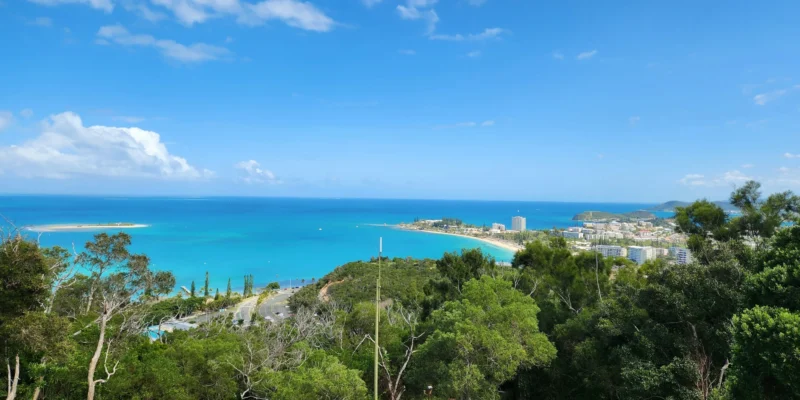
In Nouméa the debate has over Shark danger and Shark protection a formal institutional procedure was achieved for the first time. On August 21, 2026, two committees of the Economic, Social and Environmental Council of New Caledonia, short CESE-NC, with hearings on the citizens’ petition Une cohabitation de l’homme et du requin en zone urbaine littorale. This comes from the Message from CESE-NC out.
The step is politically significant, but should not be confused with a decision that has already been made. CESE-NC has not yet published a recommendation or specified what measures Nouméa should take in the future. The first hearings mark the beginning of the consultation.
Who was heard on August 21st
At 9 a.m. the committees heard from representatives of the city Nouméa: the deputy general secretary for planning, Alan Boufeneche, and Tatiana Tchong-Fat from the city planning service. The CESE committees are responsible for agriculture, livestock, forestry and fisheries as well as for the environment, spatial planning and infrastructure.
An hour later they were followed by Johanito Wamytan, the government member responsible for fisheries and marine affairs, the director of marine affairs Jean-Luc Vaslin and Frédéric Guillard, head of the relevant planning and strategy service. This meant that both the local and territorial administration had their say.
The CESE-NC is an advisory body. Its role in this process is to bring together actors and data and, if necessary, develop recommendations from this. It is not clear from the first date announcement whether scientists, environmental associations, water sports enthusiasts or representatives of the traditional Kanak perspective will be heard.
From citizen petitions to official procedures
The petition was publicly supported by the New Caledonian Va’a and Canoe-Kayak League in April and according to Radio Rythme Bleu initiated by CESE member Jean-Jacques Annonier. It is intended to encourage the Council to address the coexistence of humans and sharks in urban coastal areas and to develop recommendations for authorities and information for the population.
According to the official Rules for citizen petitions This requires 400 signatures from adult residents of New Caledonia within two months. The hearings that have now begun show that the matter has passed the threshold of the institutional consultation process.
The chronology matters: The fatal February attack shaped the political background. The petition was not publicly promoted until April, however, when sharks were killed again after another serious incident. It therefore emerged from a debate that had escalated over several weeks, rather than from a single event.
Two incidents and 16 sharks killed
On February 22, 2026, a wing foiler was fatally injured in front of Château Royal. According to preliminary findings, investigators assumed it was at least three meters long Tiger shark out of. The incident occurred in a heavily used coastal area on Pacific Ocean.
Between February 24 and 27, the city had ten large sharks caught and killed: nine tiger sharks and one Bull shark. The animals reported were between 2.80 and 4.20 meters long. This campaign immediately followed the deadly attack.
@thedailyaus New Caledonia’s capital of of Nouméa has had 3 shark attacks in the first two months of this year 🏝️ #aus #news #newcaledonia #noumea #shark #sharkattack #newcal ♬ original sound – The Daily Aus
On 15 April, a Va’a paddler was seriously injured near Côte Blanche. A second campaign followed from 17 to 20 April. Five tiger sharks and one bull shark measuring between 2.56 and 4.13 metres were killed.
In both campaigns combined, 16 sharks were killed: 14 tiger sharks and two bull sharks. It is precisely this magnitude that makes the question of a lasting strategy concrete. It’s not just about warnings after an incident, but also about the conditions under which authorities may order lethal interventions in the future.
Security, law and species protection
For the city and government, protecting people in a densely used coastal area is a priority. After a fatal or serious incident, the pressure to act quickly and visibly increases. However, the killing of individual large sharks does not automatically mean that the risk will subsequently decrease measurably.
Environmental associations therefore question both the scientific effectiveness and the proportionality of such campaigns. As early as 2023, a court stopped the city’s killing policy as disproportionate. In the short-term campaign in February 2026, the measure was already over before a final decision could be made on the urgent application.
At the same time, it would be too short-sighted to dismiss the concerns of people on the beaches and on the water as mere fear. A sustainable coexistence must identify the actual risk transparently, without hastily drawing the conclusion from two serious events that there will be a general increase in the population or a permanent change in shark behavior.
What answers the hearings must provide
What will be crucial is what data the CESE-NC evaluates: documented sightings and incidents, catch data, movement patterns of tagged sharks, use of coastal zones and environmental factors. Equally important is the question of how the effectiveness of different measures is compared and according to which criteria an intervention is considered necessary and proportionate.
The table could include monitoring, rapid warning systems, time-limited closures, spatially protected bathing areas, rules for water sports and clearly defined thresholds for fishing measures. These are currently open test areas and are not announced recommendations from CESE-NC.
The quality of the procedure will therefore be measured less by the number of hearings than by the comprehensibility of the subsequent results. Only a published report will show whether Nouméa develops a long-term, evidence-based strategy for humans and sharks from the series of attacks and killing campaigns.