


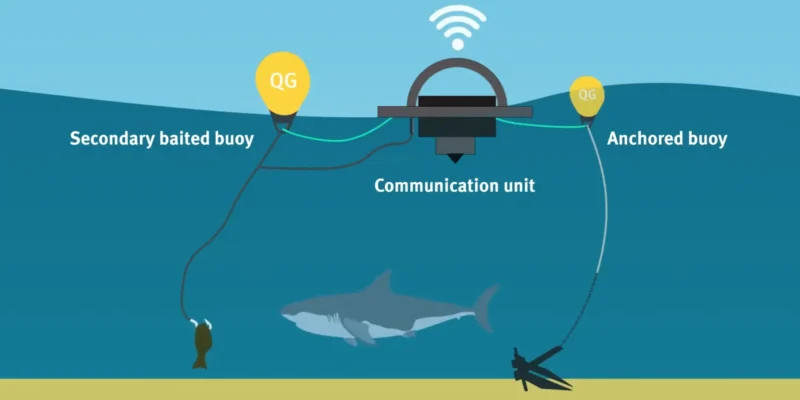
A new study in Frontiers in Marine Science evaluates three years of SMART-drumline use at 20 sites in New South Wales. It compares catches of the three target species—white sharks, tiger sharks and bull sharks—with catches of non-target species.
The most striking result is the catch rate: together, the target sharks caught 0.66 catches per 1,000 hook hours, and the non-target species caught 1.23. This meant the bycatch rate was around 86 percent higher. The key figure takes into account the different use of catches, but does not say anything about how many animals were caught in total or how they survived being caught and released.
How a SMART drumline differs from a conventional baited line
The SharkSmart programme in New South Wales describes the system as an anchored, baited hook line with two buoys and satellite GPS communication. When an animal takes the bait, an alert is sent to the response team. The team is expected to arrive within 30 minutes, identify and release the animal, and tag target sharks before releasing them about one kilometre offshore.
The concept is therefore used as a non-lethal alternative to nets and conventional control lines. However, nonlethal describes the goal of the procedure, not a guarantee for every animal. According to its currently available abstract, the new work primarily examines catch distribution and environmental patterns; It does not provide its own assessment of mortality, injuries or stress.
White sharks in cooler water, tiger sharks in warmer water
Catch patterns differed significantly by species. White sharks were caught more frequently in winter and spring and across all seasons in comparatively cool water below 21 degrees Celsius. Tiger sharks appeared more often in summer and autumn, when the sea was more than 20 degrees and the sea was calm. For bull sharks, the abstract does not provide a correspondingly clear seasonal focus.
The most common non-target species also differed. Among them, dusky sharks (Carcharhinus obscurus) and smooth hammerhead sharks (Sphyrna zygaena) were caught more often above 19 °C. By contrast, bronze whaler sharks (Carcharhinus brachyurus) appeared more often below 21 °C. Spatially, higher catch rates occurred mainly along the northern and central NSW coast.
Seasonal deployment can shift bycatch, but not eliminate it
Such patterns are practical for management: deployment times and locations could be more closely tailored to the conditions under which a particular target species is more likely. At the same time, the temperature ranges overlap. A simple seasonal rule that captures target sharks and completely avoids non-target species cannot be derived from the results.
In addition, target sharks were caught in coastal waters in all seasons. Therefore, fewer catches in a season does not mean absence. This remains an important difference for bathers: catch statistics show usage patterns, but are neither a short-term prediction for an individual beach nor a measure of the likelihood of a shark accident.
Bycatch belongs in the assessment of the protection programme
The fact that the catch rate of non-target species was almost twice as high as that of target sharks makes the ecological conflict of goals visible. An assessment should therefore not only ask how many great whites, tiger or bull sharks are tagged and relocated. Equally important are the species, condition and survival of the other animals caught, as well as the number of catches that were not released or were discovered late.
At the same time, NSW is testing the removal of shark nets at selected beaches. SMART drumlines, drones, acoustic receivers and warning systems are therefore part of a broader programme. An earlier evaluation showed that drone-based species identification can be error-prone in real-time operations.
Full study still pending
Frontiers accepted the work on August 26, 2026. The abstract and bibliographic information are already online, but the final formatted full version is yet to appear. Therefore, important details – including absolute catch numbers, effort by location, size and gender distribution, and possible survival data – cannot currently be independently verified from the full text. The numbers in the article should be compared again with tables and methods after the final version has been published.