


Body structure, characteristics & anatomy
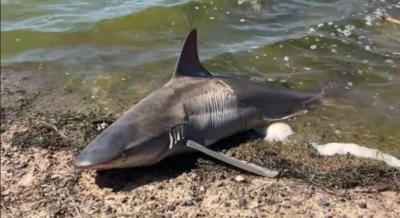
The black shark has a powerful, streamlined body built for sustained swimming in open water. Its anatomy displays a combination of stability, hydrodynamic efficiency and robust musculature. These features distinguish it clearly from smaller coastal sharks of the same family.
Body shape and proportions
The body is elongated and evenly built. The trunk appears solid without being squat. The greatest body depth is around the pectoral fins. The body tapers continuously towards the tail base. These proportions reduce water resistance and enable energy-efficient long-distance swimming.
The skin is relatively thick and firm. The underlying musculature is well developed, especially in the rear part of the body. This supports powerful lateral tail movements.
Fin structure
The pectoral fins are large, broad and sickle-shaped. They attach far forward on the body and provide lift as well as stability while gliding. The first dorsal fin is tall, distinctly triangular and begins behind the base of the pectoral fins. Its size contributes to directional stability.
The second dorsal fin is comparatively very small. It is positioned above the anal fin and primarily serves a stabilising function. The caudal fin is asymmetrical. The upper lobe is long and strongly developed, while the lower lobe is significantly shorter. This structure is typical of active swimmers and enables powerful thrusts.
Head and snout shape
The head is relatively broad with a rounded to bluntly tapered snout. This shape distinguishes the black shark from more slender-built reef sharks. The nostrils are small and lack pronounced nasal flaps.
The eyes are medium-sized and round. A nictitating membrane is present and mechanically protects the eye. It plays an important role in securing prey and in interactions with other animals.
Dentition and jaw structure
The jaw is powerful and highly mobile. The upper jaw bears broad, triangular teeth with finely serrated edges. They are adapted for cutting larger prey. The lower jaw teeth are narrower and more upright, so they primarily serve a holding function.
Tooth replacement occurs continuously. Behind the functional rows of teeth there are always replacement teeth ready to move forward. This anatomy ensures that damaged teeth are quickly replaced.
Skin and surface structure
The skin is covered with densely arranged placoid scales. These have a rearward-directed structure. They reduce turbulence on the body surface and improve hydrodynamic performance. At the same time they provide a certain degree of mechanical protection.
The coloration shows a dark grey-brown dorsal surface and a light ventral surface. This contrast is anatomically sharply delineated and aids camouflage in open water through countershading.
Sensory organs
Running along the sides of the body is the lateral line organ. It is formed as a fine canal structure beneath the skin and responds to pressure waves in the water. This system is complemented by the ampullae of Lorenzini in the snout area. These specialised sensory organs enable the detection of weak electric fields.
The combination of the lateral line, electroreception and a well-developed sense of smell is anatomically adapted for orientation and the detection of prey in open waters.
Distribution & Habitat
The Schwarzhai is one of the most widely distributed shark species in the world\u2019s oceans. Its range extends across all warm and temperate oceans. The species is absent only from permanently cold polar regions. Observations and catch records demonstrate an almost global presence along many continental margins.
In the Atlantic the Schwarzhai occurs on both sides of the ocean. Records range from the east coast of North America through the Gulf of Mexico and the Caribbean to South America. On the eastern Atlantic side it is found from Western Europe via West Africa to South Africa. Confirmed individual records have also been reported in the Mediterranean.
In the Indian Ocean the species has been recorded along the coasts of East Africa, in the Red Sea and in the region of the Indian subcontinent. The western and central Pacific also form core areas. Here the distribution range extends from Japan through Southeast Asia to Australia and New Zealand. The Schwarzhai is also regularly recorded off Central America and along the west coast of South America.
Typical habitats
The Schwarzhai utilises a broad spectrum of marine habitats. It is mainly found in nearshore and offshore areas over the continental shelf. The species is particularly frequently encountered at water depths between 10 and 200 metres. Individuals have also been recorded in deeper zones of the upper continental slope.
Close to the coast, the Schwarzhai favours open sand and mud bottoms as well as areas near reefs and island chains. Shallow bays, estuaries and offshore shelf zones play an important role, particularly for younger animals. These areas provide protection from larger predators and stable environmental conditions.
Adult Schwarzhai are more frequently found in open ocean areas. They use pelagic zones over deep water but regularly return to coastal regions. Satellite telemetry and tagging programmes show that the species travels large distances between the coast and the high seas.
Temperature and environmental conditions
The Schwarzhai prefers temperate to warm waters. Most records come from areas with temperatures between about 15 and 26 degrees Celsius. Seasonal migrations are often associated with temperature changes and the availability of suitable habitats.
In higher latitudes the species follows warmer water masses throughout the year and retreats to more southerly regions or deeper waters during the colder months. In tropical areas, however, the Schwarzhai is present year-round.
Spatial use and migratory behaviour
The use of different habitats is closely linked to the size and developmental stage of the animals. Juveniles often remain for extended periods in clearly defined coastal areas. Adult individuals display pronounced migratory behaviour and utilise extensive marine areas.
Long-distance movements of several thousand kilometres have been documented. This high mobility explains the wide distribution of the Schwarzhai and its ability to successfully utilise different marine habitats.
Lifestyle, Diet & Reproduction
The Schwarzhai lives predominantly as a solitary predator. Adults usually keep their distance from conspecifics and do not show pronounced social behaviour. Encounters between several individuals occur mainly in areas with high food availability or in coastal nursery grounds.
The species utilises a wide depth range. Juvenile Schwarzhai individuals tend to remain in shallow coastal zones. Adults regularly migrate between coastal areas and the open sea. These seasonal migrations are closely linked to water temperature and prey availability.
The Schwarzhai is predominantly diurnal. Hunting usually takes place near the seabed or in the mid-water column. The species is considered a strong, enduring swimmer, well adapted to long-distance migrations.
Diet and hunting behaviour
The Schwarzhai is an opportunistic predator with a broad diet. Its diet consists mainly of bony fishes and cephalopods. Rays and smaller sharks are taken as supplementary prey.
Stomach content studies show a clear adaptation to regionally available prey. In coastal areas, reef fishes and benthic species dominate. In open ocean zones, pelagic fish species play a greater role.
Hunting is usually carried out by targeted stalking. The Schwarzhai uses its well-developed sensory organs to detect prey over considerable distances. Short bursts of acceleration enable a rapid capture.
Reproduction and development
The Schwarzhai is viviparous. Embryos develop inside the female’s body and are nourished via a yolk-sac placenta. The gestation period is about 22 months.
Females give birth to between three and fourteen pups, depending on body size. Birth usually occurs in shallow coastal areas with a low density of predatory fish. These areas serve as nurseries and provide protection during the first months of life.
Young grow comparatively slowly. Sexual maturity is not reached until many years later. This late maturity makes the species particularly vulnerable to high fishing pressure and explains the low recovery potential of populations.
Threat & Protection Status
The Schwarzhai has a very low reproductive rate: females bear 3–16 pups, gestation lasts up to 16 months and pups are only born every two to three years. This “K‑strategy” with late sexual maturity (16–23 years) and small litter sizes leads to slow population growth, making the Schwarzhai particularly vulnerable to human exploitation.
Threats and population trends
Overfishing and bycatch
- Overfishing is the greatest threat to the black shark. The species is caught worldwide in longline, gillnet and drift net fisheries, both as a target species and as bycatch. The sharks are sought after for their meat and fins and are also targeted by recreational fishers.
- In the international shark fin trade, black shark fins accounted for about 0.7% of the fins imported to Hong Kong in 2014.
- Poorly managed bycatch: pelagic longlines, gillnets and coastal fishing gear cause high levels of unintentional catch. Sharks are often landed dead in nets, contributing to further population declines.
- Shark control programmes: In Australia and South Africa, coastal nets and drumlines are used to protect bathers; individual black sharks regularly die as bycatch.
Biological vulnerability and regional populations
- Low reproductive rate: female black sharks give birth only every two to three years. The species grows slowly and reaches sexual maturity only after 16–24 years. As a result, natural recovery rates are very low – the sharks cannot rapidly compensate for heavy fishing losses.
- Natal site fidelity: Females return to their birthplace to give birth to their young. This regional fidelity leads to genetically isolated stocks, which can result in severe depletion of individual populations through local overfishing.
Population declines
- According to the Convention on Migratory Species (CMS), the dusky shark is one of the least productive shark species. Unsustainable fishing – both targeted catches for meat and fin production and bycatch – is the primary cause of steep declines. In the Atlantic stocks fell by 62–99%, and in the Indo‑Pacific by up to 75%.
- A US stock assessment (SEDAR 2016) confirmed that the spawning stock of the northwest Atlantic population declined by 81% since 1960. Despite a ban on targeted dusky shark fisheries (since 2000), the stock remained overfished because bycatch was not sufficiently controlled.
- In the northwest and western central Atlantic region, current stocks now represent only 15–20% of the 1970s population.
- In the eastern Indian Ocean and other areas, a global decline of 70–80% is estimated.
Protection status
International listings and agreements
| Einstufung / Übereinkommen | Status / Kategorie | Hinweise |
|---|---|---|
| IUCN Red List (global) | Endangered (Endangered) | The IUCN assesses the global population as “Endangered (EN)” with the justification code A2bd (severe decline due to exploitation). Some older publications still list “Vulnerable”, but these have been superseded by later assessments. |
| CITES (Convention on International Trade in Endangered Species) | Appendix II | International trade in Schwarzhai products has been permitted only with the appropriate permits since November 2023. |
| CMS (Convention on Migratory Species) | Appendix II since 2017 | Recognises the Schwarzhai as a migratory species of international importance. Member States should develop joint conservation measures. |
| CMS‑Memorandum of Understanding for Migratory Sharks | Since 2018 | Promotes international cooperation to protect migratory sharks. |
| Australian populations | Near Threatened; Recovering/Sustainable | In Australia there are two genetically distinct stocks. The western stock is recovering due to strict catch limits, while the eastern stock is managed sustainably. The Australian population is therefore ‘Near Threatened’ (IUCN). |
| USA (Northwest Atlantic) | Overfished; ban on directed fishing | Targeted fishing has been prohibited since 2000, but bycatch is not effectively limited; the stock remains overfished. |
| South Africa | Recreational catch limits | There are bag limits (daily catch limits) and other regulatory measures to protect local stocks. |
National and regional measures
- Fishing bans and quotas: The US has prohibited targeted dusky shark fishing since 2000; nevertheless, bycatch in longline fisheries must be further reduced.
- Australia: Following substantial declines in the 1970s and 1980s, Australia introduced restrictions (e.g. closure of the North Coast Shark Fishery in 2009). The western stock has since shown signs of recovery; the eastern stock is considered sustainably managed.
- South Africa: A daily bag limit (“bag limit”) applies to dusky sharks for recreational fishing; this measure is intended to counteract overfishing.
- Germany/EU: In German waters (North Sea and Baltic Sea) the Schwarzhai does not occur; therefore there is no national Red List classification. However, the EU implements the CITES listing into applicable law, so trade in Schwarzhai products requires a permit.
Profile
- First described:
- Max. size:
- Depth:
- Max. age:
- Max. weight:
- Water type:
- IUCN Status:
Taxonomy
- Kingdom:
- Phylum:
- Subphylum:
- Infraphylum:
- Parvphylum:
- Class:
- Subclass:
- Superorder:
- Order:
- Family:
- Genus:
Dive Centres



News



Newsletter
Shark Alert in Your Inbox