Where do young sharks grow up, and how well do we know these habitats? A global review examined 538 scientific publications and identified 443 areas described as nurseries for 94 shark species in 62 countries. The findings highlight the importance of coastal habitats, but also substantial differences in the strength of the evidence.
Published on 9 September 2026, the study in Reviews in Fish Biology and Fisheries explicitly distinguishes between all areas described as nurseries in the literature and those meeting three stricter criteria. The latter group contains 145 areas and 36 shark species.
When is an area truly a nursery?
The widely used definition developed by Heupel and colleagues requires more than finding individual juveniles: young sharks must occur more frequently there than elsewhere, remain for extended periods or return, and repeatedly use the habitat over several years. A pregnant female, a birth or a single aggregation is not sufficient evidence on its own.
The larger total of 443 areas is therefore not a list of equally well-confirmed nurseries. The team also included older records and records using other definitions, analysing the stricter subset separately. Conversely, a lack of confirmation does not automatically mean an area is unimportant for young sharks: suitable comparison data or long observation series are often missing.
Coasts, bays and estuaries dominate
Of all recorded areas, 92 percent were nearshore. Sixty-one percent were in estuaries, bays or lagoons, and 19 percent in rivers. These characteristics can overlap. Coastal areas also clearly dominated the more strictly defined group, accounting for 97 percent.
The habitats are diverse: besides mangroves and seagrass, they include features such as macroalgae. The review also describes nurseries in the open ocean and deeper waters. The strong coastal emphasis therefore reflects both the biology of many studied species and the greater accessibility of such areas to researchers.
Habitats shared by several shark species
Thirty-eight percent of all recorded areas were described as nurseries for at least two shark species. Protecting such a habitat could therefore benefit several species at once. Success also depends on local pressures and on how many juveniles eventually join the adult population.
One relatively well-studied species is the bull shark: the review records 89 described nurseries across seven FAO marine regions. These are literature records under the review’s broad approach, not 89 equally rigorously confirmed or equally important protected areas. Some support relatively few juveniles; others may be particularly important for an entire region.
Long-term use is documented for only some areas
Of the 443 areas, 144 were described as nurseries over at least ten years, and 73 over at least twenty years. This supports repeated use of some habitats. It does not prove that individual females always return to their own birthplace, however. Establishing such natal fidelity requires other data that can be linked to individual animals.
The literature search was compiled in January 2025 and covers publications from 1950 to 2024. A review published in September 2026 is therefore not a complete inventory of all areas known in 2026. There is also a clear relationship between research effort and the number of described nurseries.
Implications for conservation
The researchers identify particularly large knowledge gaps in areas including the western and northern Indian Ocean, the Indo-Pacific and waters off West Africa. Few published records should not be confused with few suitable habitats.
Conservation therefore requires more than a long list of supposed nurseries or the designation of individual areas. Repeated surveys, comparison areas and measures addressing local fishing pressure and habitat loss are needed. Priorities depend on each area’s actual importance for juvenile recruitment.
A more recent example of the value of movement data is our report on winter movements of young bull sharks from Galveston Bay. It complements this topic, but as research reported in 2026 it falls outside the review’s literature coverage through 2024.
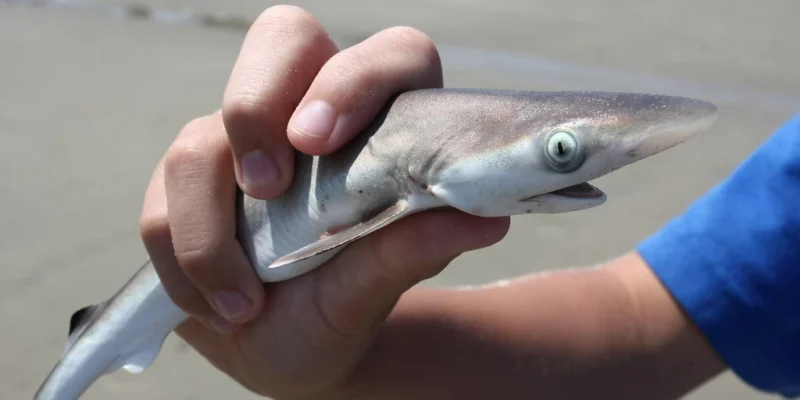
Illustrative photo: a young shark on a beach; species not identified. Hillary / LaMenta3, „161 – Baby Shark“, CC BY-SA 2.0; cropped to 2:1 and converted to WebP.