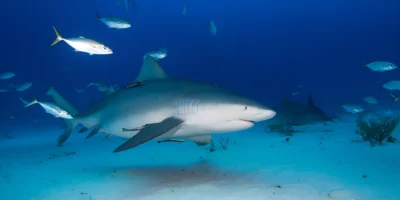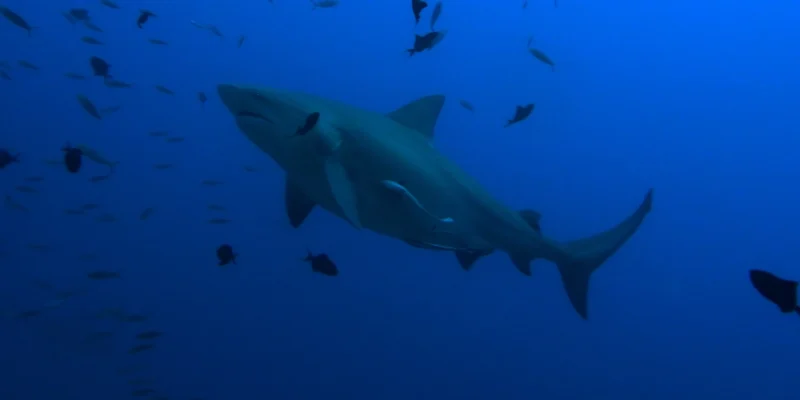
A new study in Royal Society Open Science offers rare insight into the reproductive structure of bull sharks (Carcharhinus leucas) in Fiji. The researchers analysed genetic data from 296 animals across several age classes, collected over roughly a decade at the Shark Reef Marine Reserve and in neighbouring river systems.
The result is striking: bull shark reproduction does not appear to be randomly spread across the landscape. Instead, the researchers found evidence of reproductive philopatry, meaning repeated returns to particular breeding or nursery areas.
Even more notable, several juveniles sampled in different years could be assigned to the same parental pairs. That suggests that individual males and females may mate with each other repeatedly across several reproductive seasons.
Not anonymous loners
Bull sharks are often perceived as wide-ranging solitary animals. The genetic data from Fiji show a much more precise picture. Adults observed or sampled at the Shark Reef Marine Reserve were genetically connected to young bull sharks from nearby rivers. Within individual rivers, relatedness patterns also appeared across different year classes.
That matters for research because sharks are difficult to observe across their full life cycle. Adult bull sharks can use coasts, reefs, estuaries and rivers. Genetic relatedness data reveal which places are actually connected: where adults appear, where juveniles grow up and which areas matter across generations.
Why site fidelity makes protection harder
Philopatry may sound like a fascinating behavioural detail. For conservation, however, it has a hard practical side. If female bull sharks repeatedly use particular rivers, estuaries or coastal nursery habitats, local damage cannot simply be offset by animals from other regions.
Fishing pressure, coastal development, declining water quality, mangrove loss or disturbance in river mouths then affect more than just generic habitat. They can affect specific nurseries to which individual lineages return again and again. For a slowly reproducing species such as the bull shark, that is a real risk.
The bull shark is listed globally as Vulnerable on the IUCN Red List. Key threats include fishing, bycatch, habitat loss and the degradation of coastal and brackish habitats. The new study shows why protection should be targeted as concretely as possible at the rivers, estuaries and reef systems the animals actually use.
Fiji, shark research and shark tourism
The Shark Reef Marine Reserve near Pacific Harbour is also a well-known place for divers. Tourism Fiji describes the protected area as Fiji’s first National Marine Park and one of the best-known places for encounters with bull sharks.
That is exactly why the study is relevant to responsible shark tourism. A reef where adult bull sharks appear regularly is only one part of the system. The future of these animals also depends on the rivers and estuaries where juveniles are born and grow up.
Well-managed shark tourism can finance protection and build appreciation. It becomes even more convincing when it protects not only the visible encounters on the reef, but also the less visible habitats of the next generation: rivers, mangroves, estuaries and shallow coastal areas.
More than a behavioural curiosity
The supplementary dataset for the study was published through the Royal Society Research Repository on 26 May 2026. It documents how genotype filters, relatedness values and family clusters were prepared for the analysis.
The key message is simple: bull sharks off Fiji are not an interchangeable mass of wandering animals. Their reproduction appears to be more spatially and socially structured than can be seen at the surface. For conservation planning, that knowledge is decisive.