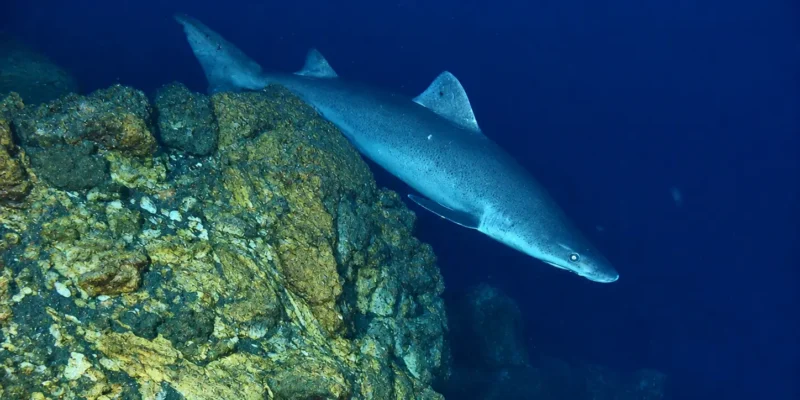
The critically endangered shieldtooth shark lives widely scattered in warm and temperate seas. However, its rare records and deep habitat make it difficult to directly measure changes in its range. A new model study now comes to what at first glance appears to be a contradictory result: suitable habitat could be dwindling worldwide, while parts of the Mediterranean are becoming more important for the species.
The July 20, 2026 in Diversity Published work by Cemal Turan and Alen Soldo examines the current and future habitat suitability of Odontaspis ferox. Their results are based on a species distribution model. So they show where environmental conditions might be suitable – not how many sharks will actually live there.
303 discovery data and twelve environmental variables
For the analysis, the researchers compiled 303 proofs of occurrence from biodiversity databases and specialist literature. After checking for highly interrelated variables, they used twelve environmental factors. These included temperature, oxygen, salinity, depth, currents and indicators of marine biological productivity.
Several statistical methods were tested against each other. The random forest model achieved the best prediction performance according to the quality measures used and therefore formed the basis of the central maps. Such a model looks for recurring relationships between sites and environmental conditions and transfers them to other marine areas.
However, the quality of a model does not eliminate the limitations of the input data. The shieldtooth shark is rare, often lives at great depths and is easily confused with related species. Databases also reflect where particularly intensive fishing, diving or research took place. A modeled gap does not necessarily have to be a real distribution gap.
Hotspots in the Eastern and Central Mediterranean
Under current conditions, the model shows a highly fragmented distribution pattern. In the Mediterranean, the most striking areas of suitability are in the east and central basin. Particularly highlighted are the Aegean Sea, the Hellenic Trench and the Ionian Sea. Even outside the Mediterranean, only certain coastal and island regions appear to be suitable.
This basically fits with the familiar way of life. Shieldtooth sharks live on continental and island slopes, deep-sea reefs and submarine mountains. Such spatially limited structures can provide suitable temperature, food and flow conditions, but are often far apart. The species therefore apparently does not already have a uniformly usable area of the world.
A possible refuge until the year 2100
For the future, the authors used the climate scenario SSP2-4.5 and looked at changes up to 2100. This medium emissions scenario assumes neither very rapid global climate protection nor the highest conceivable emissions. The maps thus describe a possible development path, not a safe forecast.
In the southeastern Mediterranean, core areas of suitable environmental conditions should be largely preserved. At the same time, modeled suitability shifts and expands into northern and central parts of the basin. The researchers interpret this pattern as a poleward shift and an indication that the Mediterranean could become an important climate refuge for the shield-toothed shark.
Globally, the projection is significantly less favorable. There, the total area of suitable habitats is shrinking. The Mediterranean would therefore not be a winner from climate change in the general sense, but perhaps a region in which suitable conditions persist or emerge for a longer period of time, while they are lost elsewhere.
Temperature and productivity determine the pattern
The study identifies water temperature and primary production as the most important influencing factors. The latter describes how much organic matter is built up primarily by microscopic algae and forms the energetic basis of marine food webs. What matters for a large predator is not only whether the water is thermally compatible, but also whether there are enough productive food chains.
However, a shift in statistical habitat suitability does not mean that shield sharks can immediately colonize new areas. Migratory routes, breeding sites, prey availability, fishing pressure and the connection between subpopulations are important factors. A suitable grid field on a map can also become an ecological trap due to intensive bottom or longline fishing.
Climate protection does not replace protection against bycatch
The shieldtooth shark probably has a very low reproductive rate and only reaches sexual maturity late. Accidental catches In bottom trawls, gillnets and longlines, this affects a species whose populations can only compensate for losses slowly. According to the authors, the possible role of the Mediterranean as a refuge increases the protective value of the basin and does not reduce existing dangers.
Particularly relevant areas for observation and precaution can be derived from the model maps. These include the Aegean Sea, the Hellenic Trench and the Ionian Sea, as well as possible future suitable areas further north. There would be better species-specific catch reports, reliable identification, gentle release live bycatch and limiting harmful fishing methods are important building blocks.
A cross-border perspective is just as important. The Mediterranean is used by many countries, while migratory sharks do not respect political boundaries. Protected areas, fishing regulations and observation programs must therefore fit together if a climatically suitable area is actually to function as a refuge.
A hypothesis that needs to be tested in the sea
The study provides a spatial hypothesis for coming decades. Whether the expected shift is already evident can only be checked with new evidence, standardized recordings and, if possible, long-term data series. Environmental DNA, underwater cameras, fishing observation and verified sighting reports could close gaps without relying on frequent catches of the rare species.
The model assumptions should also be repeated with new climate data and additional emission pathways. Different scenarios can show which areas appear robust as refugia and where outcomes depend heavily on future warming. It is also crucial not only to protect areas, but also to maintain connections between suitable habitats.
The central message is therefore cautious but relevant: the Mediterranean could become more important for the shield shark in the warming ocean. However, to turn potentially suitable water into an effective refuge, fishing pressure, knowledge gaps and conservation planning must be addressed simultaneously.