


Smalltooth sand tiger - Odontaspis ferox

Body structure, features & anatomy
The Smalltooth sand tiger has a strong, spindle-shaped body, a short pointed snout and small eyes. Five gill slits lie in front of the base of the pectoral fins. The two dorsal fins are relatively small and approximately the same size; The anal fin is also similar in size. The first dorsal fin begins closer to the pectoral than to the pelvic fins.
The most striking feature is the long, narrow and outward-facing teeth. Each main tooth usually has two or three smaller side tips. FishBase also mentions the short head, the small eyes and the dorsal and anal fins of the same size as important characteristics.
Large deep-sea shark with striking teeth
The upper side is gray to grey-brown, the underside is significantly lighter. In some animals, reddish spots appear on the flanks. Juveniles can be confused with similar sand tiger sharks; Tooth shape, fin position and body proportions are therefore more important for a reliable identification than color alone.
- Emmanuel Douzery, CC BY-SA 4.0, via Wikimedia Commons“>

-

-
-


Adults usually reach several meters in length. Documented maximum figures are around 4.5 meters and 289 kilograms. Despite its fearsome teeth, the shark is not known for aggressive behavior towards humans; its teeth are used to hold fish and other prey.
Habitat & distribution
The Smalltooth sand tiger occurs patchily in tropical and warm temperate seas. Evidence comes from the Atlantic Ocean, dem Indian Ocean, dem Pacific Ocean and that Mediterranean. The area does not consist of a closed belt, but rather of found areas that are widely separated from one another.
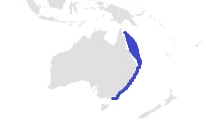
One Evaluation of new finds in the western North Atlantic documents animals in the Gulf of Mexico, off the southeastern coast of the USA, near Bermuda and in the Sargasso Sea, among other places. There are other well-known regions South Africa, Japan, Australia and New Zealand.
Incomplete worldwide distribution
The species lives close to the ground over continental and island shelves, on their slopes as well as on deep-sea reefs and submarine mountains. The known depth range is from approximately 10 to 2,000 meters, but most observations are between approximately 13 and 880 meters. Occasionally animals are also seen in surprisingly shallow water.
The historical map shows the rough known distribution pattern, not the current frequency or complete location. Rare evidence, great depths and the risk of confusion with related species make it difficult to define the population. Modern discovery data can therefore supplement regions that are still missing on older maps.
Life, diet & reproduction
smalltooth sand tigers usually swim slowly near the bottom, but can also cruise freely over slopes and reefs. Observations of individual submarine mountains indicate that several animals are present in the same area at times. It is not yet sufficiently clear whether these are regular accumulations, migration stations or breeding sites.
The diet includes bottom-dwelling bony fish, squid, shrimp and other invertebrates. Rays and chimeras are also mentioned as prey. The long jaws grip smooth, agile prey, while the powerful body allows for short accelerations. Direct feeding observations are rare because of the deep habitat.
Rare predator on slopes and deep-sea reefs
Reproduction is aplacental viviparous: young animals develop in the womb without being supplied by a placenta. The Shark information from the Hawaii Department of Environmental Conservation call intrauterine cannibalism likely; Embryos are likely to eat unfertilized eggs, as in related mackerel sharks.
Litter size, gestation period, birthing areas and reproductive rhythm are largely unknown. According to available information, males only become sexually mature at around 2.75 meters, possibly later. This late maturity and presumably very low recruitment rate limits the stocks’ ability to compensate for fishing losses.
Threats & conservation
The IUCN rates the Smalltooth sand tiger as critically endangered. The species is naturally rare, grows large and probably has very low reproductive performance. Even a small additional mortality can therefore lead to significant population declines in the long term.
The main threat is accidental catch in deep-sea and shelf fisheries. Animals get caught in bottom trawls, gillnets and longlines. Some of the catch is used for meat, liver oil or fins; Inaccurate species identification and missing reports obscure the actual extent.
Highly endangered due to low reproduction rate
What is particularly problematic is that fisheries on continental slopes and submarine mountains reach precisely the habitats in which smalltooth sand tigers reside. The expansion of deeper fishing areas can affect sub-stocks that have so far been less polluted before their size or spatial boundaries are known.
Effective protection requires species-specific catch reporting, identification training, safe release of live bycatch and restrictions on harmful fishing gear in important deep-sea habitats. International cooperation is necessary because the widely separated deposits cover several sovereign territories and offshore areas.
Encounters with humans
Encounters with divers are rare because smalltooth sand tigers mostly live deep and only come into easily accessible water locally. Occasional sightings on island slopes, reefs or submarine mountains are therefore exceptional and should be documented without persecution or luring.
The species is not considered dangerous to humans and there is no known tradition of targeted attacks. The visible teeth appear dramatic, but say little about their behavior towards divers. As with any large wild animal, distance, calm movements and a clear retreat make sense.
Rare sighting instead of typical diving shark
The closest contact occurs in fishing. The Australian Shark Report Card describes the Smalltooth sand tiger as a bycatch of several fishing methods and emphasizes the large gaps in knowledge. Dead animals should be identified and reported, and live animals should be released as gently and quickly as possible.
Verifiable photos are particularly valuable for research and protection: side view, fin position and teeth can make identification possible. Location and depth information should be reported to specialist bodies, while sensitive locations should not be unnecessarily made public if this could promote targeted fishing.
Profile
- First described:
- Max. size:
- Depth:
- Max. age:
- Max. weight:
- Water type:
- IUCN Status:
Taxonomy
- Kingdom:
- Phylum:
- Subphylum:
- Infraphylum:
- Parvphylum:
- Class:
- Subclass:
- Superorder:
- Order:
- Family:
- Genus:
News


Newsletter
Shark Alert in Your Inbox