


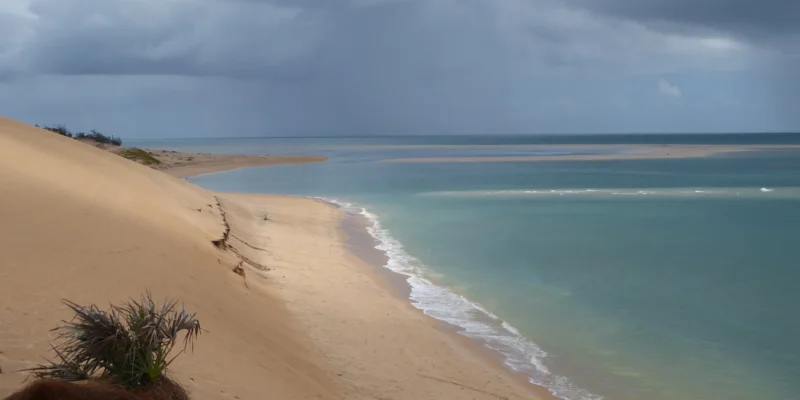
Marine animals now find shelter where coastal forests and wetlands once stood. A new study describes shallow peat reefs in the Bazaruto Archipelago off Mozambique. Numerous fish and invertebrates live in this consolidated plant material; sharks and rays also use these habitats. The research shows that ecologically important reefs are not always built by corals.
Former forest soil becomes marine habitat
Peat forms from accumulated plant remains. As sea level rises, former coastal soils can become submerged. Waves and currents remove overlying sand and expose firmer peat layers. In the Bazaruto Archipelago, these deposits form structurally complex areas in an otherwise largely sandy environment.
According to the Bazaruto Center for Scientific Studies, the team examined three peat reefs and a neighbouring coral reef. Radiocarbon dating placed the peat samples at approximately 300 to 5,000 years old. Seagrass and algae grow on the peat, while crevices and overhangs provide shelter for young fish and other animals. Living corals are absent there.
Sharks and rays are among the visitors
The researchers surveyed the organisms growing on the reefs, invertebrates, small fish and larger animals. Sharks, rays and sea turtles were observed on both reef types. This shows that use of the coastal environment extends beyond coral reefs. However, the communities were not identical: differences between reef types were particularly apparent among bottom-dwelling organisms.
The abundance of juvenile fish suggests that these habitats matter as areas where young fish grow. It does not, however, establish a shark nursery. That would require investigating, among other things, whether young sharks use these areas regularly and over extended periods. The present study compares communities; it does not track individual shark movements.
Carbon-rich peat is not yet a proven carbon sink
Some samples contained up to 40 per cent organic carbon by dry mass. This proportion describes the material examined, not the reefs’ total carbon stock. Whether additional carbon is being stored today or erosion contributes to its release remains unresolved. Further measurements are needed.
An additional habitat deserves attention
According to BCSS, the peat reefs lie in water only about two to four metres deep. Tides, shifting sand and storms can expose, bury or erode them. They are therefore not a permanent replacement for damaged coral reefs. The authors suggest giving them greater consideration in coastal maps and conservation planning.
The new work builds on the Bazaruto monitoring programme, whose long-term data we have already covered. Considering different neighbouring habitats helps protect mobile marine animals: focusing only on coral areas can overlook other structures that they use. The study provides a concrete starting point, but not yet a comprehensive inventory of all peat reefs in the region.
Coastal landscape in the Bazaruto Archipelago, photographed in 2016; the peat reefs studied are not visible. Cropped. Cornelius Kibelka / Wikimedia Commons · CC BY-SA 2.0.