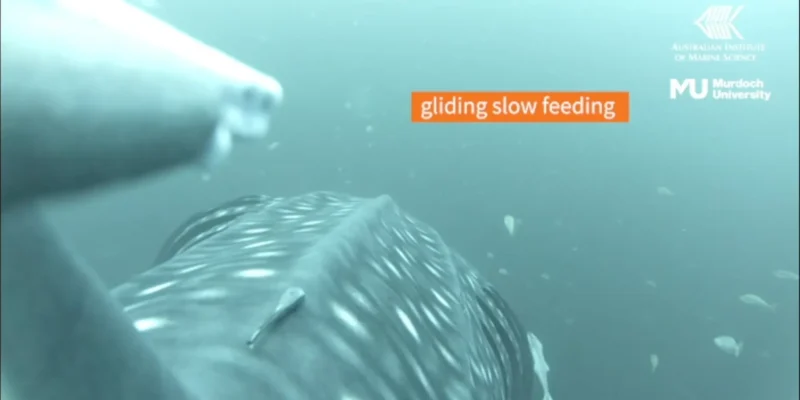
Whale sharks not only glide leisurely through clouds of plankton with their mouths open. New research from the Australian Institute of Marine Science (AIMS) and Murdoch University reveals a surprisingly diverse repertoire: Earth’s largest fish use numerous strategies to capture small, unevenly distributed prey at different depths.
The researchers attached cameras to the dorsal fins of five whale sharks on Ningaloo Reef in Western Australia. They also evaluated around 100 scientific publications. This resulted in a catalog of 36 behaviors – according to the team, the most comprehensive compilation for the whale shark to date.
You are currently viewing a placeholder content from Facebook. To access the actual content, click the button below. Please note that doing so will share data with third-party providers.
More InformationTwelve behaviors are used to search for food
Twelve of the 36 behaviors described are related to foraging. Six of them are being scientifically described for the first time. This diversity is remarkable because whale sharks as filter feeders are often reduced to a simple image: open their big mouths, let water flow through them and filter out plankton. The recordings show that the animals adapt their behavior much more flexibly.
Whale sharks eat tiny prey such as plankton and copepods. Such organisms are rarely evenly distributed in tropical seas, but rather form spatially and temporally limited aggregations. If you want to absorb enough of it, you have to take advantage of many opportunities. The research team therefore describes the whale sharks as constant snack hunters in the sea.
Sinking with mouth open
The newly described strategies include slow sliding feeding. The whale shark opens its mouth and allows itself to sink while water and prey flow through the filter apparatus. The animal does not have to constantly swim actively for this downward movement and can therefore use less conspicuous layers of food.
Another strategy is diving feeding. The whale shark actively swims steeply towards the sea floor and picks up as much prey as possible along the way. The recordings complement observations on the surface with a perspective that remains largely hidden from researchers from the boat.
Slow feeding at all depths
In the camera data, slow feeding was the most common form of foraging observed. Particularly important: This behavior occurred at all depths recorded by the cameras. Whale sharks do not only look for food on the surface, where people can easily see them during seasonal gatherings.
This does not change the basic classification as a filter feeder, but it does change the understanding of their everyday life. Visible feeding events on the surface are only a portion. A significant amount of foraging can occur deeper and involve different movement patterns depending on where sufficient prey is concentrated.
More strategies than other major filter feeders
According to the researchers, whale sharks have more different feeding habits than other large filter feeders such as baleen whales or basking sharks. This includes active suction movements as well as passive filtering when gliding. This flexibility could explain how the animals persist in warm tropical seas, even though food there is often scarce and patchy.
The comparison does not make the whale shark a classic hunter of large prey. His specialization remains filtering small organisms. What is new is the range of movements, positions and depths with which he opens up this tiny prey.
Animal cameras close an observation gap
Cameras directly on the animal show the environment from the whale shark’s perspective. They document what happens outside of brief encounters with boats, divers or snorkelers. This allows movements with the open mouth, orientation in the water and reactions to prey accumulations to be directly linked.
The underlying specialist article in Marine Biology combines this new camera perspective with knowledge from the literature. This makes the catalog more than a collection of spectacular recordings: it creates a more consistent vocabulary with which future studies can describe and compare whale shark behavior.
Ningaloo Reef as a safe pantry
The Ningaloo Reef is one of the most famous seasonal collecting areas for whale sharks. The new results underline its importance as a food area. AIMS researcher Luciana Ferreira describes the area as a protected pantry where the animals can always find small meals.
This raises a practical question for protection: it’s not just places with spectacular feeding accumulations on the surface that are important. Deeper food layers and the processes that concentrate small prey are also part of the whale sharks’ habitat. Protection and management must therefore take the entire three-dimensional food area into account.