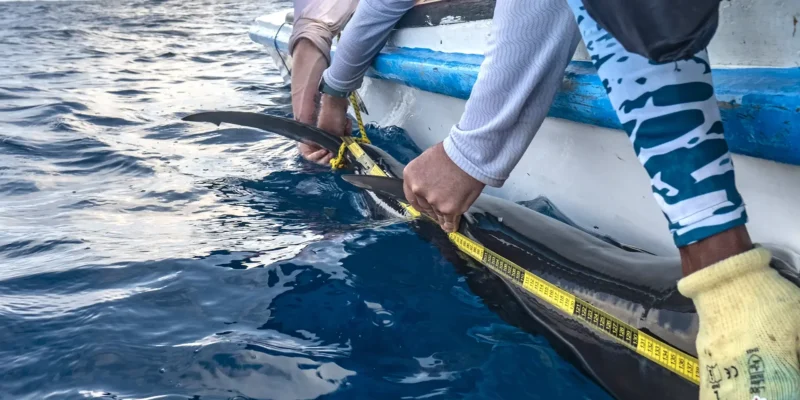
Juvenile smooth hammerhead sharks (Sphyrna zygaena) have been documented in a small bay near Isabela Island in the Galápagos. The genetic confirmation is exceptional: the archipelago had gone more than two decades without an official record of the species.
The discovery is often described as a new nursery. Ongoing research still needs to establish how regularly juveniles use the bay, how long they remain there and whether other sites in the archipelago serve the same function. It is therefore best understood as a possible nursery whose ecological importance is now being tested.
A record after more than 20 years
The Galapagos Science Center reported in May 2024 that Galápagos National Park scientists had found juvenile smooth hammerheads during a Greenpeace expedition. A satellite tag was also fitted to a subadult female to follow her movements beyond the bay.
Smooth hammerheads may have been overlooked or confused with the much better-known scalloped hammerheads of Galápagos. The smooth species lacks the pronounced central notch on the front of the head, but this distinction can be difficult to see in young, moving animals. Genetic analysis confirmed the identification.
What makes a genuine nursery?
A single gathering of young sharks is not enough to establish a nursery. Researchers look for more juveniles than in surrounding areas, extended residence and repeated use by successive generations. The project is now investigating these criteria rather than treating the first observation as a final conclusion.
Tags, cameras, DNA and diet
The current report from Texas A&M University at Galveston profiles Ecuadorian graduate student María Antonia Izurieta Burbano De Lara. She works with Universidad San Francisco de Quito, the Galápagos National Park Directorate, MigraMar and other partners.
Juveniles receive acoustic transmitters that are detected by receivers throughout the marine reserve. Underwater video, genetic comparisons and dietary work using fecal samples add information about occurrence, behavior, population relationships and prey. Together, the methods reveal much more than isolated sightings.
Could Galápagos connect eastern Pacific populations?
DNA from Galápagos is being compared with samples from elsewhere in the eastern tropical Pacific. The results could show whether the sharks form a relatively isolated group or connect populations farther north and south. Galápagos may therefore be both a local refuge and part of a wider migration network.
Protection cannot end at the reserve boundary
Smooth hammerheads are highly mobile. They are protected inside Galápagos marine protected areas, but older animals can cross into waters with substantial fishing pressure. Knowing nursery habitats, departure times and migration corridors is essential if protection is to follow the sharks through their life cycle.
Why the exact location should remain quiet
Public reports place the bay near Isabela without promoting a precise site. That restraint is appropriate for a sensitive juvenile habitat and an active research area. Divers should not search for the bay; keeping distance, following park rules and reporting incidental sightings responsibly is more useful.
From rediscovery to conservation decisions
The finding changes the picture of Galápagos hammerheads, but important questions remain. Repeated tracking must show whether the bay meets nursery criteria, when juveniles leave protected waters and how strongly populations across the eastern Pacific are connected. Those answers can turn an exciting rediscovery into practical conservation.