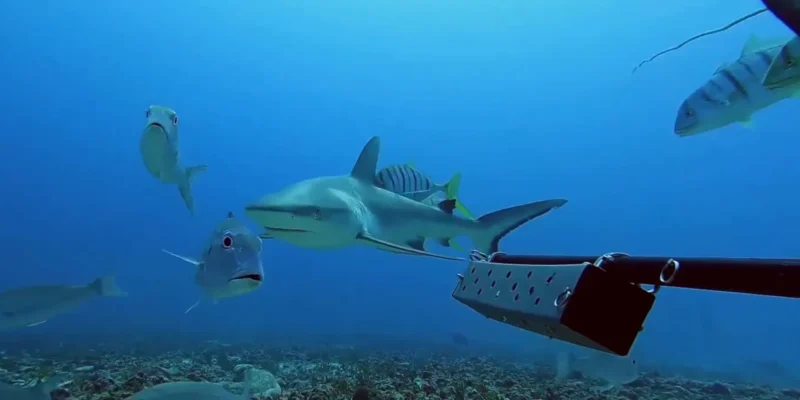
A new study in Journal of Fish Biology describes unusual behavior from the waters of the Seychelles: Three species of trevally swam specifically alongside large sharks and rubbed their bodies against their rough skin. Encounters with grey reef sharks , bull sharks and tiger sharks were documented. According to the researchers, these are the first published field observations of this species for bull and tiger sharks.
The most plausible explanation is body care. By rubbing themselves against sharks, the trevallies may remove ectoparasites, dead skin or other irritants. This is where scientific caution matters: the cameras document intentional rubbing, but they do not show that parasites were actually removed. Parasite reduction is a plausible hypothesis supported by earlier research, not a directly measured result of the new study.
More than 500 hours of underwater video evaluated
Nico Fassbender and his team examined more than 500 hours of footage from baited underwater cameras, so-called BRUVS. The images came from several parts of the Seychelles archipelago: from the northwest and east coast of Mahé, the west coast of Praslin including Cousin and Cousine as well as from the St. Joseph Atoll and from D’Arros in the Amirantes. This means it is not a single random recording on just one reef.
Involved were Bluefin Trevallies (Caranx melampygus), Black and Gold Pilot Mackerels (Gnathanodon speciosus) and Yellowspot Trevallies (Turrum fulvoguttatum). The fish approached singly or in groups, following the shark and then accelerating alongside its body. Upon contact, they stroked the shark skin from the flank towards the head.
A targeted maneuver with a built-in safety limit
The process did not appear to be a random collision. The trevallies repeatedly positioned themselves next to a swimming shark and used its body for brief, controlled contact. It was noticeable that they did not reach the head area. Fassbender interprets this as a possible caution against the dangerous end of the supposed cleaning device. After all, large trevally are generally part of the prey range of bull fish and tiger sharks.
The video recordings of the encounters also show how unspectacular the sharks themselves reacted: no obvious defensive, hunting or escape behavior could be seen. This suggests that the short contact did not represent a major disruption for them, at least in these situations. However, the study does not show any benefit for the shark. It would therefore be premature to speak of a mutually beneficial symbiosis.
Why shark skin of all things?
Shark skin feels rough despite its smooth appearance. It is covered with tiny, tooth-like placoid scales. If a fish passes over it in the right direction, this surface can act like a moving file. Unlike a rock, the shark also swims through the reef and thus becomes a mobile scratching surface, so to speak.
It is noteworthy that both permanent cleaning stations and rough coral surfaces were available on the reefs examined. So the fish didn’t have to rely on sharks because of a lack of alternatives. That they still chose the riskier, moving surface suggests that its nature or accessibility may provide a particular advantage. Which property is crucial has not been tested.
Parasites are the best explanation – but no proof yet
External parasites can colonize the skin, gill covers and sensitive areas around the eyes of fish. Scratching is therefore known as a form of body hygiene in many fish species. In the new material, however, the parasite load was not counted before and after contact, nor were detached parasites recorded. There was also no comparison of the health status of scratching and non-scratching animals.
Clearly formulated, the work shows three things: the behavior was targeted, it occurred in several species of trevally and sharks, and it was observed despite other cleaning options. The fact that this removes ectoparasites and improves the fitness of the fish is a biologically well-founded interpretation that would have to be tested experimentally or through particularly detailed recordings in the future.
Previous observations support the hypothesis
The behavior is not entirely without antecedents. a 2022 study documented how large pelagic fish – including tuna and rainbow trevally – rubbed up against sharks or sharks in three oceans. The contacts often affected the head, eye region, gill covers and flanks, i.e. areas of the body where parasites often reside. The researchers also rated this as likely personal hygiene.
In this older study, the fish preferred sharks over other bony fish as a friction surface. Larger fish in particular took advantage of sharks; For smaller animals, the risk of becoming prey themselves could be higher. The new work now extends this picture from the open sea to tropical reef landscapes and to include concrete interactions with gray, bull and tiger sharks.
Sharks shape a reef even through inconspicuous services
The Save Our Seas Foundation places the observation into a larger ecological question: When sharks disappear from a habitat, it may not just be large predators missing from the food web. Even rare and previously little-known interactions can be lost. If rubbing does indeed reduce parasites, sharks could indirectly contribute to the health of other reef fish in this way.
This is initially a functional hypothesis and not a quantified ecosystem service. It remains to be seen how often individual fish use sharks, whether the contact measurably reduces their parasite load and whether this results in an advantage for populations. This is precisely why long camera series are valuable: they make brief behaviors visible that divers would only be able to observe with a lot of luck.