This article was published on 15 July 2026 and updated on 20 October 2026.
Update of 20 October 2026
A new NOAA Fisheries analysis provides quantitative evidence on a central issue in the research strategy: an adjusted depredation index from an independent longline survey in the Gulf of Mexico tripled between 2005 and 2025. The agency published the findings on 19 October. The analysis covered 2,846 research sets and 27,001 fish examined for depredation.
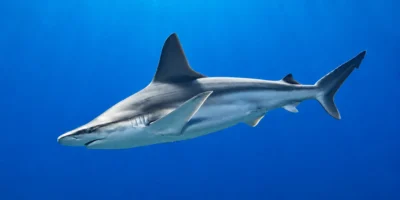
The index uses statistical models that account for differences in environmental conditions and sampling locations. It is not an overall loss rate for all recreational or commercial fisheries. Damaged gear without verifiable predation was not counted as confirmed depredation. Sharks dominated the cases in which the predator was directly identified, including sandbar, blacktip, bull and tiger sharks.
The time series therefore complements the strategy described in the earlier report. It measures losses of already hooked fish, not attacks on people. The rising index alone establishes neither a uniform increase across all shark populations nor that broadly increasing removals would resolve the conflict.
Earlier report
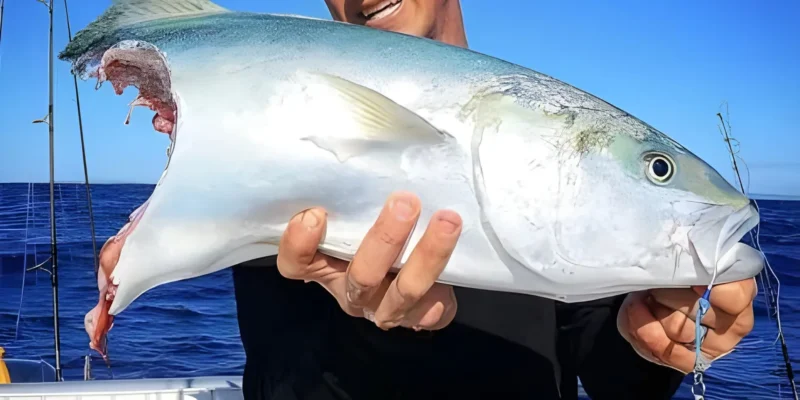
A fish is on the hook and the line is coming toward the boat—then all that remains is a head, fins or an empty hook. When sharks eat all or part of a fish already hooked, fisheries researchers call it shark depredation. In plain language, sharks are taking the catch. For many anglers along the U.S. Atlantic coast and Gulf coast, this has long been more than an occasional nuisance.
The U.S. fisheries agency NOAA Fisheries is therefore developing a strategic framework to better connect research with fisheries management. Published on 14 July 2026, the outline is not a final regulation or a decision to raise shark catch quotas. Instead, it identifies the knowledge gaps NOAA wants to address with states, scientists and the fishing sector.
Why depredation is more than just a lost fish
The fishery bears direct costs: catch, bait and sometimes equipment are lost. Depredation also has a biological dimension. A hooked fish eaten by a shark is effectively a dead discard from the stock, yet these losses are not always fully captured in catch statistics and stock models. Estimating sustainable harvest therefore requires data on how often depredation occurs and which fish species are most affected.
A study published in 2026 in the ICES Journal of Marine Science reviewed a century of reports from Maine to Texas and the U.S. Caribbean. It documented depredation in 51 recreational target stocks and evidence involving 22 shark species. That breadth helps explain why no single technical or regulatory solution is likely to work across every region and fishery.
More sharks – or simply more encounters?
Public debate often reaches for a quick explanation: there are too many sharks. NOAA cautions against that generalisation. Some Atlantic coastal shark stocks, including blacktip shark stocks, have recovered from past overfishing. Other species, such as the dusky shark (Carcharhinus obscurus), still need to be rebuilt, while data remain insufficient to assess several other stocks reliably.
Use of the sea has changed as well. More recreational fishing and more released fish and discards can create additional feeding opportunities. At the same time, depredation is not new. The key research question is therefore not simply how many sharks are present, but how stock trends, fishing effort and behaviour interact.
Sandbar sharks and bull sharks are a particular focus
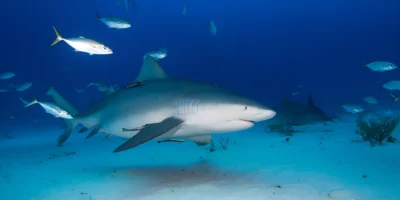
NOAA reports that sandbar sharks and bull sharks are among the species most often implicated in depredation during recreational fishing for snapper and grouper. A new sandbar shark stock assessment began in May 2026, with initial results expected in early 2027. If an alternative assessment method proves successful, a comparable bull shark assessment could follow in late 2027.
These assessments are important because management cannot operate on assumptions. Only reliable data can show whether changing population sizes contribute measurably to the conflict and whether catch limits would even be an appropriate part of the answer. A species that often appears in hooked catches is not automatically widespread or in good biological condition.
Do individual sharks learn the sounds of fishing?
A second key question concerns learned behavior. Sharks may be able to associate the sound of engines, the retrieval of equipment, or the release and discarding of fish with an easy meal. What is crucial is whether only individual, particularly experienced animals use such signals or whether the behavior spreads throughout a local population.
NOAA wants to use acoustic telemetry in areas with a high risk of depredation in the Gulf of Mexico. Sharks receive transmitters whose signals are registered by underwater receiving stations. Over about a year, residency time and movements of individual animals can be compared with catch and depredation reports from charter and recreational fishing. If this approach works, it could later be used in the US Pacific and the Caribbean.
Deterrence must be appropriate for the species and situation
The third pillar is technical countermeasures. Among other things, electromagnetic devices and certain metals that are supposed to influence the sensory system of sharks are being examined. What works on one species or under laboratory conditions does not necessarily have the same effect on another species, in strong currents or with a specific type of fishing gear.
NOAA is therefore planning a joint meta-analysis with state authorities, private research institutes and universities. In addition to the biological effect, cost must also be considered. A device helps fishers only if it works reliably under real conditions, does not worsen the target catch and remains affordable for companies or recreational anglers.
What role can fisheries management play?
As a fourth question, NOAA examines how management actions could influence the conflict. The starting point is contradictory: the number of active commercial shark fishermen has declined, while many recreational anglers catch and release sharks. NOAA is considering scientifically based adjustments for the Atlantic and Gulf that could link catch limits more closely to current stock assessments and at the same time allow for more flexibility.
This is explicitly not a simple ‘catch more sharks and the problem will disappear’ strategy. Without knowing which species and individuals are involved, the health of their stocks and the importance of learned cues, indiscriminate removal could cause ecological harm without meaningfully reducing fishing losses.
What the NOAA strategy means for shark protection
Depredation is also a question of public acceptance. Repeated losses can erode support for shark-protection rules and, in the worst case, encourage retaliation against the animals. Conversely, dismissing fishers’ experience as mere perception does little for shark conservation. The conflict is real, even if its causes differ from one region to another.
The most sensible path is therefore the same one that NOAA is taking with the new framework: evaluate stock data, telemetry, field reports, deterrence tests and management together. This can better protect catches and at the same time prevent all sharks from being declared a problem across the board.
A research framework, not yet a final rule
The strategy is still being developed. Key elements—including the sandbar shark stock assessment and the year-long telemetry study—will produce new data only in the months ahead. Planned deterrent trials must also establish which approaches work outside controlled experiments.
It is precisely this openness that is a strength. Shark Depredation has no monocausal explanation and probably no universal solution. A good strategy must take the fishery’s lost catch seriously, without equating stock recovery with overpopulation. Only then can an emotional conflict become a solvable management problem.