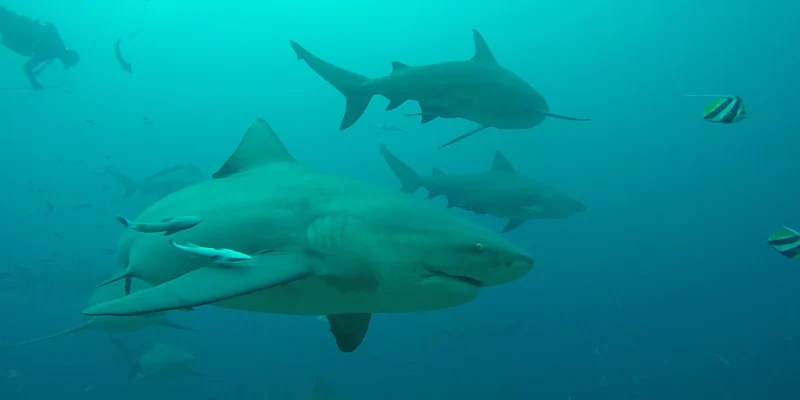
Family ties also play a role in the social life of adult sharks. This is shown by a new study in the scientific journal Ecology and Evolution. Researchers combined genetic data with six years of observations of bull sharks at Shark Reef Marine Reserve off Fiji.
Most of the animals examined were not closely related to each other. Nevertheless, individual bull sharks stayed with relatives slightly more often and had direct social interactions with them more often than with unrelated conspecifics. The team calls this small but measurable kinship influence “Kinfluence,” a combination of the English terms for kinship and influence.
The result does not mean that adult bull sharks live in stable family groups. Rather, it shows that kinship, along with other characteristics, influences the choice of social partners. This distinction is important precisely because the effect is subtle and most of the animals on the reef were not close relatives.
How researchers measure social life in sharks
The researchers distinguished between two levels of social behavior. An association was considered when two sharks came within about a body length of one another. Additionally, they recorded directional interactions: parallel swimming, an arrangement in which one animal follows the other, and actively joining another shark to swim in synchrony with it.
Genetic analyses then showed which animals were related to each other. Family relationships contributed to both forms of social behavior. The pattern was particularly clear in pairs of male bull sharks. The study not only describes spatial proximity, but also connects observed encounters with the animals’ actual relationships.
an earlier behavioral study by the same team had already shown that bull sharks actively choose their social partners. Gender, age and size influenced which animals spent time together. The new finding complements this picture: kinship also plays a role, but was weaker than the factors described previously.
Why kinship can be an advantage
From an evolutionary perspective, favoring relatives can be advantageous. When related animals help each other or reduce risks together, the genes they share also indirectly benefit. However, the current study does not directly demonstrate such benefits. First, it shows that kinship is related to the structure of the social network.
How the sharks recognize their relatives is still an open question. Natasha D. Marosi from the University of Exeter and the Fiji Shark Lab suspects that several mechanisms work together. Young bull sharks spend their first years in rivers, estuaries and shallow coastal areas. There, full and half siblings or cousins can grow up together and later recognize each other as adults. The study did not clarify which signals they use for this.
High juvenile mortality makes family encounters rare
Close family relationships among adult bull sharks are difficult to prove because only part of a family reaches adulthood. According to the researchers, mortality of young bull sharks is high in riverine and coastal habitats; illegal fishing contributes significantly to this. Accordingly, few related animals can meet again on the reef years later.
This raises a cautious conservation question: If relatives help shape the social network, the loss of many young animals could not only reduce the number of adult sharks later, but also thin out possible family relationships. Whether and what consequences this has for cooperation, space use or reproduction was not examined in this work.
Earlier genetic studies from Fiji also show that rivers, estuaries and reefs must be viewed as a coherent system. Females apparently return repeatedly to specific breeding areas, and individual parental pairs can have offspring over several years. Protection for just one part of this life cycle is therefore not enough.
A complex network rather than solitary predators
Large sharks are still often considered solitary animals. Long-term observations off Fiji paint a different picture: bull sharks differentiate between possible social partners, form a dynamic network and react to several characteristics at the same time. Kinship is a part of this system, but not the only force shaping it.
For divers, the Shark Reef Marine Reserve is best known as the site of regular bull shark encounters. The study makes it clear that a reef assemblage is not an arbitrary group of interchangeable animals. Behind the encounters are individual relationships, experiences and in some cases even family ties.
The research was supported by the Hai Stiftung Shark Foundation, the Rufford Foundation, the Waitt Foundation and the Fiji Shark Lab. The combination of long-term observation and genetics was crucial for the new finding: Only together do both data sets show who swims with whom – and who is related to whom.
Featured image: amanderson2, CC BY 2.0, via Wikimedia Commons. Cropped to a 2:1 aspect ratio.