


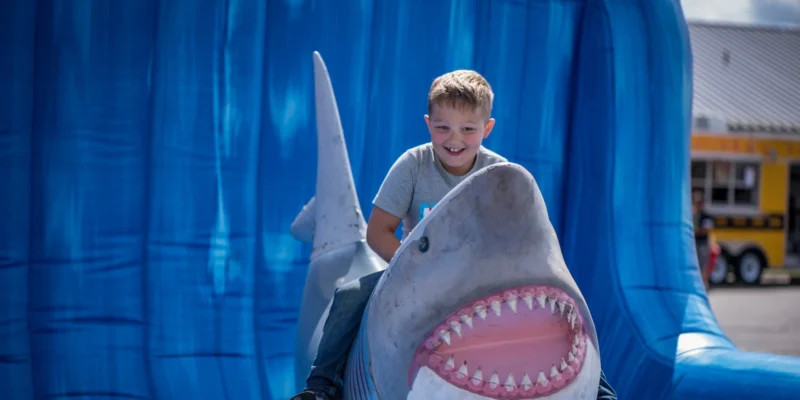
Many young children don’t see sharks primarily as a threat. A new study shows that around two thirds of the children studied liked sharks. At the same time, explicit fear associations became more common with increasing age. The data shows a connection, but does not explain what causes this development.
Parents recorded responses from 374 children
The research team evaluated an online survey of 323 parents. They asked their 374 children between the ages of two and twelve open-ended questions and recorded their answers. The families lived in 17 countries or regions, but 61 percent of the children lived in Australia. The sample is therefore international, but not globally representative.
The open-ended questions were intended to avoid suggesting fear to the children through the wording itself. Parents recorded, among other things, what their children think sharks do, what they look like and whether the children like sharks. Researchers then assigned the answers to categories; a second person checked part of the coding.
69 percent liked sharks
Overall, 69 percent of children said they liked sharks. Common reasons were that sharks were cool, looked interesting or were good swimmers. When describing their appearance, the children particularly often mentioned teeth, size and fins. Books were the most common contact with sharks at 65 percent, followed by aquariums at 59 percent and television shows at 38 percent.
13.9 percent explicitly associated sharks with fear or described them as scary. The researchers only counted statements about sharks biting or being dangerous as fear associations if the children actually expressed fear at the same time. In this way, the analysis separates knowledge of danger from an emotional reaction.
Fear associations increased with age
The proportion of children with explicit fear associations increased statistically significantly across age groups. Differences by gender, country of residence, frequency of ocean visits, or parent-reported anxiety level were not significant in this sample. This does not mean that parents or the media have no influence – just that the study was unable to prove such an influence with its data.
The researchers discuss that social narratives and media images could play a role. However, the specific media impact was not directly measured. There is also no longitudinal study that follows the same children over the years. The results therefore describe age differences at one point in time and do not prove development in individual children.
Positive experiences can be important for shark protection
Early books, aquarium visits and educational opportunities could give children a more nuanced picture of sharks. This is consistent with an already published review of 171 studies: More knowledge about sharks was associated with more positive attitudes and greater support for their protection. Both works show connections and a need for research, not simple instructions that are guaranteed to prevent anxiety.
What the study leaves open
The children’s answers were asked and recorded by their parents. The formulation, selection and interpretation may have been influenced unconsciously. The predominantly Australian and English-speaking sample also limits transferability to other cultures. Future studies should follow children over longer periods of time and capture different media and educational experiences in more detail.