


Tiger shark - Galeocerdo cuvier
Body Structure, Characteristics & Anatomy
Anatomy and Body Structure of the Tiger Shark
A Look at the External Characteristics
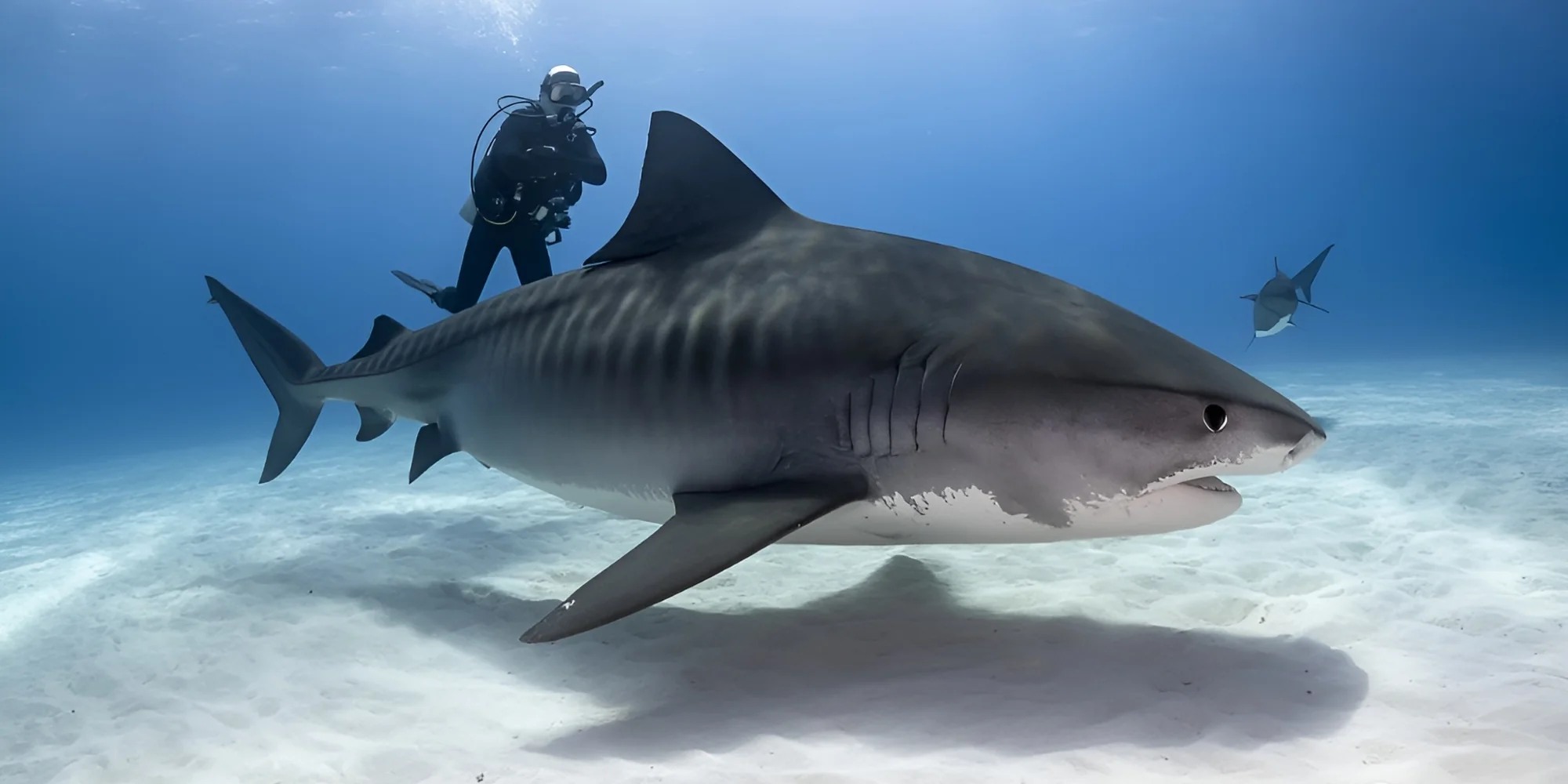
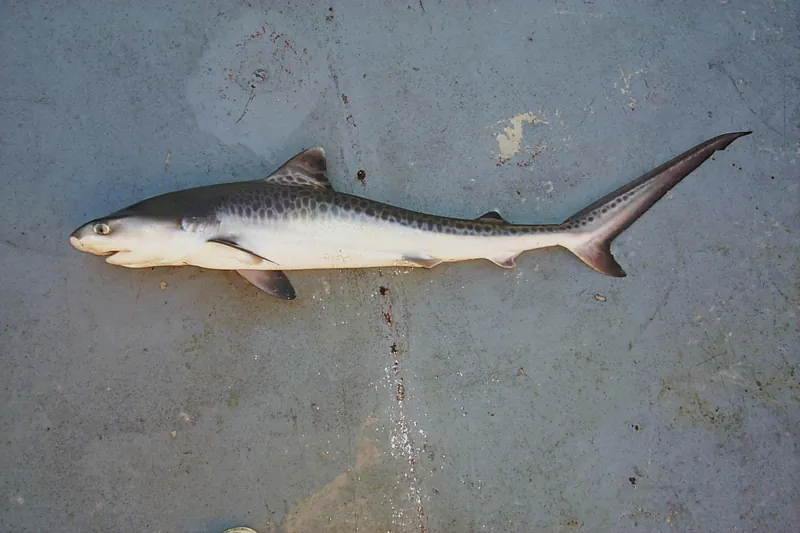
The tiger shark, scientifically known as Galeocerdo cuvier, is one of the largest and most impressive shark species in the world’s oceans. It owes its name to the distinctive striped pattern, which is particularly visible in juveniles. As they age, these dark transverse stripes fade but usually remain visible as shading.
Tiger sharks have a robust, torpedo-shaped body built for fast and powerful swimming. The upper side is typically grey-blue to olive in colour, while the underside is a contrasting lighter shade, often whitish or yellowish. This so-called countershading helps the shark to visually camouflage itself from both above and below.
Head and Snout
The tiger shark’s head is broad and short. The snout appears blunt and slightly flattened, giving the animal a robust appearance. The nostrils are located on the underside and are surrounded by sensory pits (Ampullae of Lorenzini), which detect electrical fields—an important aid in hunting.
Eyes and Sensory Organs
The tiger shark’s eyes are large, round, and highly light-sensitive. Behind each eye is a small spiracle, which in bottom-dwelling sharks is often used for respiration—though in the tiger shark, it is more of a rudimentary structure. Its sensory equipment enables it to hunt efficiently even in low light or murky water.
Gills and Skin Structure
Five gill slits on each side of the body allow the shark to extract oxygen from the water. The skin is covered with tiny, tooth-like scales—called placoid scales. These make the skin rough like sandpaper but also reduce water resistance and protect against parasites and injuries.
Fin Arrangement
The tiger shark has two dorsal fins, the first of which is large, sickle-shaped, and prominent. The second is significantly smaller and located closer to the tail fin. Its pectoral fins are strong and broadly set, while the pelvic fins are narrower. The tail fin is asymmetrical: the upper lobe is longer than the lower one, providing powerful forward propulsion.
Jaws and Teeth
The jaws are among the most striking anatomical features. The teeth are broad, triangular, and heavily serrated at the sides—ideal for slicing through prey. Unlike in many shark species, the teeth in the upper and lower jaws are nearly identical in structure. Tiger sharks can use these teeth to cut through hard objects such as turtle shells or bones. Broken teeth are continuously replaced—new teeth grow from the rows inside the jaw.
Sexual Dimorphism: Males vs. Females
Body Size and Weight
A clearly visible difference between the sexes lies in body size. Female tiger sharks are, on average, larger than their male counterparts. While males typically measure between 2.5 and 3.5 metres in length, females often reach lengths of over 4 metres. Some individuals can even exceed 5 metres. Weight varies accordingly—females often weigh several hundred kilograms more.
Reproductive Organs and External Characteristics
A reliable distinguishing feature is the so-called claspers—paired appendages on the pelvic fins of males, used for reproduction. These are clearly visible externally and are completely absent in females. Apart from this, both sexes are very similar in terms of colour, fin structure, and body shape.
Maturation and Growth
Male tiger sharks reach sexual maturity earlier, at a body length of about 2.25 to 2.9 metres. Females usually require a length of at least 2.5 to 3.5 metres. This is due to the more complex reproductive system, as females give birth to live young and undergo longer gestation periods.
Distribution & Habitat
Global Distribution
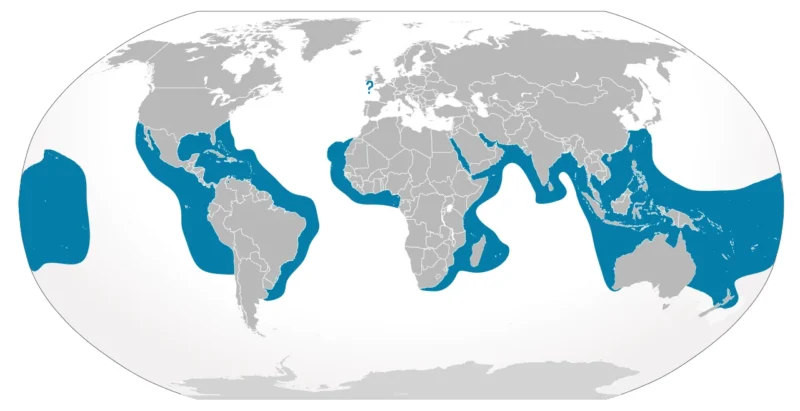
The tiger shark is a widely distributed species found in nearly all tropical and warm-temperate marine regions of the world. Its range extends across the Atlantic, Indian Ocean, and Pacific. It is most frequently observed in waters between the 40th parallel north and south.
In the western Atlantic, the tiger shark inhabits the eastern coasts of North and South America—from the coasts of Florida and the Caribbean to Brazil. In the eastern Atlantic, it is found from West Africa to the Cape Verde Islands. Occasionally, individuals are sighted further north, primarily due to seasonal migrations and warm ocean currents.
In the Indian Ocean, the tiger shark is found off the coasts of East Africa, around the Maldives, near Madagascar, and in waters surrounding the Indian subcontinent. In the Pacific, it is present in tropical island regions such as Polynesia, Micronesia, and Melanesia, as well as along the coasts of Australia and Southeast Asia. Hawaii, Tahiti, and the Galápagos Islands are also among its preferred habitats.
Typical Habitats
Tiger sharks are highly adaptable and utilise various marine habitats. They are found both near the coast and in pelagic, or open ocean, zones. They are most commonly observed in the following habitats:
Coastal Waters
Shallow, warm coastal regions are among the tiger shark’s preferred habitats. There, they roam sandbanks, lagoons, and bays, often near mangroves or river mouths. These zones not only provide abundant food but also structural diversity through underwater landscapes such as seagrass beds or rock formations.
Coral Reefs and Reef Edges
Coral reefs are among the most important habitats for the tiger shark. Particularly in tropical regions, they regularly patrol along outer reefs and reef edges, where biodiversity is high and food is plentiful. These areas are also home to turtles, rays, and smaller sharks—all potential prey for the tiger shark.
Open Sea
Although the tiger shark is frequently found in coastal areas, it is also one of the shark species that covers long distances over open water. It often stays above the continental shelf, where the sea is relatively shallow, but can also utilise deeper zones down to several hundred metres. In these pelagic areas, the tiger shark searches for migrating fish schools or drifting prey.
Differences Between Age Groups
The use of habitats partly differs between young and adult individuals. Juveniles typically prefer protected, shallower coastal regions where they are relatively safe from larger predatory fish. These so-called nurseries are often located in shallow lagoons or mangrove bays.
Adult tiger sharks, on the other hand, are significantly more mobile and exhibit a broader range of habitats. They sometimes migrate over long distances and alternate between reef zones, open waters, and coastal areas. They often follow seasonal patterns or food availability.
A regional comparison off northeastern Brazil revealed a finer age distribution: coastal samples were dominated by newborn and very young tiger sharks, while oceanic samples consisted mainly of juveniles. This is consistent with an age-related change in habitat use, but does not demonstrate individual migrations or, by itself, establish that an area functions as a nursery.
Lifestyle, Diet & Reproduction
General Lifestyle and Behaviour
The tiger shark is considered a solitary animal that only occasionally appears in groups during large food sources. On such occasions, a loose hierarchy emerges, where larger individuals eat first, and smaller ones wait until the larger ones are satiated. The animal is primarily active at dusk and during the night. During the day, it often retreats to coastal or deeper waters, while in the evening, it seeks out shallow water zones near boundaries.
Tiger sharks cover very large areas. Individual animals swim up to 16 km a day and often only return to the same place after months. Their range can cover several square kilometres—typically around 23 km². Seasonal migrations take them into temperate zones during warmer periods and back into tropical waters in winter. Females tend to stay closer to shore, especially when they are pregnant.
Dietary Spectrum and Hunting Strategy
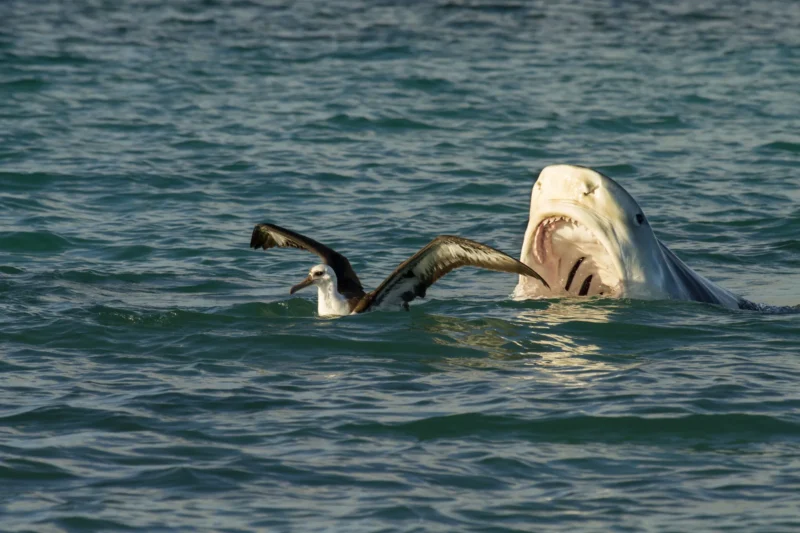
The tiger shark has one of the broadest dietary spectra in the animal kingdom. Its reputation as the “ocean’s garbage disposal” stems from the fact that it eats nearly anything that fits into its mouth—from molluscs, fish, turtles, rays, smaller shark species, marine mammals, and seabirds to carrion, marine birds, and sometimes even man-made objects. This is due to its highly serrated teeth, which act like saw blades and can cut through hard shells or bones. Larger animals prefer turtles, seals, or thick-shelled fish as they age, while juveniles primarily hunt small fish and crustaceans.
Its hunting strategy relies on isolation and camouflage. It approaches silently, sneaks up from deeper zones, and uses short bursts of speed to overwhelm prey by surprise.
Reproduction and Life Cycle
Tiger sharks are ovoviviparous—this means the young initially develop from large eggs inside the mother’s womb, then receive nourishment through embryotrophic fluid before being born live.
| Merkmal | Beschreibung |
|---|---|
| Reproductive Cycle | approximately every three years per female |
| Gestation Period | approximately 13 to 16 months |
| Litter Size | between 10 and 82 juveniles, usually 25 to 40 |
| Size at Birth | around 51 to 76 cm |
| Sexual Maturity | males at about 2.3 to 2.9 m, females at about 2.5 to 3.5 m in length |
| Estimated Lifespan | about 20 to 50 years |
In the northern hemisphere, mating usually occurs between March and May, with births taking place from April to June. In southern regions, mating often happens in November or December, with births between February and March. Juveniles are born in so-called nurseries—common shallow water areas like lagoons or protected river mouths, where they are better protected from larger predators.
After birth, the mother does not provide further care. The juveniles are immediately independent, well-camouflaged, and equipped with sharp teeth—however, their chances of survival are low. It takes several years for them to reach maturity, which is accompanied by a complete change in flank markings and the development of a more robust body.
Growth off northeastern Brazil
A study off northeastern Brazil involving 221 measured tiger sharks and vertebral samples from 67 individuals provides regional growth estimates. The model predicts a total length of about 1.65 metres at one year and two metres at one and a half years. Using a previously published maturity length of 3.10 metres gives an estimated age at maturity of about 4.7 years; maturity was not directly observed. Age estimation assumes annual growth-band pairs, but the study could not confirm their periodicity. These figures therefore do not establish worldwide age thresholds, maximum lifespan or maximum body size.
Humans & Tiger Sharks
Myths and Facts
The tiger shark is considered dangerous but is no more aggressive than other large shark species. Worldwide, there are only a small number of documented incidents involving humans. Most cases are misunderstandings—the shark mistakes a swimmer or surfer for prey. The image of a bloodthirsty predator is greatly exaggerated.
Encounters While Diving
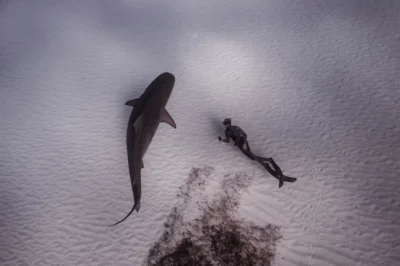
In certain regions, diving with tiger sharks is a fixed part of ecotourism. Trained dive guides observe the animals up close—without cages and usually without incidents. Such encounters enable unique experiences and promote understanding of this fascinating species.
Dive Spots for Encounters with Tiger Sharks
Tiger Beach, Bahamas
Off the coast of Grand Bahama lies one of the most famous spots: Tiger Beach. Here, large tiger sharks—mostly females—regularly gather in clear, shallow water. Divers can experience them up close. The sharks are considered curious but not aggressive, as long as they are treated with respect.
Fuvahmulah, Maldives
On this remote island in the Maldives, visitors can observe tiger sharks year-round. Through targeted feeding, the animals can be lured to specific locations, enabling safe and controlled dives. Particularly impressive is the high number of documented individuals in this area.
Aliwal Shoal, South Africa
Near Durban, along Aliwal Shoal, there is also the opportunity to encounter tiger sharks. Here, so-called “shark dives” take place—guided dives with experienced guides, where the animals are observed respectfully.
Hawaii
Hawaii is one of the few places where tiger sharks regularly appear near beaches. Special dive tours allow interaction with these animals in a respectful manner—usually with strict rules and professional supervision.
Diving Safely with Tiger Sharks
Behavioural Recommendations
- Always enter the water with experienced dive guides
- Move calmly and slowly—no sudden gestures
- Hover upright in the water, maintain eye contact
- Never touch the sharks or block their path
- Do not wear shiny equipment
Assessing Risks Realistically
The risk of being injured while diving with tiger sharks is extremely low. When safety rules are followed, encounters are usually harmless. It is important to treat the animals with respect and not to crowd them or treat them like animals in a zoo.
Endangerment & Population Trends
The tiger shark (*Galeocerdo cuvier*) is one of the largest predatory fish in the world’s oceans. Despite its wide distribution in tropical and subtropical waters, this species is under increasing pressure. Particularly, hunting by humans and its slow reproduction rate endanger its population. This article takes a look at the current challenges regarding the endangerment and population trends of the tiger shark.
Endangerment of the Tiger Shark
The tiger shark reproduces only every two to three years and gives birth to comparatively few offspring. This biological trait makes it particularly vulnerable to overfishing. In many regions, the tiger shark is targeted—either for commercial reasons or as part of sport fishing. Additionally, it often ends up as bycatch in industrial fishing nets.
Particularly problematic is the trade in shark fins. In some countries, these are considered a delicacy, leading to high demand. Tiger sharks are often killed just for their fins. Skin, liver oil, and cartilage are also used commercially. Many fishing areas lack sufficient regulation, and comprehensive data on actual catch numbers are missing. This makes it difficult to accurately assess the global population.
The International Union for Conservation of Nature (IUCN) currently classifies the tiger shark as “near threatened.” This means that while the species is not yet immediately at risk of extinction, a further decline in populations is likely if no protective measures are implemented.
Population Trends in Different Regions
The global trend of the tiger shark population is difficult to quantify precisely. Long-term and comprehensive surveys are lacking. Nevertheless, regional studies provide clear indications of a decline.
In Australia, for example, data from the so-called Shark Control Program show that tiger shark catch rates have dropped by over 70 percent since the 1960s. At the same time, the average body size of the caught animals has decreased. This suggests that particularly larger, sexually mature animals are disappearing from the populations.
Similar trends can be observed in the Atlantic. There, too, catch numbers have significantly decreased over the past decades. Particularly concerning is that increasingly young animals are being caught before they can reproduce. This negatively affects the regeneration of the populations.
In the Arabian Sea, a decline in the tiger shark population of around 30 percent has been estimated over the last 75 years. Projections suggest that this trend will continue in the coming decades unless effective protective measures are introduced.
An exception is currently South Africa. There, observations even show slightly increasing catch numbers. Nevertheless, scientists warn against concluding a global recovery from regional developments. The worldwide trend continues to decline.
Profile
- First described:
- Max. size:
- Depth:
- Max. age:
- Max. weight:
- Water type:
- IUCN Status:
Taxonomy
- Kingdom:
- Phylum:
- Subphylum:
- Infraphylum:
- Parvphylum:
- Class:
- Subclass:
- Superorder:
- Order:
- Family:
- Genus:
Dive Centres

Maputo Dive Center

Thresher Shark Divers

Ticao Island Resort

Evolution Diving Resort

Atlas Divers Malapascua

The Ark Divers

Coral Coast Divers

Florida Shark Diving
Bounty Hunter Shark Adventures

Shark Addicts

Coiba Dive Center

Life & Dive
Dive in Adventure Tours
BACK TO BASICS ADVENTURES

Blue Ocean Dive Resort

Extreme Dive Fuvahmulah

Fuvahmulah Dive School

Fluid Divecenter

Epic Diving

Dressel Divers Montego Bay

Atlantis Divers

Beqa Adventure Divers

Reef Oasis Dive Club














News

Tiger sharks off Brazil: Two metres long at just a year and a half?
Bawley Point: White and tiger sharks feed on whale carcass
SMART drumlines in NSW: bycatch rate nearly twice that of target sharks
Tiger shark knocks surfer off board at Ala Moana; no injuries
Nouméa begins formal hearings on coexistence with sharks
Wayuu fishers in Colombia rethink shark fishing
Drone-assisted shark fishing banned along the Jersey Shore
Trevallies use sharks as mobile scratching surfaces

Young tiger shark caught off Cape Cod – is New England becoming a new nursery ground?
Maldives opens its first shark research center
Drone shark surveillance: 62 percent of target-shark reports were wrong
Sint Maarten: insular shelf recognized as important shark and ray area
More Than Remoras: Why a Shark Is Also Habitat for Other Fish
Underwater misunderstanding: shark bites researcher off Little Cayman
Tourist dies in extremely rare shark attack
Trump pardons divers – after conviction for theft for freeing sharks
Tiger Sharks in Hawaiʻi – September is Birthing Season

















Newsletter
Shark Alert in Your Inbox