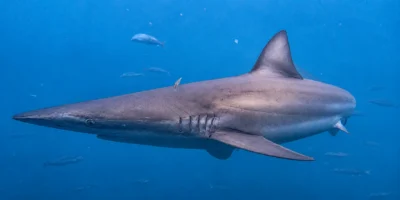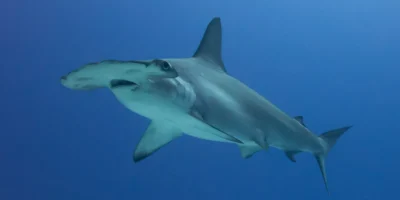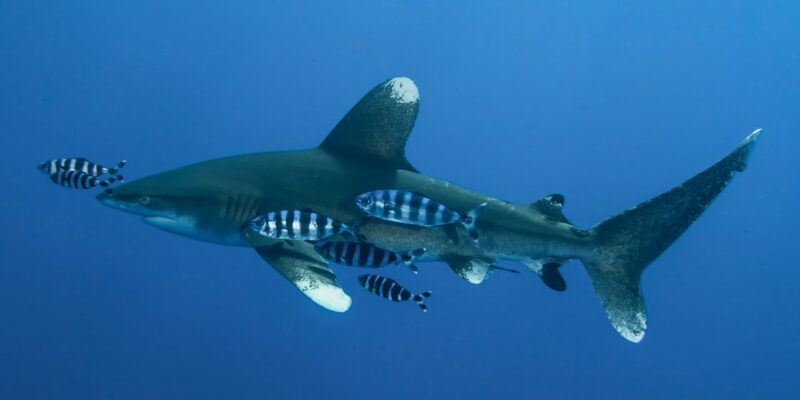
When divers see a shark, the first things they notice are usually its outline, movement and distance. But there is often a smaller story swimming beside it: remoras, pilot fish, jacks or other companion fish using the shark as shelter, transport or a moving meeting point.
A new study in Ecology and Evolution examines these relationships in the open ocean. Jett K. Walker, Jessica J. Meeuwig and Christopher D. H. Thompson analysed global midwater BRUVS data from the Atlantic, Indian and Pacific Oceans.
The Marine Futures Lab summarises the key result clearly: almost half of the observed sharks hosted at least one companion fish. This is not just attractive footage for divers, but a recurring ecological relationship.
Sharks as moving habitat
The study treats sharks as mobile hosts. For smaller fish, staying close to a large shark can mean lower predation risk, access to scraps or prey disturbed by the host, and energy-saving movement through large stretches of ocean.
Remoras attach directly with a suction disc. Pilot fish, jacks and other free-swimming companions keep close without attaching. The benefit to the shark is often less obvious, so many of these associations are best understood as commensal relationships, though the balance can shift with context.
For divers, the scene feels familiar: a tiger shark with remoras, a blue shark with pilot fish, or a reef shark with a small escort. The study shows that these observations are part of a larger pattern. A shark is not only a single species; it can be a small ecological network in motion.
Seven shark species, three oceans
The dataset came from baited remote underwater video systems suspended in midwater. The wider database included 8,827 deployments across 48 global locations between 2014 and 2024. The analysis focused on seven shark species: Australian blacktip, copper, grey reef, tiger, great hammerhead, blue and scalloped hammerhead sharks.
Companions were not randomly distributed. Australian blacktip and copper sharks were more likely to host companion fish in the models, while scalloped hammerheads rarely carried them. The companions also showed patterns: yellowtail scad were mainly recorded with Australian blacktips, and pilot fish especially often with blue sharks.
That matters because a few shark species may support a disproportionate share of companion animals. If those host populations decline, the loss is not limited to the sharks themselves; it can also remove the living platforms, shelter and encounter points used by smaller species.
Temperature, salinity, wind and distance from shore
The study also asked which conditions predict these associations. Companion presence was best explained by sea surface temperature, salinity, wind speed and distance from shore. Companion abundance was linked especially to primary productivity, wind and salinity.
The idea is simple: sharks, companions and prey do not meet evenly across the ocean. Productive, dynamic or current-rich waters can make encounters more likely. Offshore areas with lower animal densities may create different dynamics, where staying near a large shark becomes especially valuable.
Many of these environmental drivers are sensitive to climate change. As temperature, salinity, productivity and wind patterns shift, individual species are not the only things that may be affected. Relationships between species can change too.
What protected areas change
Protection status was one of the most interesting parts of the study. Partially protected areas showed a higher probability that sharks had companions at all. Highly protected areas, however, showed the clearer effect on numbers: when companions were present, sharks carried more of them there.
That is a nuanced result, but an important one. Protection is not only about target species. If a protected area allows shark populations and ecosystem structure to recover, it can also support the smaller animals and behaviours connected to those sharks.
For a diving audience, the message is powerful. A protected shark is not just one more animal in the water. It can be a moving habitat where other fish find food, safety and orientation.
Why this matters for shark conservation
Shark conservation is often described through population numbers, fishing pressure and threat status. That remains essential, but it is incomplete. The new study reminds us that sharks carry relationships: with prey, cleaners, companion fish and the ocean spaces where these encounters become possible.
If sharks disappear, smaller and less visible ecological functions can disappear with them. The authors discuss the risk of co-decline, where dependent species or relationships decline alongside their hosts. That makes protection of large mobile animals even more urgent.
For divers, it changes the next encounter. The remora is not decoration, and the pilot fish in a blue shark’s shadow is not background detail. They show that a shark in the open ocean can also be a place: a moving point of shelter, opportunity and connection.