


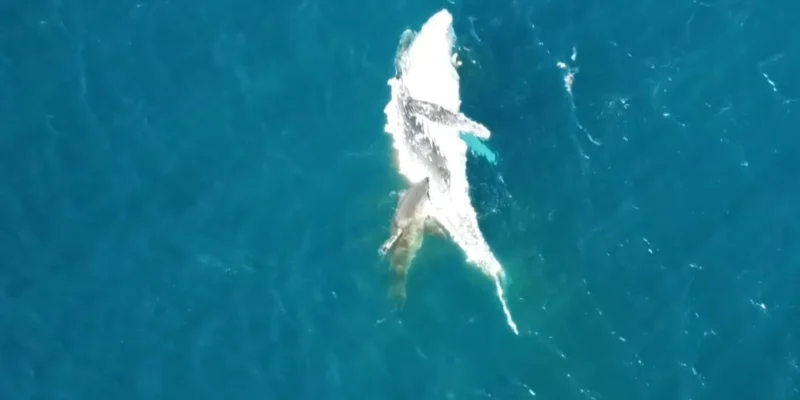
Off Bawley Point on the south coast of New South Wales, several large sharks have gathered around a drifting humpback whale carcass. The Australian ABC reported on August 26, 2026, on the drone footage by professional bodyboarder, drone pilot, and marine mammal rescue helper Lilly Pollard.
According to the report, the carcass drifted about 1.5 kilometers off the coast. During Pollard’s short drone flight, five sharks came to the whale. Visible were great white sharks (Carcharodon carcharias) and tiger sharks (Galeocerdo cuvier).
A white shark almost as long as the comparison boat
Particularly striking was a very large great white shark. Pollard compared it to a fishing boat about five meters long nearby and estimated the shark to be more than five meters. The other animals she estimated at about three to four meters.
According to their observation, the sharks came to the carcass one after another, ate, and then swam around the boats.
Why whale carcasses matter to sharks
A large whale provides a rare but very plentiful meal with its energy-rich fat. Marine researcher Duncan Leadbitter explained to ABC that such observations could become more common with the recovery of humpback whale populations: As more whales reach old age, more animals also die naturally.
However, the ecological significance does not end at the surface. When the carcass sinks to the depths, it becomes a so-called Whale Fall and can provide food and habitat for numerous organisms there for years or even decades. The event off Bawley Point thus connects two natural processes: scavenging by large sharks at the surface and the later nutrient supply for the deep sea.
Who decides what happens to a dead whale?
The handling of a whale carcass in New South Wales depends on the location, accessibility, and risk. The official NSW guideline for dead whales assigns responsibility to the respective land or water manager. In principle, carcasses should decompose naturally as much as possible; in urban or heavily visited areas, removal may be advisable.
Leadbitter suggested a clearer regulation for drifting carcasses. As a possible option, he mentioned towing them to the continental shelf, which in this section of the south coast is about 20 kilometers away. That was a suggestion from the researcher, not a confirmed measure in the specific case of Bawley Point.