


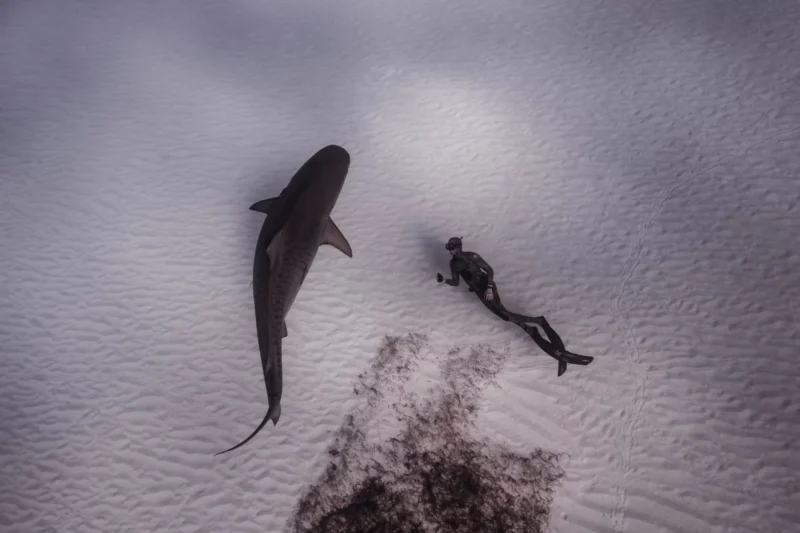
During a scientific diving mission off the island of Little Cayman in early February there was a rare incident: a marine researcher was bitten by a juvenile tiger shark during a research dive. The incident occurred as part of ongoing studies at known spawning sites of the Nassau grouper and attracted international attention.
What exactly happened
The bite occurred during a planned research operation at a seasonal spawning site. Visibility underwater was limited at the time, which is considered a decisive factor in the situation. According to the experts involved, it was a case of mistaken identity: the roughly two-metre-long juvenile tiger shark may have briefly mistaken the diver for potential prey.
Immediately after the bite the animal released and withdrew on its own. There was no further approach or pursuit behaviour, indicating a defensive rather than aggressive response.
Health of the researcher
The injured researcher received prompt medical treatment and was then airlifted to George Town for further care. According to the authorities concerned, he is on the road to recovery. There was never any life-threatening danger.
Assessment of the incident
The Cayman Islands Department of Environment emphasises that this was an extremely rare incident. Shark bites are exceptional in the waters of the Cayman Islands and are not proportionate to the high number of dives safely carried out each year.
Sharks do not count people among their natural prey. In most documented cases in which bites do occur, environmental factors such as poor visibility, unusual noises or specific research situations play a role. It appears that this exact combination was also present in this case.
Implications for research and dive safety
The incident highlights the challenges of marine research in the natural habitats of large predatory fish. At the same time, it shows how important clear safety protocols, experienced teams and a realistic assessment of risk are.
For divers, the event does not change the overall assessment: encounters with sharks generally remain calm, controlled and safe. The incident off Little Cayman is a rare example of how exceptional conditions can lead to an unexpected misunderstanding between humans and animals.
