


The National Action Plan for Sharks, Rays, and Chimeras 2025–2030 has a much broader scope than its abbreviated name, “Shark Action Plan,” would suggest. The 26-page core document covers sharks, rays, and chimaeras in the waters of Sri Lanka, as well as catches by Sri Lankan vessels on the high seas in the Indian Ocean. It is the country’s third national action plan and aims to modernize the foundations for research, management, and enforcement by 2030.
The traceability of shark catches announced by the Ministry of Fisheries in August 2026 builds on this framework. The action plan itself, however, is more than just the current traceability initiative: it identifies specific data gaps, planned changes to fishing gear, important habitats, and verifiable work objectives.
Approximately 105 species—about two-thirds of which are considered threatened
The plan identifies approximately 105 species of sharks, rays, and chimaeras in Sri Lanka’s 532,619-square-kilometer exclusive economic zone. About 66 percent of these are classified as critically endangered according to the IUCN Red List. Overfishing is identified as the most significant threat; many species grow slowly, reach sexual maturity late, and produce few offspring.
The scale of the fishing industry explains why conservation measures cannot be planned in isolation from income and food security. For 2022, the document lists 49,786 licensed fishing vessels and approximately 224,610 fishermen. In 2021, 8,730 metric tons of sharks and rays were landed—2.6 percent of the total marine fish production of 331,675 metric tons.
Mostly bycatch, but fully utilized economically
Sharks and rays are primarily caught as bycatch in longlines and gillnets. In addition, there are targeted fisheries: deep-sea sharks are caught with handlines for their liver oil, and rays are caught using, among other methods, bottom-set gillnets. The meat is sold fresh or salted and dried. Fins, gill plates from mobulids, primarily ray skins, liver oil, as well as teeth and jaws are also exported.
It is precisely this diversity of products that makes data collection difficult. The plan therefore calls not only for improved landing statistics but also, by the third year of the plan, for species-specific data on dried fish, ray skins, and shark liver oil. The economic value and the dependence of families along the coast are also to be examined. While the document considers discards to be presumably rare, it acknowledges that they are scarcely documented.
What is already in effect—and what is yet to be introduced
Finning is already prohibited in Sri Lanka. Thresher sharks, including Pacific thresher sharks and common thresher sharks, as well as whitetip deep-sea sharks and whale sharks, may not be retained under the rules summarized in the plan. The release of pregnant sharks has so far only been recommended.
The new proposals should be considered separately. The legal definition of “sharks” is to be explicitly expanded to include rays and chimeras. Every retained cartilaginous fish must be landed in its entirety; for mobulids, a retention ban is planned following a transition period. Multi-day and certain single-day vessels must carry equipment for the live release of endangered species and report protected bycatch on a species-specific basis, including the condition of the animals at the time of release. These points are objectives of the plan and do not automatically constitute existing law.
Ten priority species are finally to be assessed
The research component is unusually specific. First, a brief risk assessment will identify the 20 species most important for research and management. For the ten highest priorities, data will then be collected on age and size at sexual maturity, growth, reproductive cycles, and fertility. By the fifth year of the plan, the goal is to have stock assessments with clear management recommendations for at least ten species.
- Landings should be recorded more frequently and at more locations on a species-specific basis.
- Trade and catch data should be compared to identify unreported removals or gaps.
- Losses due to discards, ghost nets, and post-release mortality should be quantified.
- Nursery areas, spawning grounds, seasonal feeding grounds, and aggregations should be mapped.
- Modified fishing gear and more gentle handling methods are to be tested in the field.
Baththalangunduwa is the most urgent geographic priority
Among the designated Important Shark and Ray Areas areas, the plan classifies Baththalangunduwa on the edge of the Puttalam lagoon as the highest priority for urgent action. Pigeon Island is given the lowest priority because the area is already designated as a marine protected area. For at least one of these areas, a species and habitat management plan is to be implemented and monitored by the fourth year of the plan.
The profile of the Important Shark and Ray Areas shows why Baththalangunduwa stands out: In surveys of 87 Sri Lankan landing sites, it was the only location where newborn winghead hammerhead sharks (Eusphyra blochii) were documented. In February 2019, eleven individuals measuring only 37.5 to 43 centimeters in length were recorded there. For the western Indian Ocean and large parts of Asia, there is currently no other known area where early life stages of this threatened species are regularly observed.
Skates and chimaeras are not a footnote
The plan uses “cartilaginous fish” to refer to the entire group and follows the FAO definition, according to which the umbrella term “sharks” also includes rays and chimaeras. This is important in practice: Skates are specifically targeted and traded for their meat, skins, and gill plates, while comparatively little is known about chimaeras. In the future, both groups should be explicitly included in data collection, reporting requirements, release rules, and species identification.
With regard to fishing gear, the action plan provides for a transition period for wire leaders, a maximum gillnet length of 2.5 kilometers, a ban on entangling or drifting fish aggregating devices, and a gradual transition from J-hooks to circle hooks. Such changes can reduce bycatch mortality, but their actual impact should be assessed on a species-by-species basis.
Trade and enforcement are to become more transparent
For species listed under CITES, Sri Lanka intends to report national quotas—zero for protected species, where applicable—introduce certificates for catches outside national waters, and update scientific due-diligence assessments. Plans also include increased inspections in ports, at sea, and at export points; a central database for violations and repeat offenders; and training and identification guides in Sinhala, Tamil, and English.
It is noteworthy that the plan aims not only to monitor fishermen but also to reward cooperation: Each year, awards will be given to particularly valuable research contributions as well as to fishermen, boat captains, or ship owners who demonstrate good data sharing and exemplary release practices. In parallel, a scientific committee and a steering committee are planned, both of which will meet annually.
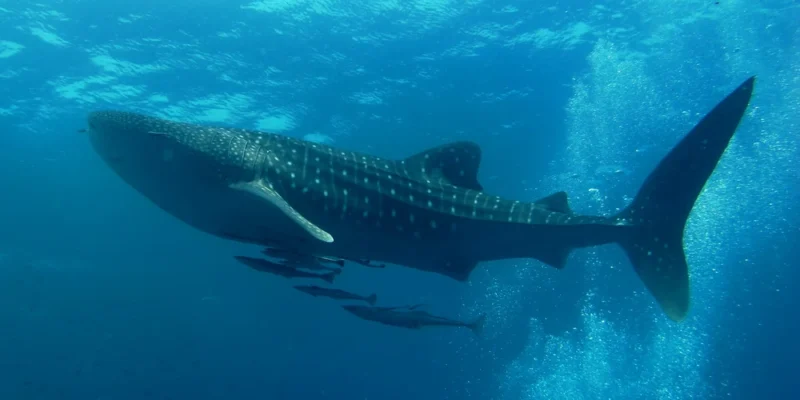
Whale shark in the Andaman Sea. Photo: Abe Khao Lak, CC BY-SA 4.0, via Wikimedia Commons; saved as WebP.