


Common thresher shark - Alopias vulpinus
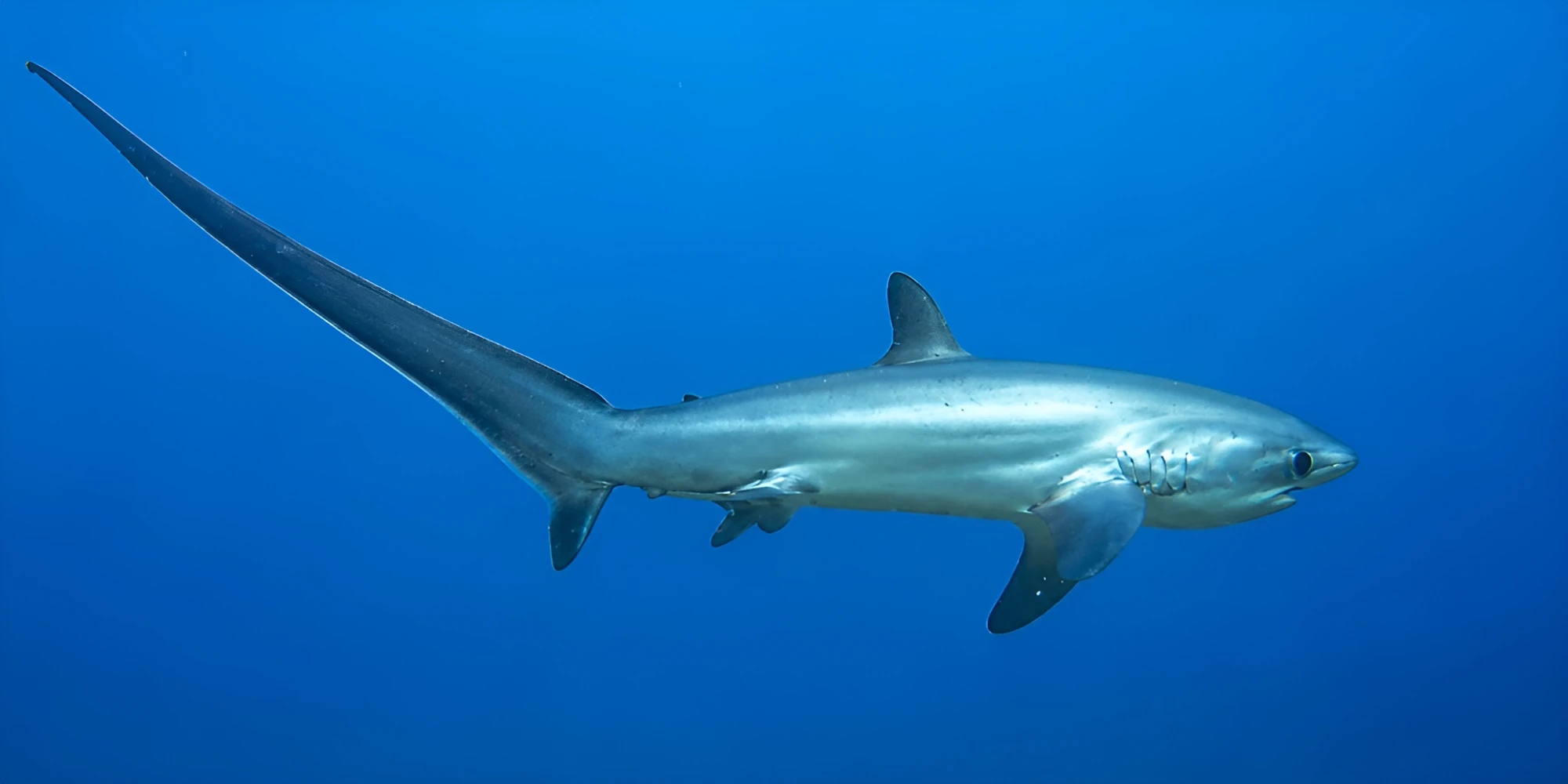

Body structure, features & anatomy
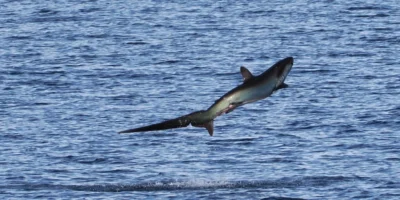
The Common thresher shark Alopias vulpinus is a streamlined thresher shark whose silhouette is dominated by the extremely long upper tail lobe. That tail is a functional hunting tool, not just a visual oddity.
It is usually larger and more powerful than the pelagic thresher shark. The pale underside often rises above the pectoral-fin base, a useful field mark when photos show the side of the body.
Key features
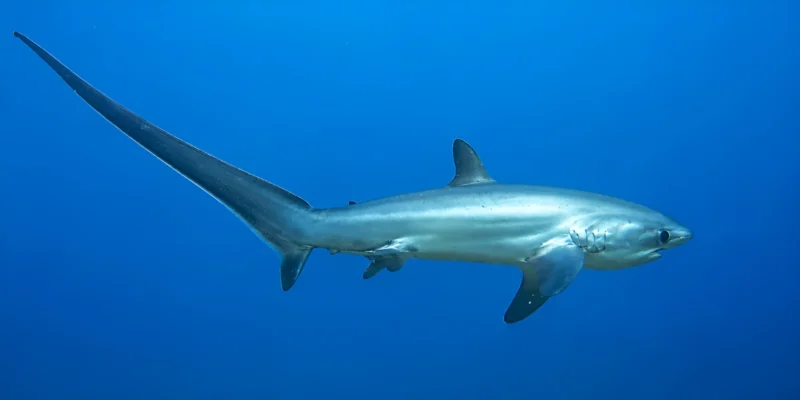
- Tail: very long upper lobe used to stun or herd schooling fish.
- Body: slender open-water form with long pectoral fins.
- Eyes: larger than many sharks, but not the enormous eyes of the bigeye thresher.
- Colour: dark back and pale belly with species-specific boundary lines.
Similar species
All three Alopias species can look similar underwater. Identification depends on body size, eye size, the shape of the head and how far the pale belly colour extends upward.
Distribution & habitat
The Common thresher shark is widely distributed in temperate to tropical seas of the Atlantic, Indian Ocean and Pacific. It is more closely tied to continental shelves, shelf edges and productive coastal-pelagic waters than the pelagic thresher.
Habitat
It uses both coastal and offshore waters, especially shelf edges, island slopes, fronts and upwelling zones where schooling fish concentrate.
Regional pattern
- Atlantic: both sides of the ocean, including the Mediterranean.
- Pacific: temperate and subtropical coasts and islands.
- Nursery areas: young animals often use shallower coastal zones.
Short conclusion
Protection must include the deeper edges and open-water corridors that connect visible dive sites with the habitats where these sharks spend most of their lives.
Life history, diet & reproduction
The Common thresher shark is an active predator of productive coastal and open-water systems. It often follows schooling fish and can use the long tail like a whip during hunting.
Reproduction
The species is aplacental viviparous with oophagy. Litters are small, often two to four pups, and the young are already large at birth.
Diet
- herrings, sardines, anchovies and mackerel-like fishes
- squid and other mobile prey
- schooling fish concentrated by fronts, upwelling and shelf edges
Short conclusion
The spectacular tail is therefore part of the shark’s ecological role: it lets a large predator exploit fast, dense schools of prey.
Threats & protection status
The Common thresher shark is globally listed as IUCN Vulnerable (VU). A wide range does not make thresher sharks safe, because they mature slowly, produce few young and are caught across large fishing areas.
Main threats
- Bycatch: longlines, gillnets and other pelagic gear.
- Targeted use: meat, fins and other products.
- Data gaps: catches are often reported only as thresher shark.
- Slow recovery: small litters and late maturity limit resilience.
Protection framework
All Alopias species are listed in CITES Appendix II. International trade is not automatically banned, but it must be legal and non-detrimental.
Short conclusion
Effective protection needs species-specific catch data, bycatch reduction, trade control and protection of nursery areas, cleaning stations and deep-water edges.
Common thresher shark & humans
For divers, the Common thresher shark is less predictable than reef sharks. Encounters are usually brief, seasonal and linked to prey, visibility and local ocean conditions.
Diving encounters
Thresher sharks are not considered aggressive toward divers. The best approach is patience, distance and no chasing; food cues, hooked fish and nets change the situation completely.
- Keep distance: do not block cleaning stations or approach from behind.
- Stay calm: fast movements shorten encounters.
- Avoid food cues: bait and spearfishing change behaviour.
- Follow local rules: guides know currents and timing.
Fishing and value
The common thresher has a long history in commercial and sport fisheries. Careful release, catch limits and better reporting are central to reducing unnecessary mortality.
Short conclusion
The relationship with people is therefore mostly a management question: whether a remarkable open-water shark is valued alive and protected from avoidable capture.
Profile
- First described:
- Max. size:
- Depth:
- Max. age:
- Max. weight:
- Water type:
- IUCN Status:
Taxonomy
- Kingdom:
- Phylum:
- Subphylum:
- Infraphylum:
- Parvphylum:
- Class:
- Subclass:
- Superorder:
- Order:
- Family:
- Genus:
News

Common thresher sharks off the Isle of Wight: Exeter launches first UK study
Conservation Push in the Western Indian Ocean: What Madagascar’s and Zanzibar’s New Shark Rules Mean
Sri Lanka: Coast Guard seizes more than 220 kilos of thresher shark meat
Why some sharks sprint while others glide: Researchers decode the architecture of their spines
Sri Lanka plans end-to-end traceability for caught sharks
What Sri Lanka’s shark action plan aims to change by 2030
Maldives opens its first shark research center
Endangered shark species meat discovered in US supermarkets
Court stops export of thresher sharks and silky shark in Costa Rica
CMS CoP15: New international protection agreements for hammerhead and thresher sharks





Newsletter
Shark Alert in Your Inbox