


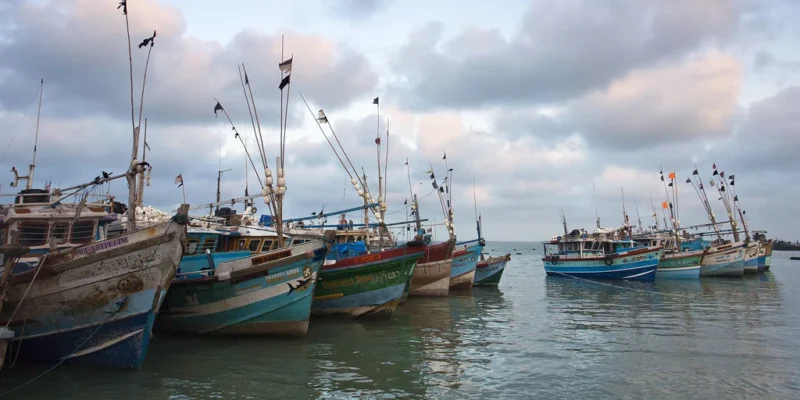
Sri Lanka plans to make shark catches from multi-day fishing trips traceable from the point of catch to the end consumer in the future. On August 21, 2026, the Sri Lankan Ministry of Fisheries published the results of a meeting on stricter regulation of shark fishing and the trade in shark products.
The following video from the Food and Agriculture Organization of the United Nations (FAO) shows Sri Lankan multi-day fishing vessels and explains approaches for safer and more efficient fleet design.
The focus is on three initiatives: a systematic data system for sharks caught in multi-day fishing operations, a cap on current exports, and a management plan coordinated by the research agency NARA to be completed by the end of 2026. The Daily Mirror reported on the program a day later but did not mention all three decisions from the official announcement.
Three Resolutions—But No New Catch Quotas Yet
- Every shark caught by a multi-day vessel should be traceable from the point of catch to the final consumer via a structured data system.
- The export of shark parts, and in particular live ornamental sharks, should not exceed current levels.
- NARA is to work with exporters and the relevant authorities to develop and submit a comprehensive management plan by the end of the year.
The announcement does not yet constitute a general fishing ban, nor does it specify a new quota. Among other things, the start date of the traceability system, the technical labeling of individual catches, controls along the supply chain, and penalties for false or missing information remain to be determined.
Every shark is to be assigned a verifiable origin
According to the ministry, sharks caught in Sri Lanka’s multi-day fisheries are primarily bycatch. Nevertheless, their bodies are put to economic use. The report mentions exports of fins, gill products, jaws, and skins, as well as certain live ornamental sharks. The report does not specify the value of the foreign exchange earnings generated from these activities.
End-to-end traceability could link species, catch location, vessel, landing, processing, and export. This would be particularly important when protected species are confused with legally tradable species that look similar, or when processed products are difficult to identify with certainty later on.
Just how serious this problem is was demonstrated in June 2026 by the previously documented seizure of more than 220 kilograms of thresher sharks in Negombo. The case involved a group of species whose specimens may not be retained or landed as catch in Sri Lanka. Effective supply chain documentation could bring such cases to light earlier, but it is no substitute for inspections and reliable species identification.
Exports should not continue to grow—the initial quantity is missing
Particularly unusual is the decision to freeze exports of shark parts and live ornamental sharks at current levels. This is not an export ban: legal exports should remain possible, but should not increase. The baseline volume and whether individual products or species will be subject to separate caps have not yet been published.
Without a clearly defined basis, it will be difficult to determine later whether the limit is being adhered to. It also remains unclear whether it should be implemented through a binding regulation, via export licenses, or initially only through administrative measures. Representatives from the Fisheries Export Association attended the meeting and are to be included in further planning.
An action plan for 2025–2030 is already in place
This new initiative is not starting from scratch. The National Action Plan for Sharks, Skates, and Chimeras 2025–2030, published on the Indian Ocean Tuna Commission’s portal, identifies research, sustainable management, and education, monitoring, and enforcement as its three main objectives. The plan already calls for species-specific catch and trade data, stock assessments, revised regulations, and stronger enforcement.
Our detailed analysis of the Shark Action Plan 2025–2030 outlines the measures and deadlines involved.
The document also calls for phasing out wire leaders, limiting gillnets to a maximum length of 2.5 kilometers, banning entangling or drifting fish aggregating devices, and gradually replacing J-hooks with circle hooks. The ministry’s announcement does not clarify whether the NARA plan, announced for late 2026, will implement these measures or become a separate set of regulations.
About two-thirds of the cartilaginous fish recorded are considered threatened
The national action plan lists approximately 105 species of sharks, rays, and chimaeras in Sri Lankan waters. According to the IUCN’s global Red List, about 66 percent of these are considered critically endangered. Overfishing and bycatch are described as the main threats.
For 2021, the plan calls for 8,730 metric tons of sharks and rays—2.6 percent of the country’s total marine fish production. Finning is already prohibited. Thresher sharks, including Pacific thresher sharks and common thresher sharks, as well as whitetip deep-sea sharks and whale sharks, may not be retained. It is recommended that pregnant sharks be released.
Sri Lanka’s fishing fleet operates not only in national waters but also on the high seas in the Indian Ocean. Therefore, a new system must align national regulations with the requirements of the IOTC and the trade controls of the Washington Convention on International Trade in Endangered Species (CITES) CITES. Especially for long-distance migratory species, controls at the point of export alone are not sufficient.
Verifiable implementation will be crucial
The announced measures can close data gaps and make illegal trade more difficult. However, their effectiveness depends on whether every catch is recorded by species, whether the information matches across the boat, port, processing facility, and export, and whether inspectors are granted access to a shared database.
The first specific milestone is the end of 2026. By then, NARA is expected to submit the management plan. Only once it is published will it become clear which measures will be binding, how the export cap will be calculated, and whether the promise of seamless traceability can be verified in practice.
Fishing boats in Kalpitiya, Sri Lanka. Photo: Kosala Bandara, CC BY 2.0, via Flickr; cropped to 2:1.