


Pelagic thresher shark - Alopias pelagicus
Body structure, features & anatomy
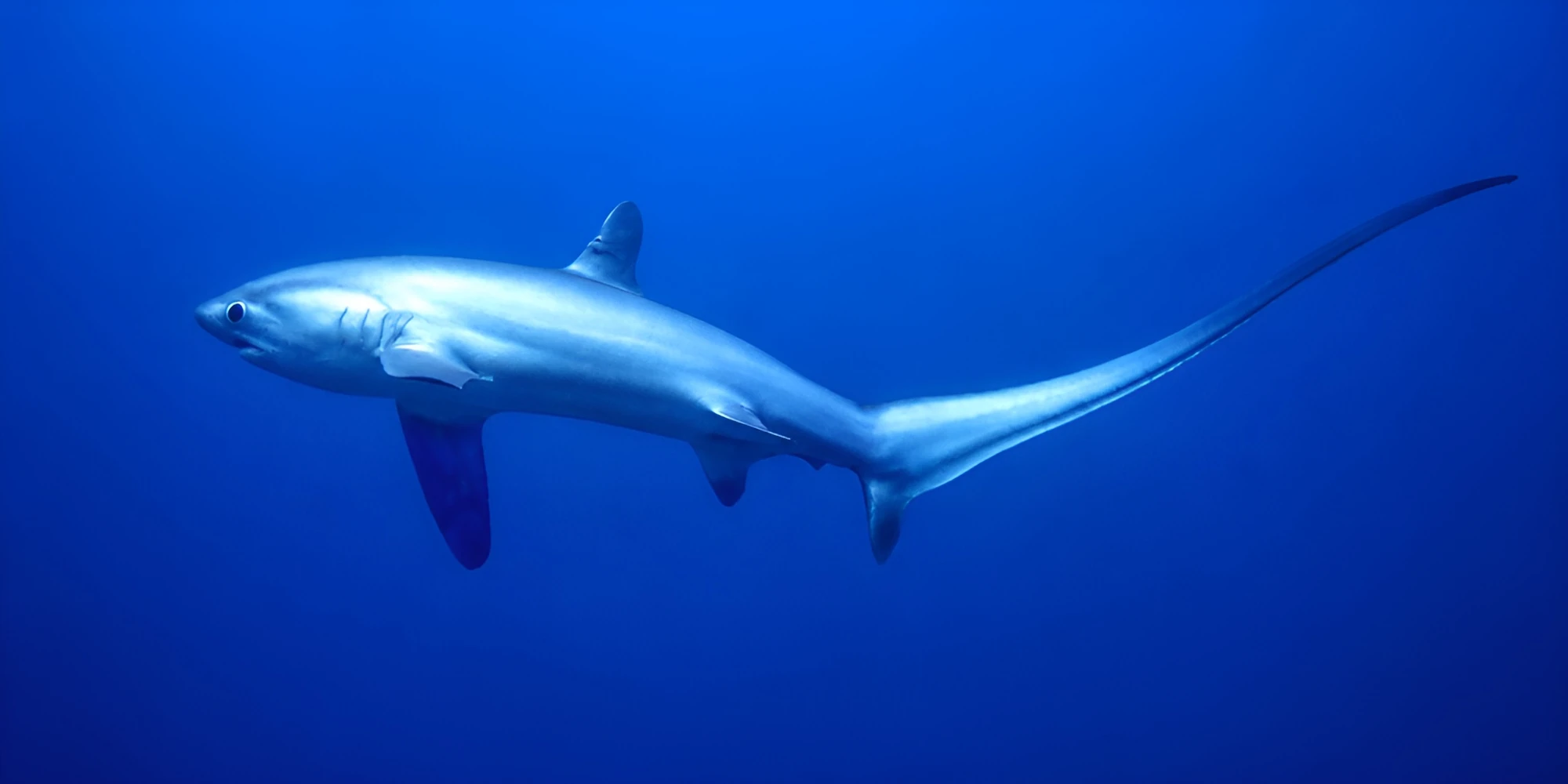
The Pelagic thresher shark Alopias pelagicus is a streamlined thresher shark whose silhouette is dominated by the extremely long upper tail lobe. That tail is a functional hunting tool, not just a visual oddity.
It is usually slimmer than the common thresher shark, with a dark blue to grey-brown back and a pale underside that normally does not rise strongly above the pectoral-fin base.
Key features
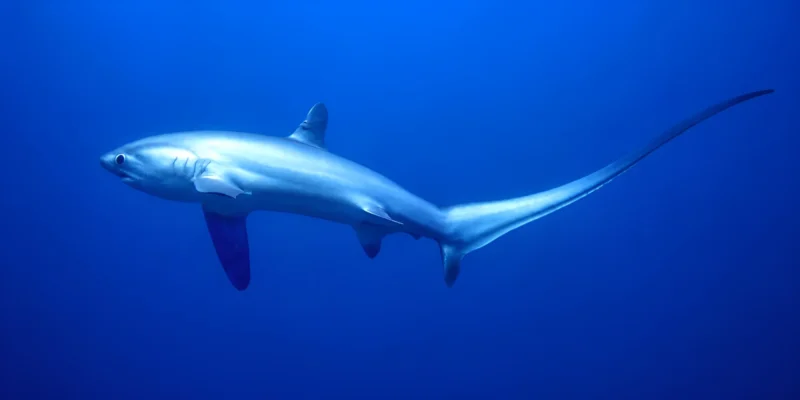
- Tail: very long upper lobe used to stun or herd schooling fish.
- Body: slender open-water form with long pectoral fins.
- Eyes: larger than many sharks, but not the enormous eyes of the bigeye thresher.
- Colour: dark back and pale belly with species-specific boundary lines.
Similar species
All three Alopias species can look similar underwater. Identification depends on body size, eye size, the shape of the head and how far the pale belly colour extends upward.
Distribution & habitat
The Pelagic thresher shark is a tropical to subtropical Indo-Pacific species of open water. It ranges from the Red Sea and western Indian Ocean across Southeast Asia to the central and eastern Pacific.
Habitat
It is mainly pelagic, often over deep water, but can appear near steep outer reefs, islands and seamount-like structures where cleaning stations and prey bring it within reach of divers.
Regional pattern
- Indo-Pacific: Red Sea, Indian Ocean, Southeast Asia, Philippines, Indonesia and wider Pacific islands.
- Diving hotspots: deep cleaning stations such as those known from Malapascua.
- Depth: from surface layers to several hundred metres.
Short conclusion
Protection must include the deeper edges and open-water corridors that connect visible dive sites with the habitats where these sharks spend most of their lives.
Life history, diet & reproduction
The Pelagic thresher shark is an active open-ocean hunter. It usually moves alone or in loose groups and uses the long tail to strike schooling fish and squid.
Reproduction
The species is aplacental viviparous. Embryos develop inside the female and feed on unfertilised eggs; litters are small, usually two pups, which makes recovery from overfishing slow.
Diet
- small pelagic fishes
- squid and other cephalopods
- prey concentrated at deep edges and in night-time vertical movements
Short conclusion
The spectacular tail is therefore part of the shark’s ecological role: it lets a large predator exploit fast, dense schools of prey.
Threats & protection status
The Pelagic thresher shark is globally listed as IUCN Endangered (EN). A wide range does not make thresher sharks safe, because they mature slowly, produce few young and are caught across large fishing areas.
Main threats
- Bycatch: longlines, gillnets and other pelagic gear.
- Targeted use: meat, fins and other products.
- Data gaps: catches are often reported only as thresher shark.
- Slow recovery: small litters and late maturity limit resilience.
Protection framework
All Alopias species are listed in CITES Appendix II. International trade is not automatically banned, but it must be legal and non-detrimental.
Short conclusion
Effective protection needs species-specific catch data, bycatch reduction, trade control and protection of nursery areas, cleaning stations and deep-water edges.
Pelagic thresher shark & humans
For divers, the Pelagic thresher shark is a rare and quiet blue-water encounter. The species is generally shy, and good observations depend on calm behaviour and respect for cleaning stations.
Diving encounters
Thresher sharks are not considered aggressive toward divers. The best approach is patience, distance and no chasing; food cues, hooked fish and nets change the situation completely.
- Keep distance: do not block cleaning stations or approach from behind.
- Stay calm: fast movements shorten encounters.
- Avoid food cues: bait and spearfishing change behaviour.
- Follow local rules: guides know currents and timing.
Fishing and value
Living pelagic threshers can support carefully managed shark tourism at a few hotspots, while fishing pressure affects the same deep edges and corridors.
Short conclusion
The relationship with people is therefore mostly a management question: whether a remarkable open-water shark is valued alive and protected from avoidable capture.
Profile
- First described:
- Max. size:
- Depth:
- Max. age:
- Max. weight:
- Water type:
- IUCN Status:
Taxonomy
- Kingdom:
- Phylum:
- Subphylum:
- Infraphylum:
- Parvphylum:
- Class:
- Subclass:
- Superorder:
- Order:
- Family:
- Genus:
Newsletter
Shark Alert in Your Inbox