


Caribbean reef shark - Carcharhinus perezii
Body structure, characteristics & anatomy
Size and body shape
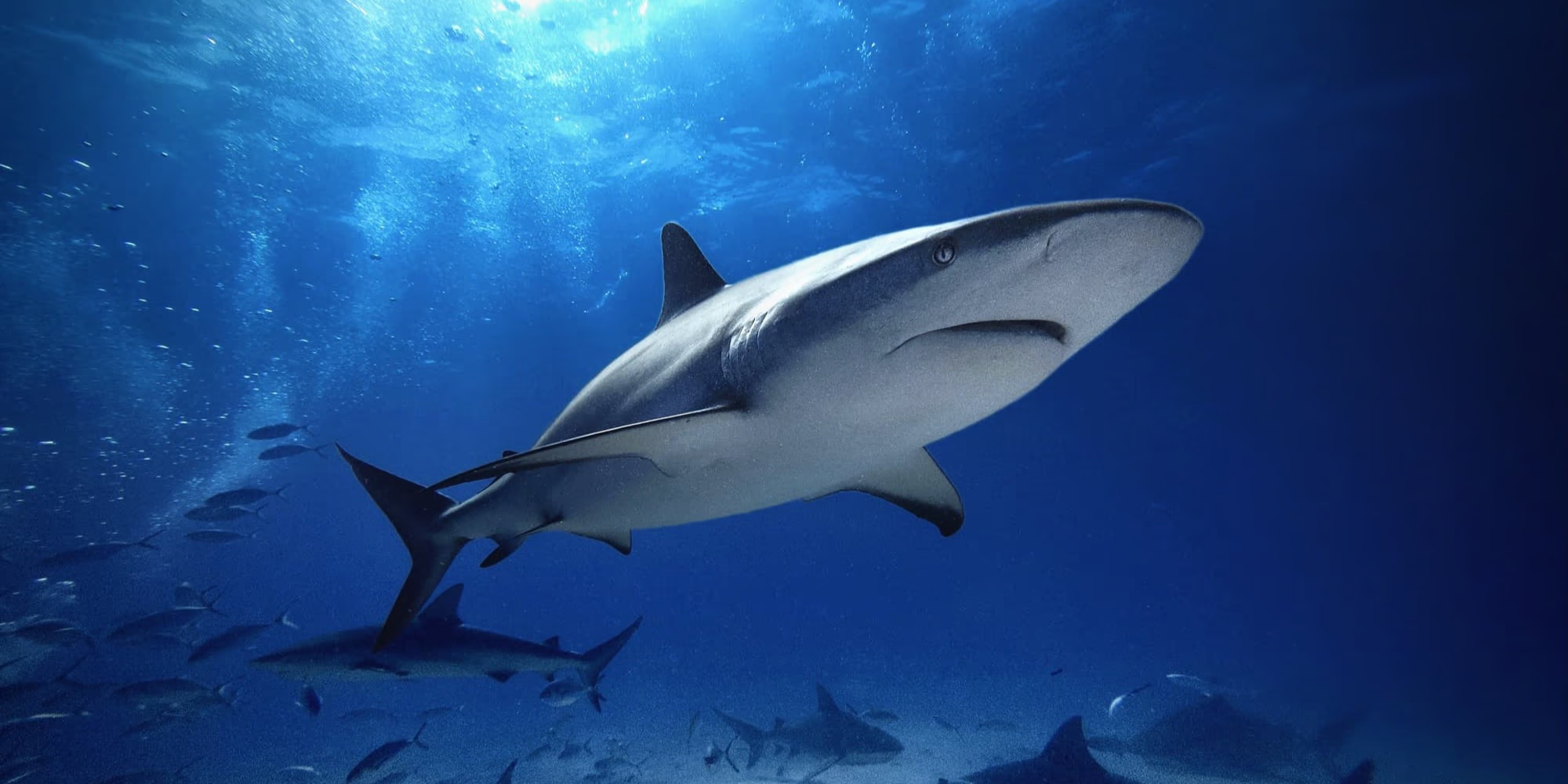
The Caribbean reef shark has a robust, streamlined body that is difficult to distinguish from other large requiem sharks. Most animals are 2 – 2.5 metres long. The maximum length is about 3 metres, and the maximum weight is around 70 kg. Its shape is spindle-like with a distinct interdorsal ridge between the first and second dorsal fin.
Colouration and markings
The dorsal (back) body area is dark grey to grey-brown, the belly side white to yellowish white. An inconspicuous white band runs along the flanks. The fins have no striking markings; however, the undersides of the paired fins as well as the anal fin and the lower lobe of the tail fin are dark coloured. These colour features make camouflage on the reef easier.
Head, snout and eyes
The snout is short, broad and bluntly rounded; only weakly developed nasal flaps sit at the front. The large round eyes have a nictitating membrane, which protects them during attacks or contact with objects. The head contains the sensory organs: olfactory field, eyes and hearing openings.
Jaws and teeth
The upper and lower jaws each carry 11 – 13 rows of teeth. The teeth have broad bases and sharp, serrated cutting edges with narrow tips. The front two to four teeth of each half of the jaw are upright, while the teeth further out are increasingly slanted. The upper teeth have slender tips, whereas the lower teeth are more distinctly triangular in shape in order to hold and cut prey.
Gill slits
Like all requiem sharks, the Caribbean reef shark has five relatively long gill slits. The third gill slit begins above the base of the pectoral fins. The gills enable gas exchange by allowing water to flow in through the mouth and out again over the gills.
Fins and fin position
The shark has five pairs of fins and a heterocercal caudal fin. Key features include:
| Merkmal | Beschreibung |
|---|---|
| Pectoral fins | Long, narrow fins that taper to a point; used for steering and generate lift. |
| First dorsal fin | Tall and sickle-shaped (falcon-like), beginning above or just in front of the ends of the pectoral fins. |
| Interdorsal ridge | Low ridge between the first and second dorsal fins. |
| Second dorsal fin | Relatively large, with a very short rear free tip; its origin lies above or slightly in front of the anal fin. |
| Anal fin | Small and located behind the second dorsal fin; the lower lobe of the caudal fin is dark coloured. |
| Pelvic fins | Stabilise the body; in males modified into claspers, which serve as copulatory organs. |
| Caudal fin | Strongly asymmetrical; a large upper lobe provides propulsion, the smaller lower lobe provides directional control. |
Skin and dermal denticles
The shark’s skin is covered with dermal denticles – tiny, tooth-like scales that lie close together and form a rough, low-drag skin pattern. Each denticle has five, in larger animals sometimes seven, parallel longitudinal ridges and small marginal teeth. This structure reduces drag and enables fast, energy-efficient swimming movements. The denticles are replaced throughout life like teeth.
Other external features
- Robust build: The body is heavy and muscular, which, together with the spindle-shaped profile, allows efficient swimming.
- Large pectoral fins: The long, narrow pectoral fins generate lift and are used for steering.
- Short, rounded snout: Easy to recognise and an important distinguishing feature from other Carcharhinus species.
Skeleton and musculature
As with all sharks, the skeleton of the Caribbean reef shark is made entirely of cartilage. This material is lighter and more flexible than bone and allows tight turns as well as lower energy consumption. Parts of the cartilage, especially the vertebral column and the skull, are reinforced by calcium phosphate and carbonates, but they do not become true bones. As sharks do not have bone marrow, red blood cells are produced in the kidney and the epigonal organ, while white blood cells are produced mainly in the spleen and in the spiral valve of the intestine.
Shark muscle tissue consists of two types: red muscle for sustained swimming and white muscle for rapid sprints. Longitudinal muscle fibres along the body create wave-like movements when they contract, propelling the shark forwards.
Skin and teeth
The skin is protected by dermal denticles (see above). The teeth are made of hard enamel and are arranged in rows. Behind the functional tooth rows are several replacement teeth, which move forwards and are swapped in when older teeth are lost. Sharks renew their teeth regularly – some species lose and replace thousands of teeth over the course of their lives.
Digestive system
After a short, broad oesophagus comes a U-shaped stomach. The intestine has a spiral valve, a twisted structure that increases surface area and thus enables efficient nutrient absorption. The end of the digestive tract opens into the cloaca, a common outlet for the digestive, urinary and reproductive organs. As with many sharks, the Caribbean reef shark can evert its stomach to remove indigestible contents or parasites.
Circulatory system and respiration
The shark has a two-chambered, S-shaped heart. The blood is first pumped to the gills, where it is enriched with oxygen, and then directed into the body. Fast-swimming shark species maintain higher body temperatures through a special heat-exchange circulatory system. In the Caribbean reef shark, as a relatively slow territorial hunter, this effect is slight. Sharks have low blood pressure. To maintain blood circulation, many species have to swim continuously.
The five gill slits are used for breathing. Water is taken in through the mouth and flows over the gill arches, where gas exchange takes place. Some sharks have to swim continuously to pass water over the gills; others can breathe by pumping movements of the throat cavity. In the Caribbean reef shark, it has been observed that it can lie motionless on the seabed or in caves at times. This is unusual behaviour for active shark species.
Buoyancy and liver
As sharks do not have an air sac (swim bladder), they regulate their buoyancy through a lightweight cartilaginous skeleton and through their massive, oil-rich liver, which can make up as much as 25 % of body weight. The squalene oil stored in the liver has a lower density than water and helps to compensate for buoyancy. In addition, the pectoral fins and body shape generate hydrodynamic lift.
Sense of smell
Sharks have an excellent sense of smell. Up to two thirds of their brain mass is used to process olfactory information. They can detect odours at extremely low concentrations, for example a teaspoon of blood in an average swimming pool.
Vision
The eyes located on the side of the head provide almost all-round vision. A reflective tapetum lucidum layer behind the retina amplifies the light and allows the shark to see even in low light. The nictitating membrane protects the eye during attacks.
Hearing and sound perception
The inner ear consists of three fluid-filled canals; fine hairs register vibrations. Sharks are particularly sensitive to low-frequency sounds and are attracted by the movements of injured prey animals.
Sense of touch and taste
Numerous nerve endings in the skin enable fine perception of the surface. The teeth contain pressure receptors and also serve as a tactile organ. The sense of taste is less pronounced. Sharks often investigate potential prey with a “test bite” and spit out unsuitable food again.
Electroreception and pressure sense
The shark’s head is studded with ampullae of Lorenzini. These are small, gel-filled pores that can detect electric fields. With these sensors, the shark detects the muscle movements of prey or the Earth’s magnetic field for orientation. The lateral line organ consists of pores along the body that register changes in water pressure. It helps the shark to “see” obstacles and to orient itself in murky waters.
Distribution & Habitat
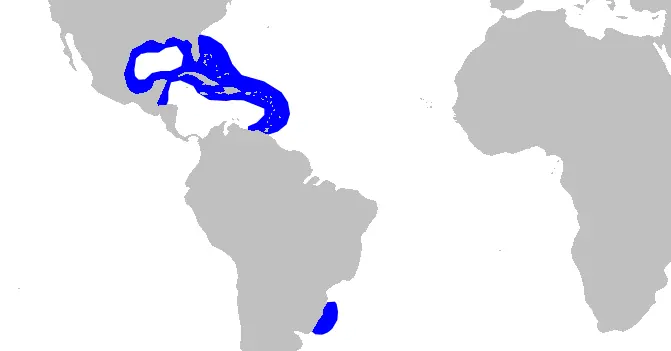
The Caribbean reef shark is a large requiem shark species found exclusively in the tropical western Atlantic.
Distribution
The best-known regions for sightings are the Bahamas (especially Grand Bahama Island and New Providence), the Virgin Islands, the Turks and Caicos Islands and Roatán in Honduras. Caribbean reef sharks are also regularly seen in Mexico (Yucatán), Belize, Cuba and off the Florida coast. A pronounced seasonal migration is not known; therefore, the animals can be encountered almost all year round. In some areas they are observed a little less often during the rainy season, but the differences are small.
Habitat
Encounters with the Caribbean reef shark often take place on the outer slopes of coral reefs, where the animals patrol at depths of 10–30 metres. They are particularly easy to observe in the Bahamas, the Greater and Lesser Antilles, and along Caribbean coasts of Central America. Because these sharks sometimes rest in caves, divers may also find them lying motionless on the seabed.
Lifestyle, diet & reproduction
Lifestyle
It infiltrates shallow areas, but normally lives around coral and also in caves, where it can lie motionless on the seabed and “sleep” for several hours. FishBase adds that the animals occur on continental and island shelves, often close to the drop-offs of the outer reef edges and mostly at depths below 30 m, but they can venture down to 65 m (according to other sources up to ~378 m).
Carcharhinus perezi shows a particular behaviour: it often rests motionless on the seabed or in caves. According to the Mexican fish portal, they often rest on the seabed or in caves – behaviour that is unusual for sharks – and they show strong site fidelity with limited migrations. In addition to daytime sleepiness, they are more active nocturnal hunters with keen hearing, sense of smell, taste and touch, as well as good eyesight. The ANGARI Foundation adds that Caribbean reef sharks can perceive low-frequency sounds in order to locate prey. They can also evert their stomach to clean it – a special adaptation.
Cleaning stations with small “cleaner fish” are visited regularly.
Diet
Scientific sources show a broad diet:
- Bony fish – FishBase names bigeye seabreams (Priacanthidae) as prey. The 4Ocean Foundation lists snappers and parrotfish as typical reef prey.
- Cephalopods – 4Ocean states that Caribbean reef sharks also eat squid and octopuses; the Mexican fish portal mentions “a variety of cephalopods” as food.
- Crustaceans and other cartilaginous fish – The ANGARI Foundation reports that the sharks eat reef fish, crabs and other cartilaginous fish, as well as occasionally southern stingrays and eagle rays.
These sharks are opportunistic hunters that hunt mainly at night. They patrol the reef edges and use camouflage and speed to surprise prey. Their pronounced sensory arsenal (smell, hearing, sight, taste, touch and electroreception) enables them to detect even weak signals from their prey.
Reproduction
The Caribbean reef shark is among the live-bearing sharks (viviparous). The females develop a yolk-sac placenta, through which they nourish the embryos.
- Litter size: 3-6 pups.
- Gestation and reproductive cycle: Gestation lasts about a year, with a two-year reproductive rhythm.
- Birth and sexual maturity: The pups measure about 70 cm at birth; males reach sexual maturity at 150-170 cm, females only at 200-300 cm.
- Mating and birthing sites: Females give birth to their young in shallow bays, coastal lagoons and sheltered areas of coral reefs. These “nursery areas” provide protection from predatory fish and an abundant food supply.
Mating is typical of requiem sharks, with the male grasping the female. The low population growth—long gestation periods and small litter sizes—makes the species vulnerable to overfishing. Bimini Shark Lab and Mexican‑Fish emphasise that the species produces offspring every two or three years and lives to a maximum of about 15 years.
Threats & conservation status
Overfishing and bycatch
The main reason for the drastic decline of the species is intensive fishing. Caribbean reef sharks are targeted for meat, fins, skin or liver oil and end up as bycatch in longline and gillnet fisheries. Many populations are also pressured by recreational fishing. A global study with over 22,000 hours of underwater video footage showed in 2023 that populations of five reef shark species, including the Caribbean reef shark, have declined worldwide by 60–73 %. In well-managed marine protected areas, stocks were stable in contrast. Earlier results from this study helped the IUCN to upgrade the Caribbean reef shark to “Vulnerable”.
Habitat loss
The destruction of coral reefs and seagrass meadows caused by climate change, pollution, coastal development and eutrophication reduces the sharks’ food supply and nursery grounds. The Nature Foundation Sint Maarten emphasises that in the Dutch Antilles the species recorded a population decline of 50–79 % over 29 years, mainly due to habitat degradation and overfishing. Warmer water, coral bleaching and marine pollution mean the sharks find less prey and retreat into deeper water.
Slow life cycle
The slow reproductive cycle (bi‑annually only a few pups) makes the species particularly vulnerable to overexploitation. ANGARI Foundation highlights that high catch rates combined with a low reproductive rate accelerate the decline in numbers. Sharks take years to reach sexual maturity; therefore, stock recovery takes a long time even when fishing bans are in place.
IUCN Red List
The International Union for Conservation of Nature (IUCN) upgraded Carcharhinus perezi in 2019 from “Vulnerable” to “Endangered”. The assessment in version 2025‑2 (as of 2026) justifies this status on the basis of a population decline of 50–79 % over three generations (around 29 years) as a result of high fishing mortality and habitat loss. The species was assessed under criterion A2bcd (decline despite unclear exact catch figures). Some older websites still list the species as “Near Threatened”, but this information is out of date.
CITES and international trade
At the CITES conference (CoP19) in 2022/23, the international community decided to include all species in the requiem shark family (Carcharhinidae), including the Caribbean reef shark, in Appendix II. This makes international trade in live animals, meat and fins subject to permits and it may only take place if it is sustainable. The listing came into force in November 2023 and is intended to curb global demand for shark products.
SPAW Protocol of the Cartagena Convention
The Netherlands and other Caribbean states applied in 2023/24 for the Caribbean reef shark to be listed in Annex III of the SPAW Protocol (Convention for the Protection and Sustainable Use of Caribbean Biodiversity). This annex obliges the contracting parties to take additional protective measures. The Nature Foundation Sint Maarten stresses that such a listing is necessary to stabilise stocks across the entire Caribbean region.
National and regional conservation measures
Bahamas – Shark Sanctuary (since 2011): In 2011, the Bahamas amended its fisheries laws and established the Atlantic’s first shark sanctuary. The regulation prohibits the fishing, possession, sale, import or export of sharks or shark products throughout the entire territory; only permitted research and the immediate release of accidentally caught sharks are allowed. Since the 1990s, the Bahamas has also benefited from a longline ban. Thanks to these regulations, the reef shark population remained stable, and shark tourism generates over US$ 110 million annually.
Belize – Protected areas and fishing bans: In Belize, in 2021, 2-nautical-mile no-take zones (3,885 km²) were established around the Lighthouse, Glover’s Reef and Turneffe atolls. The protection was developed jointly by fishers, scientists and authorities. In 2025, the NGO MarAlliance reported that Caribbean reef shark numbers at the protected atolls have reached more than three times the original stock. Further factors, such as the gillnet ban in force since 2020, contribute to the success.
Yarari Sanctuary (Dutch Caribbean): Since 2015, the Yarari Marine Mammal & Shark Sanctuary has existed between Bonaire and Saba; in 2018 it was extended to St. Eustatius. In 2024/25, protection was enshrined in a nature park regulation. The aim is to protect marine mammals, sharks and rays in territorial waters, establish further protected areas and restrict fishing activities. In 2019, the Netherlands adopted an international shark strategy to better manage its global territories.
Florida and the USA: In the United States, the Caribbean reef shark may not be fished in federal waters. The Florida Fish and Wildlife Conservation Commission has listed the shark as a prohibited species since 2026; it is forbidden to catch, possess, buy, sell or trade it. This applies to state and federal waters. In the USA, the trade in shark fins was also completely banned in 2022, which is intended to reduce the economic incentive to hunt.
Successful conservation examples and outlook
The drastic decline in stocks shows that conservation measures are urgently needed. On the positive side, stocks in well-managed protected areas remain stable or recover. In Belize, shark stocks have more than tripled after the establishment of no-take zones. In the Bahamas, populations are stable, and dive tourism generates significant revenue. However, studies in marine parks such as Man of War Shoal (St. Maarten) show that sharks often move to deeper areas and that existing protected areas need to be expanded.
The greatest challenges remain regulating coastal fishing, enforcing existing laws, and reducing environmental pressures. International trade controls (CITES Appendix II), regional agreements (SPAW), and national protected areas such as the Yarari‑Sanctuary provide important tools. In the long term, sustainable fisheries, marine protected areas, and environmental education can help ensure that the Caribbean reef shark is preserved as a “silent reef guardian”.
Profile
- First described:
- Max. size:
- Depth:
- Max. age:
- Max. weight:
- Water type:
- IUCN Status:
Taxonomy
- Kingdom:
- Phylum:
- Subphylum:
- Infraphylum:
- Parvphylum:
- Class:
- Subclass:
- Superorder:
- Order:
- Family:
- Genus:
Dive Centres




News

Trump pardons divers – after conviction for theft for freeing sharks
Fewer reef sharks in Caribbean coral reefs with high diving activity
Birth alert on the reef: satellite tag to find Caribbean reef shark nurseries
Sint Maarten: insular shelf recognized as important shark and ray area

Shark attack in Jamaica: British woman loses finger



Newsletter
Shark Alert in Your Inbox