


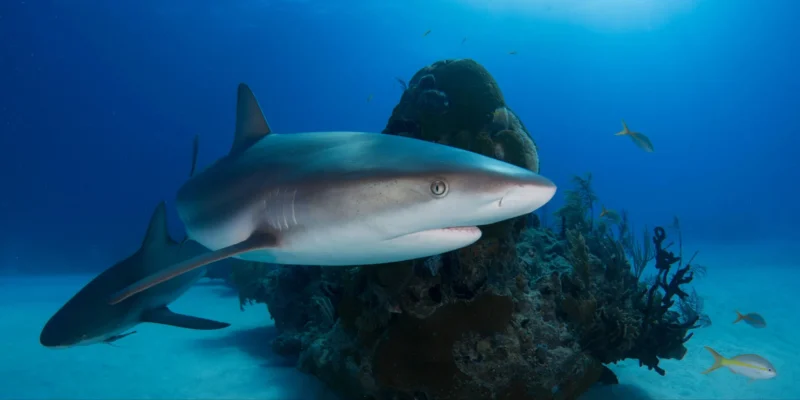
A recent study, published in “Journal of Applied Ecology” and led by Twan Stoffers of Wageningen University & Research, points to a decline of reef sharks in Caribbean coral reefs with intensive diving activity and strong coastal development.
The study was based on 995 underwater video recordings (BRUVs) made between 2012 and 2017 in seven different reef systems of the Dutch Antilles as well as the Saba Bank. While the Saba Bank, which is exposed to only minimal human disturbance, showed a natural distribution of sharks, presence in populated reef areas was strongly correlated with human activity.
Effects on different shark species and reef ecology
The results of the study indicate that Caribbean reef sharks (Carcharhinus perezi) in particular are more sensitive to human presence. This species is known to be susceptible to noise and disturbance. In contrast, bottom-dwelling nurse sharks (Ginglymostoma cirratum) and southern stingrays showed lower sensitivity to human activity.
Caribbean reef sharks play an important role in their ecosystem by maintaining species balance and promoting the health of coral reefs. Their absence can have far-reaching consequences for the entire reef community. Nurse sharks, on the other hand, are often more tolerant of disturbance, as they spend more time on the seabed and are less affected by surface activities.
The findings of the study suggest that even recreational activities often considered to be minimally disruptive can have an impact on shark populations. Twan Stoffers emphasised in this context: “This study shows that the protection of reef sharks must take into account not only fishing pressure but also non-extractive activities such as diving tourism and coastal development.” This requires a more comprehensive approach to conservation that goes beyond mere fishing restrictions.
