


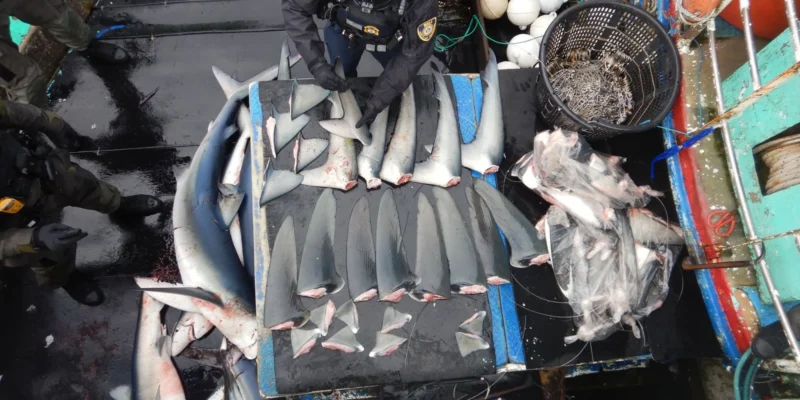
On the open waters of the North Pacific, countries jointly inspect fishing vessels operating far beyond national coastal waters. NOAA Fisheries reports that U.S. fisheries enforcement officers have completed their deployments for Operation North Pacific Guard 2026. They documented violations of international conservation and fisheries rules, including shark finning.
The enforcement officers traveled more than 8,000 nautical miles aboard the Canadian coast guard vessel Sir Wilfrid Laurier. That corresponds to over 14,800 kilometers. During the patrol, the international teams carried out dozens of checks and searches on fishing vessels.
Three types of violations at the center
According to NOAA, numerous violations of conservation and management measures were identified. They include Shark Finning, possession of endangered species and inaccurate or false information about the catch. The authority does not publish which species were affected and how many individual cases occurred in each category.
Shark Finning refers to the removal of the valuable fins, while the rest of the shark’s body is often not completely landed. This practice makes catch controls more difficult and can result in many more sharks being killed than can be estimated from the bodies landed.
False catch reports are less visible but just as problematic for management. Stock calculations, catch quotas and protective measures are based on the information provided by the fleets. If species, quantities or fishing locations are not reported correctly, a distorted picture of the actual fishing pressure is created.
High-seas inspections require international authority
Outside national territorial waters, no single state can control every ship at will. The teams therefore used powers from international agreements. The possible violations identified were confidentially forwarded to the flag states of the vessels concerned and to the relevant regional fisheries organizations.
The flag state is the country under whose flag a ship is registered. It has primary responsibility for further investigations and possible sanctions. Regional fisheries management organizations can also check whether common rules for catching, documentation or protected species have been violated.
NOAA therefore speaks of documented or possible violations, not of completed criminal proceedings. The report does not mention any fines imposed, arrests or final decisions. The vessel inspection provides evidence; the legal assessment follows through the relevant procedures.
Partners from five countries and multiple agencies
The operation involved the NOAA Office of Law Enforcement, Fisheries and Oceans Canada, the Canadian Coast Guard, the Royal Canadian Mounted Police and the US Coast Guard. The Fisheries Agency of Japan and the Korea Coast Guard also participated.
This composition is not a symbolic addition. High-seas fleets move over huge distances, change fishing areas and call at ports in different countries. Information from an inspection can therefore be relevant for several authorities, the flag state and international bodies at the same time.
According to authorities, NOAA inspectors contributed their specialized expertise in fisheries law, catch documents and the identification of protected species. The Canadian ship also provided the platform for the more than 8,000 nautical mile long patrol.
The photo documents an inventory—not a final judgment
The image published by NOAA shows an inspector taking inventory of shark fins on a foreign-flagged vessel. There are numerous severed fins and other parts of the catch on the deck. The photograph documents the inspection, but in itself does not allow any statement to be made as to which specific violation will later be legally confirmed.
The shark species cannot be determined with certainty from the recording. NOAA does not mention species names in the report. That’s why the article is not linked to a specific shark species and deliberately separates the visible catch from the legal classification that is still pending.
Illegal fishing harms nature and lawful businesses
Illegal, unreported and unregulated fishing is internationally referred to as IUU fishing. It can deplete stocks more quickly, exacerbate bycatch and species conservation problems and undermine the data basis for fishing regulations. The risk is particularly great on the high seas because controls are complex and the distances are enormous.
There is also an economic effect. Anyone who adheres to quotas, reporting requirements, protective regulations and guidelines for dealing with sharks bears costs. Illegal suppliers can circumvent these rules and bring their goods into the supply chain more cheaply. As a result, compliant fishing companies and traders fall behind.
NOAA therefore classifies the deployment as both a protective measure for marine resources and a contribution to fairer markets. The authority also points to the political mandate to keep illegally caught seafood out of supply chains and to protect the competitiveness of the lawful U.S. fishing industry.
High-seas patrols close a critical enforcement gap
Port inspections and trade controls remain important, but only begin after the catch. Patrols at sea can compare fishing gear, species, quantities and documents directly where the fishing takes place. This preserves evidence before the catch is sorted, reloaded or fed into international supply chains.
The current report also shows the limits of public information. NOAA reports a long patrol, dozens of inspections and multiple types of violations, but keeps details of vessels and ongoing investigations confidential. Flag states and fisheries organizations will now decide whether the findings result in sanctions.
For shark conservation, the key point is that finning and unreported catches must not be prohibited only on paper. Inspections, evidence gathering and cross-border cooperation are what make rules enforceable on the remote high seas.