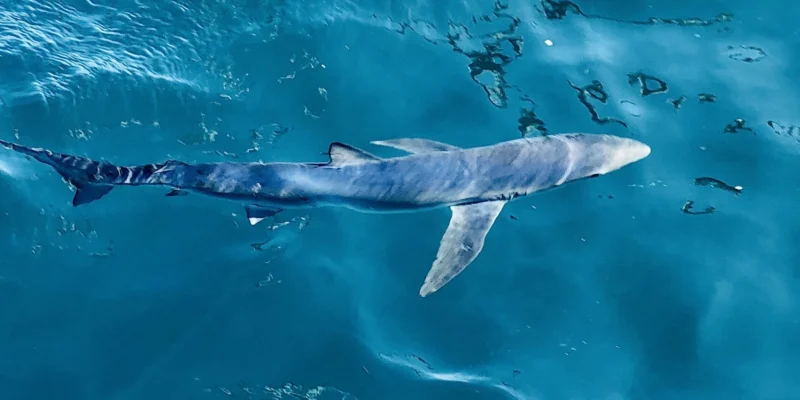
Changes in the composition of large marine fish are becoming apparent in the waters off southwest England and around the Channel Islands. BBC reports that some shark species are observed more frequently or further north. Researchers do not attribute this to a single factor: warmer water changes habitats, while prey fish shift their distribution and migration times.
For the United Kingdom, this does not mean that tropical species or species that are particularly dangerous to humans will suddenly live off the coast permanently. Rather, well-known species may use new routes, arrive earlier or temporarily appear in regions where they have been recorded less frequently. Individual sightings are indications, but not proof of a long-term population trend.
The large sighting off Jersey remains unidentified
The sighting that drew the current attention occurred off Jersey. After a dark gray shark estimated to be three to 3.7 meters long was reported off a beach on Saturday, lifeguards urged people to leave the water. However, there is no confirmed species identification.
The marine researcher Bryce Stewart told the BBC that several species were possible, including basking shark, blue shark, porbeagle shark and smalltooth sand tiger shark. This list is not an identification. Without sufficiently clear images of body shape, fins, coloration and swimming movement, the species should therefore remain unidentified.
Alex Plaster from Jersey’s marine resources team pointed to rare observations of larger species such as shortfin mako, porbeagle shark and blue shark. He described the risk of a bite in the region as practically zero. According to him, there is no known case of a person being bitten by a shark in the entire English Channel.
Over the past 100 years, 14 shark species have been documented in Jersey’s waters. Many of them remain small; however, larger species also occasionally appear. Biodiversity is therefore not new. The frequency, season and migration route of individual species may be new or at least more visible.
Warmer water shifts more than boundaries
Sharks don’t just react to water temperature. Where their prey occurs is also crucial. When fish and cephalopods move to cooler areas or at different times of the year, mobile predators can follow them over long distances. Warmer winters can also cause species to stay in more northerly waters longer.
In addition to sharks, Stewart also cites sea bream, rays and Atlantic bluefin tuna as examples of changes in the regional species range. The significant increase in bluefin tuna off southwest England has been linked to changing migration routes and relationships between predators and prey.
Whether a shark species is actually becoming more common cannot be determined from reports on beaches alone. To do this, observation effort, catch data, electronic tags, sex, body size, season and water temperature must be evaluated together. More cameras and more people on the water can also increase the number of reported sightings.
Three shark species in a new research project
Since July 2026, a new University of Exeter research project has been surveying three species in English waters: blue sharks (Prionace glauca), porbeagles (Lamna nasus) and tope sharks (Galeorhinus galeus). The project, which runs until March 2029, is financed by Natural England and is intended to better record migration routes, areas used repeatedly, reproductive areas and the conservation status.
75 electronic tags are planned, including satellite transmitters with a lifespan of up to two years. In addition, non-invasive ultrasound examinations are intended to detect pregnant females. The team wants to use this to locate possible pupping and nursery areas without having to take blood samples for the examination.
The data is merged with historical catch records and the knowledge of experienced anglers. Single snapshots are not enough, especially for species that travel large distances in the eastern North Atlantic. Only repeated position data can show whether migration corridors are permanently shifting or just fluctuate from year to year.
Blue sharks: a plausible but unconfirmed pupping hypothesis
The sex distribution of blue sharks off southwest England is particularly interesting. According to Stewart, almost all of the animals observed there are females, many possibly pregnant. One hypothesis is that they move to peripheral areas during pregnancy to gain distance from males, and may give birth off the southwest English coast.
This explanation is not yet a confirmed description of a nursery area. To do this, pregnancy, length of stay, births and repeated use of the same region would have to be proven. This is exactly where ultrasound, satellite telemetry and long-term observation series can test the hypothesis.
What sightings mean for swimmers and divers
A large dorsal fin is not a reliable indication of a dangerous species. If the sighting is unclear, it is still appropriate to follow the lifeguards’ instructions, leave the water calmly and keep your distance. The animal should not be pursued or circled for photos or videos.
The changes off southwest England are therefore primarily a research question: Which species appear when, where do their prey move and which areas are important for reproduction and birth? The answers will come not from one spectacular sighting, but from several years of systematic data.