


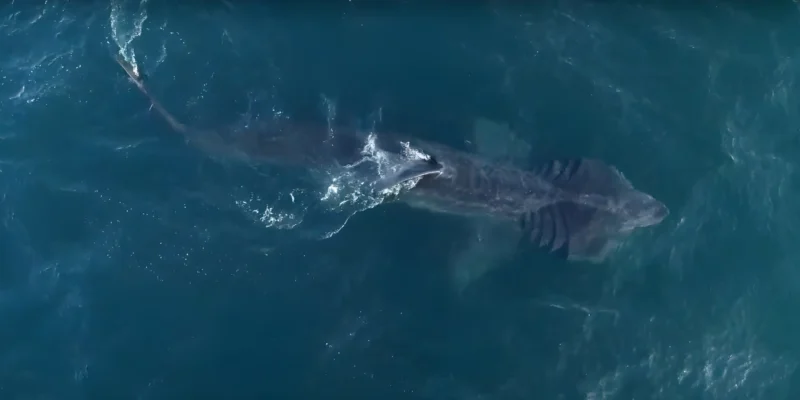
Basking sharks do not gather only where food is abundant. A new modelling study from Ireland suggests that attraction to other sharks also plays a part. Combining both influences reproduced observed aggregations better than foraging, social attraction or random movement alone.
The team led by Chelsea Gray investigated movements around the Inishowen Peninsula in County Donegal. Published on 1 October 2026, the paper describes a first individual-based model for the basking shark: individual simulated animals move according to set rules in a computer. Their decisions give rise to larger distribution patterns.
Comparing four explanations
The researchers compared four variants. In one, sharks sought only food; in a second, they sought other sharks. A third combined both behaviours, while a fourth let the animals move randomly. Public sightings reported to the Irish Basking Shark Group and the Irish Whale and Dolphin Group between 1982 and 2018 provided the comparison data.
There were 458 sighting reports for the modelled region, including 210 involving at least two animals. The simulation was restricted to April through October and the upper ten metres of water. These limits reflect the fact that people mainly report sharks at the surface. They do not describe the species’ entire habitat.
Food and attraction to other sharks work together
Overall, the combined model best matched the timing patterns and group sizes in the sightings data. Foraging alone also produced aggregations, but reproduced the observed patterns less well. Social attraction without shared environmental cues and random movement produced particularly unrealistic results.
The work therefore supports the idea that food availability and social interactions should be considered together. It does not, however, prove friendships between particular animals or establish that every group forms for reproduction. The simulated sharks did not differ in age, sex or body size.
Many gaps in the data limit the conclusions
Zooplankton is an important source of uncertainty. Samples were missing from the plankton dataset for 79 per cent of the days considered; intermediate values were calculated to fill the gaps. The small-scale distribution of food was not measured directly either. In the model, it was redistributed each day.
Voluntary sighting reports are also not systematically conducted population surveys. More reports may simply mean that more people are watching or that observations are easier to submit. Reporting frequency alone therefore cannot establish a reliable population trend.
A research tool, not yet a prediction map
The model aims to explain possible processes. It cannot currently predict reliably where a group will gather tomorrow. Better data on food and behaviour could eventually help identify temporarily important habitats more precisely and take risks from boat traffic into account.
Two perspectives help put this into context: our report on aggregations in Donegal Bay describes specific coastal observations. Research on basking sharks in the deep sea, by contrast, shows how much of their lives takes place below the visible surface. The new model complements this work with a tool for testing explanations of behaviour.