


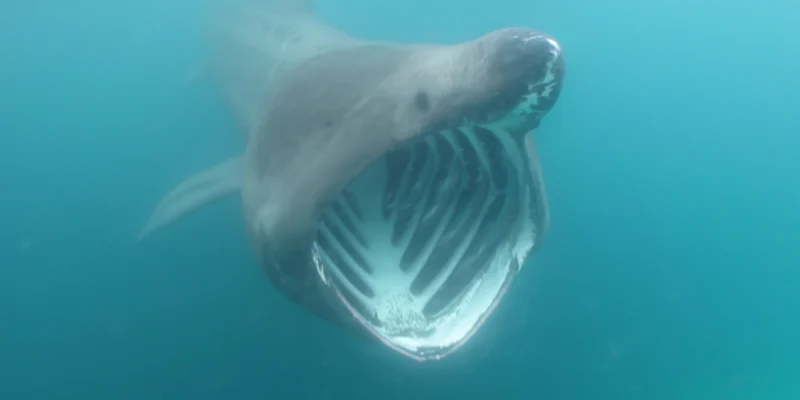
Unusually large numbers of basking sharks have been observed in recent days off Mullaghmore Head in County Sligo and in Donegal Bay. Local reports describe dozens of animals feeding close to shore, travelling in groups and sometimes breaching clear of the water.
The report by Donegal Daily describes the sightings as a rare concentration. Donegal Bay Conservation Trust especially highlights the nearshore activity around Mullaghmore Head: for many people, the sharks were visible from land or from boats without anyone having to search for them.
Basking sharks look spectacular because of their size, but they are not hunters of people. Cetorhinus maximus is the second-largest fish in the world after the whale shark and filters plankton from the water. When the animals move at the surface with their mouths wide open, they are following productive water masses with food, not swimmers or fish.
Why Donegal Bay stands out now
Ireland’s Atlantic coast is one of Europe’s most important seasonal basking-shark areas. In spring and early summer, wind, currents and plankton blooms can bring the sharks very close to shore. Those conditions can temporarily turn bays, headlands and current edges into observation points.
What stands out is not only the number of animals, but also their behaviour. Several sharks were seen feeding close to shore, while others moved through the bay in groups. Breaching was also reported. Why basking sharks breach is not fully resolved; communication, parasite removal and social behaviour are among the explanations discussed.
Gentle giants, not scenery
For divers, boat crews and coastal visitors, an aggregation like this is an exceptional wildlife moment. At the same time, it is a good reminder to keep distance: basking sharks should not be chased, circled, touched or forced to change course. Good observation means letting the animals choose direction and distance.
Ireland officially listed the basking shark as a protected wild animal under the Wildlife Act in 2022. The protection is more than symbolic: the species is globally threatened, and Irish waters are described as an internationally important area for basking sharks.
Why every sighting counts
The current concentration is also scientifically valuable. Basking sharks are huge, but their migrations, residence times and key feeding sites are still not fully understood. Sighting series help reveal seasonal patterns and make sensitive areas more visible in conservation and marine planning.
The Irish Basking Shark Group explains that sighting data are pooled with the National Biodiversity Data Centre and the Irish Whale and Dolphin Group in a national database. Such reports can later support research, environmental assessments and conservation decisions.
Hotspot, not shark alarm
The Donegal Bay story is therefore not a shark alarm, but a strong sign of a functioning coastal ecosystem. Where basking sharks feed in large numbers, enough plankton is present, and the animals find the conditions they need for a short window of time.
For Ireland, this fits into a larger picture: the west coast is not just a backdrop for spectacular wildlife moments, but real habitat for migratory large fish. Donegal Bay and Mullaghmore show why basking-shark protection needs both respectful encounters on site and long-term data collection over many years.
