


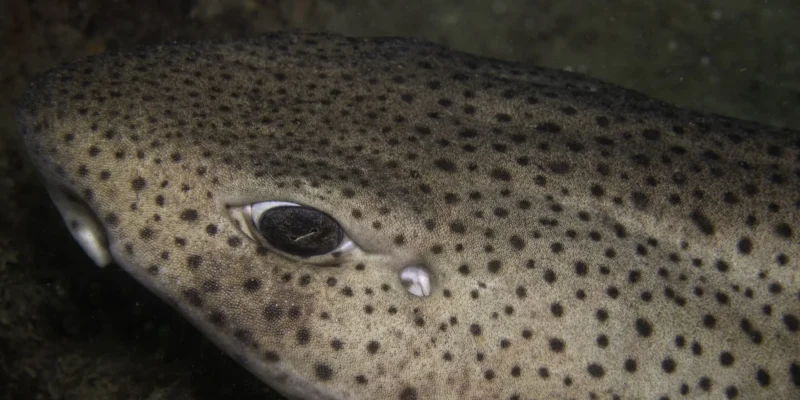
A nursehound, also known as the large-spotted catshark (Scyliorhinus stellaris), has been documented showing an unusual threat-like display toward a human snorkeller in Cornwall. The observation is described in a new scientific note listed by PubMed and available via ResearchGate.
For shark reporting, the important point is context. This was not an attack story. It was a close-range behavioural observation of a normally harmless, bottom-living shark reacting to a person in its immediate space.
What was observed
The described animal was a female nursehound in shallow Cornish water. As the snorkeller approached, the shark showed a posture interpreted as agonistic or threat-like: lowered pectoral fins, an arched body, jaw-gaping and repeated turning toward the person.
Those signals matter because they suggest the shark was communicating discomfort or defence. The animal did not become a predator looking for prey. It behaved more like a wild animal trying to create distance when approached too closely.
Nursehounds are often seen resting on or near the seabed, especially around rocky and structurally rich habitat. If a snorkeller or diver blocks the animal’s route or hovers too close, a defensive display can be a way to warn before retreating.
Why this is useful science
Single observations do not rewrite shark behaviour, but they can add detail where formal records are scarce. Small coastal sharks are familiar to divers in Europe, yet their body language around people is still less documented than their distribution or diet.
The Cornwall case gives researchers a clear behavioural sequence to compare with other catshark and elasmobranch responses. It also helps separate defensive signalling from the sensational language often used around sharks.
That distinction is valuable for public communication. A threat display is not a sign that nursehounds are dangerous. It is a reminder that even harmless sharks are not props, and that their signals deserve space.
What snorkellers and divers can learn
The practical lesson is simple: slow down, keep distance and avoid boxing a shark in. If a shark turns repeatedly toward you, arches, gapes its jaws or seems unwilling to settle, the respectful response is to back away calmly.
Good documentation can still be useful, especially when it includes location, time, behaviour and species identification. But the animal should not be chased for footage. A short, steady record from a respectful distance is more valuable than a stressful close-up.
For nursehounds in particular, divers should watch the seafloor and avoid placing cameras or fins directly in front of the animal’s head. A quiet exit route often makes the encounter calm again.
Not alarm, but respect
The Cornwall observation is interesting precisely because it is modest. It shows a local shark responding to a local situation, not a monster narrative. That is the kind of detail that makes shark education better.
For dive communities, the story is a useful bridge between fascination and etiquette. Sharks can be approachable in the sense that they are observable, but that does not mean they want to be approached.
Seen this way, the nursehound’s display is less a warning about sharks than a lesson in how to share coastal water well: observe, leave room, and let the animal decide when the encounter is over.
