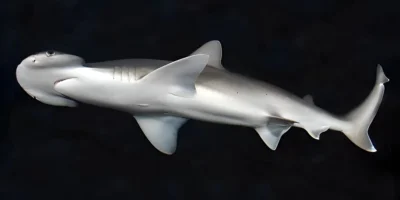
The unusually broad head of hammerhead sharks serves several functions: It carries sensory organs, affects water flow around the body and may aid maneuvering. The bonnethead shark (Sphyrna tiburo) presents another puzzle. Males and females have differently shaped heads. A new study from Florida tested whether their diet explains those differences.
The result is an important negative finding: The researchers found no connection between the gender-specific head shapes and the nutritional patterns recorded with stable isotopes. At the same time, the work corrects an older idea of the development of the head. It is not only adult males that form a tip. Rather, young animals of both sexes begin with a more pointed head shape and become rounder as they mature.
144 sharks from two Florida bays
The team examined a total of 144 shovelnose hammerhead sharks from May 2022 to May 2023. 105 animals came from the Biscayne Bay on Florida’s Atlantic coast, another 39 from the Tampa Bay area on the Gulf of Mexico. The two bays lie on opposite sides of the peninsula and differ in their environmental conditions. This made it possible to check whether the same pattern occurs in two regional groups.
After the catch, the body and head were measured. Immediately before release, the researchers photographed the top and bottom of the head on a grid board. The recordings were then evaluated using the ImageJ software. Instead of just judging the shape with the eye, the team was able to describe the curvature of the front edge of the head mathematically as a parabola and compare it between gender, stage of maturity and location. The Original illustration 2 shows the grid board and the measuring points set.
This method is quick and comparatively less invasive. It provides standardized images while the animals can be released after the brief scientific examination. This is particularly useful for a species with regional differences because the same procedure can be used in other parts of the distribution area in the future.
Heads become rounder in both sexes
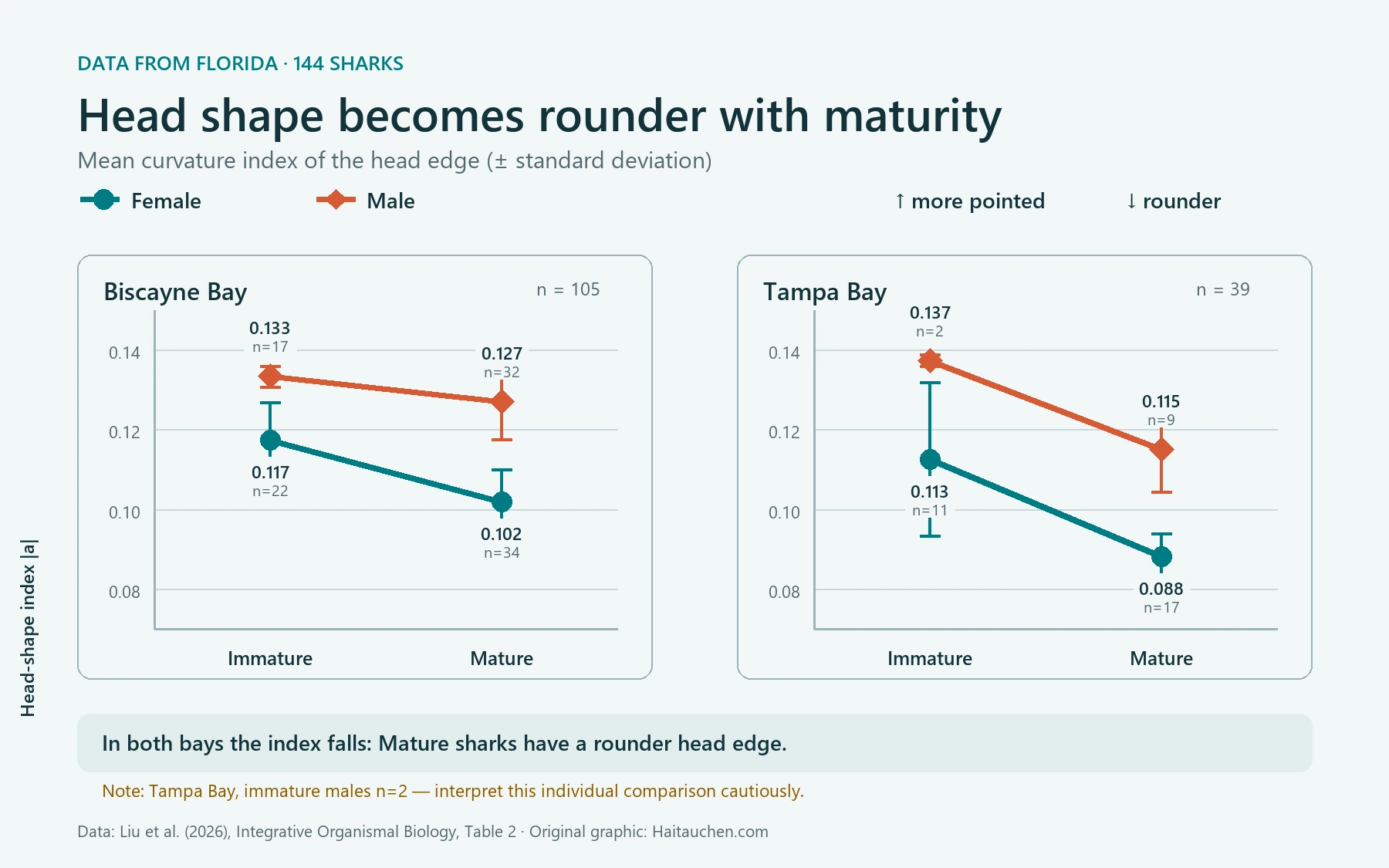
In both pens, the head shapes of males and females differed significantly. Males retained a more pronounced protrusion on the leading edge, while females’ heads were more evenly rounded. However, the direction of development is crucial: in both sexes, mature animals were rounder than immature ones. A direct photo comparison is shown in Original figure 5 of the study.
The change was more pronounced in females. This means that the difference between the sexes becomes visible as they grow, but differently than previously assumed. According to the new data, the tip does not arise as a secondary sexual characteristic of mature males. It is already more pronounced in young males and females and declines to varying degrees over the course of development.
The means from both bays make the trend visible: Mature sharks have a lower curvature index, indicating a rounder front edge of the head.
Why the heads are drifting apart remains an open question. The study reliably shows how the shape changes in the two groups examined. However, it shows neither a mating advantage nor a specific function of the male advantage. The finding limits possible explanations, but does not replace them with a new, proven cause.
Isotopes reveal the longer-term diet
To study the diet, the team analyzed muscle samples from 137 animals for stable carbon and nitrogen isotopes. Such chemical signatures reflect from which food web an animal gets its energy and at which trophic level it eats. Muscle tissue integrates information over many months and thus supplements stomach contents, which are primarily shown during the last meals.
Shovelnose hammerhead sharks are uncommon among sharks. In addition to crabs, shrimps, molluscs and small fish, they can also digest seaweed. However, the isotope values in this study do not indicate that the animals examined were particularly dependent on seaweed. Seagrass and macroalgae were nevertheless observed in some sharks during field work. How much plant food was actually used cannot be determined with certainty.
Two food webs, but no explanation for head shape
The isotope values differed significantly between Biscayne Bay and Tampa Bay. First of all, this means that the sharks obtained energy from food webs with different initial chemical signatures. It doesn’t prove that they ate completely different types of prey. Even the same prey can have different isotope values in two ecosystems, due to local nutrient sources and human influences.
Within the pens, the nutritional niches of males and females overlapped. In addition, the isotope signatures changed regionally with growth, without being parallel to the head shape. It is precisely this lack of common change that speaks against the assumption that different foods or different trophic roles are the most important trigger of the sex difference.
This is not a definitive refutation of every possible influence of food intake. Isotopes show where nutrients come from, but not how a shark tracks down, holds onto or breaks down individual prey. Differences in feeding mechanics could therefore exist without becoming visible in the measured isotope values. However, the work found no support for the tested hypothesis.
Does a pointed head help young sharks swim?
As the next approach, the authors propose a hydrodynamic explanation. Smaller, young sharks could benefit from a more pointed head shape when swimming. Larger females may outgrow this advantage as their body size increases for reproduction and gestation. This is a new working hypothesis and not yet a proven mechanism.
In order to test them, future studies would have to record the shape of the head, body structure, pectoral fins and swimming movements together. Embryos could also show a crucial phase: in them, the front edge of the head is even more pointed. A comparison by gender could clarify when the different growth patterns first begin.
What the study still cannot answer
The sample was unevenly distributed between pens and animals were captured using different capture methods. In Biscayne Bay scientific longlines were used, in Tampa Bay predominantly a scientific gill net. Such devices can capture different size classes with varying degrees of success. Very young animals in particular were not represented in sufficient numbers.
In addition, the field work only lasted one year. The results convincingly describe the animals captured from these two bays, but cannot automatically be transferred to the entire distribution area. Shovelnose hammerhead sharks live on both coasts of the Americas, and regional groups can differ genetically, ecologically, and physically.
Narrowing down an open question
Especially a negative result can advance research. Diet was an obvious explanation because shovelnose hammerhead sharks eat an unusually wide range of animal and plant foods. The combination of head photos and isotope samples from the same individuals now shows that diet and shape do not vary together.
This means that the gender-specific head shape remains unique, but somewhat better understood: both genders start out more pointed, both become more rounded, and females change more. Swimming experiments, developmental biology and studies of other populations must clarify what forces are behind this growth. The mystery has not been solved – but the number of plausible explanations has become smaller.