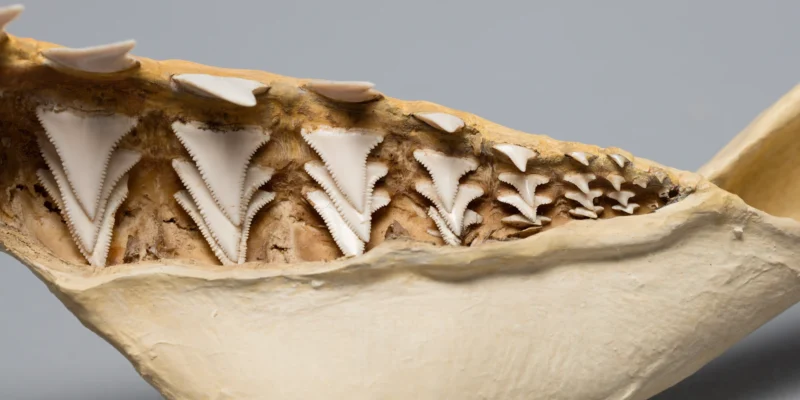
A single tooth in a Portuguese museum collection tells of great white sharks in the Atlantic around 3.5 million years ago. The fossil was long assigned to megalodon. In their 2010 study, however, Miguel Telles Antunes and Ausenda Cáceres Balbino identified it as a great white shark tooth (Carcharodon carcharias). They thus described the first fossil record of this species then recognised in Portugal.
From a well excavation to a museum collection
The tooth comes from Matos, about one and a half kilometres southeast of Marinha Grande in western Portugal. It was found while a well was being dug and reached the University of Coimbra along with other fossils. It was already mentioned in 1941 as Carcharodon megalodon, the name used for megalodon at that time.
Decades later, Pedro Callapez located the specimen in the Coimbra collection for re-examination. It bears collection number 496. The 2010 publication therefore concerns the reidentification of a long-known find.
What identifies the tooth as a great white shark
Antunes and Balbino identified the fossil as a lateral tooth from the right upper jaw. Their identification rests in part on its relatively flat, thin shape, irregular cutting-edge serrations and flat root. It also lacks a clearly defined, depressed zone at the base of the crown on the tongue-facing side, a feature typical of megalodon teeth.
The crown is 31.3 millimetres high and 33.2 millimetres wide. By comparison with a great white of known length, the researchers estimated the animal’s total length at about four metres. This estimate is derived from the tooth; no associated skeleton is available. They interpreted wear and small chips along the cutting edges as signs that the tooth had been shed after use.
Evidence from the Pliocene
The fossil-bearing sands and conglomerates formed when the sea covered parts of what is now dry land. Using associated mollusc fossils and calcareous microfossils, the study assigned the deposits to the late Zanclean to early Piacenzian. These stages belong to the Pliocene; the authors give an approximate age of 3.5 million years. The tooth itself was not radiometrically dated.
The find adds to the picture of the great white shark’s former distribution in the eastern Atlantic. It shows that the species inhabited the waters of present-day Portugal during the Pliocene. It cannot establish when the species first arrived: the first recognised fossil record need not mark the actual beginning of its presence.
What one tooth cannot reveal
As informative as the reidentification is for documenting the species, it tells us little about its population at the time. One tooth cannot show how common great whites were in the region. Above all, the find illustrates the value of scientific collections: re-examining a fossil stored for decades can extend a species’ known distribution.