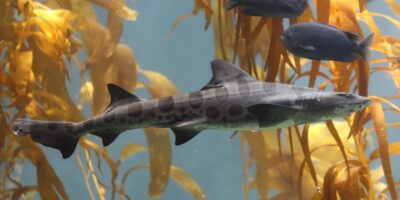
The well-known summer shark aggregation off La Jolla Shores became visible earlier than usual in 2026. NBC 7 San Diego reports that as coastal waters warm, leopard sharks are returning to the shallows off San Diego. For swimmers and snorkelers, this marks the start of one of Southern California’s most unusual wildlife encounters.
The early return fits with what researchers know about these animals: water temperature, calm conditions and the time of day influence when the sharks gather close to land. However, it is not yet proof that the entire migration has permanently shifted. This would require comparable observations over many years.
Why leopard sharks gather off La Jolla
Every summer, leopard sharks (Triakis semifasciata) enter the sheltered, sandy shallows at the southern end of La Jolla Shores. Their dark saddle markings and spots stand out along the back. Adults are generally about 1.2 to 1.5 meters long and feed mainly on or near the seafloor.
The group consists almost entirely of large females, most of which are pregnant. During the day they stay in very shallow water warmed by the sun. At night, individual animals continue to swim towards the nearby underwater canyon, where they hunt, among other things, squid.
La Jolla combines several favorable characteristics in a small area: a quiet stretch of beach, sandy bottom, warm surface water and rich feeding areas in deeper water. In addition, the well-known assembly point is in a protected coastal area.
Warm water acts like an incubator
Leopard sharks are ectothermic. Their body temperature largely follows that of the surrounding water. Pregnant females can therefore benefit from warmer areas: a higher body temperature can accelerate embryonic development and shorten the long gestation period.
Research by Scripps Institution of Oceanography shows that females stay particularly close to the coast during the day and use the warmest shallow waters. The number of animals present is typically greatest in the afternoon, when the water reaches its highest temperature of the day. Animals that had been tracked for several years also repeatedly returned to the same stretch of coast.
The term “nursery area” can be misleading here. Pregnant females primarily use La Jolla to regulate their body temperature during gestation. The aggregation does not automatically mean that every shark gives birth or mates there.
What the early 2026 season tells us—and what it does not
If the water warms sooner, suitable conditions may emerge earlier in the year. This provides a plausible immediate explanation for the observations from 2026. However, visibility, waves and the number of people in the water also influence how early a gathering is even noticed.
A single year cannot therefore be directly translated into a climate trend. A reliable statement would require long-term series on arrivals, number of sharks, water temperature and local sea conditions. The early start is initially a striking seasonal signal – not a ready diagnosis of the consequences of climate change.
At the same time, the event shows how quickly ectothermic marine animals can respond to temperature changes. If warm periods shift over the long term, the sharks’ length of stay, the timing of the aggregation and their distribution along the California coast could change as well. Whether that is already happening requires systematic study.
Snorkeling among peaceful bottom-dwelling sharks
Leopard sharks are considered shy and harmless towards humans. They search the bottom for crabs, mussels, fish and other small prey. The fact that many sharks are swimming in shallow water at the same time is not a warning signal and is usually not a reason for a beach closure.
For a quiet encounter, snorkelers should keep their distance, swim slowly and not cut off the animals’ path. Touching, following or circling them for a photo puts unnecessary strain on the sharks – especially because they are predominantly pregnant females. The sandy soil should also be disturbed as little as possible.
The animals can often be recognized from the surface at shallow depths. However, good visibility depends heavily on wind and waves. Anyone who goes into the water should heed local advice from lifeguards and realistically assess their own swimming abilities.
A return that is more than a spectacle
La Jolla’s leopard sharks show how important small, protected stretches of coastline can be for migratory animals. Shallow water a few hundred meters wide offers warmth and peace, while the nearby canyon provides food. If one of these building blocks is lost, the place loses part of its special function.
In 2026, this natural spectacle appears to be starting earlier. The decisive factor will be whether researchers and local observers document the point in time uniformly in the future. It would then be possible to distinguish whether La Jolla is simply experiencing an unusually warm year – or whether the seasonal rhythm of the leopard sharks is actually shifting.