


Leopard shark - Triakis semifasciata
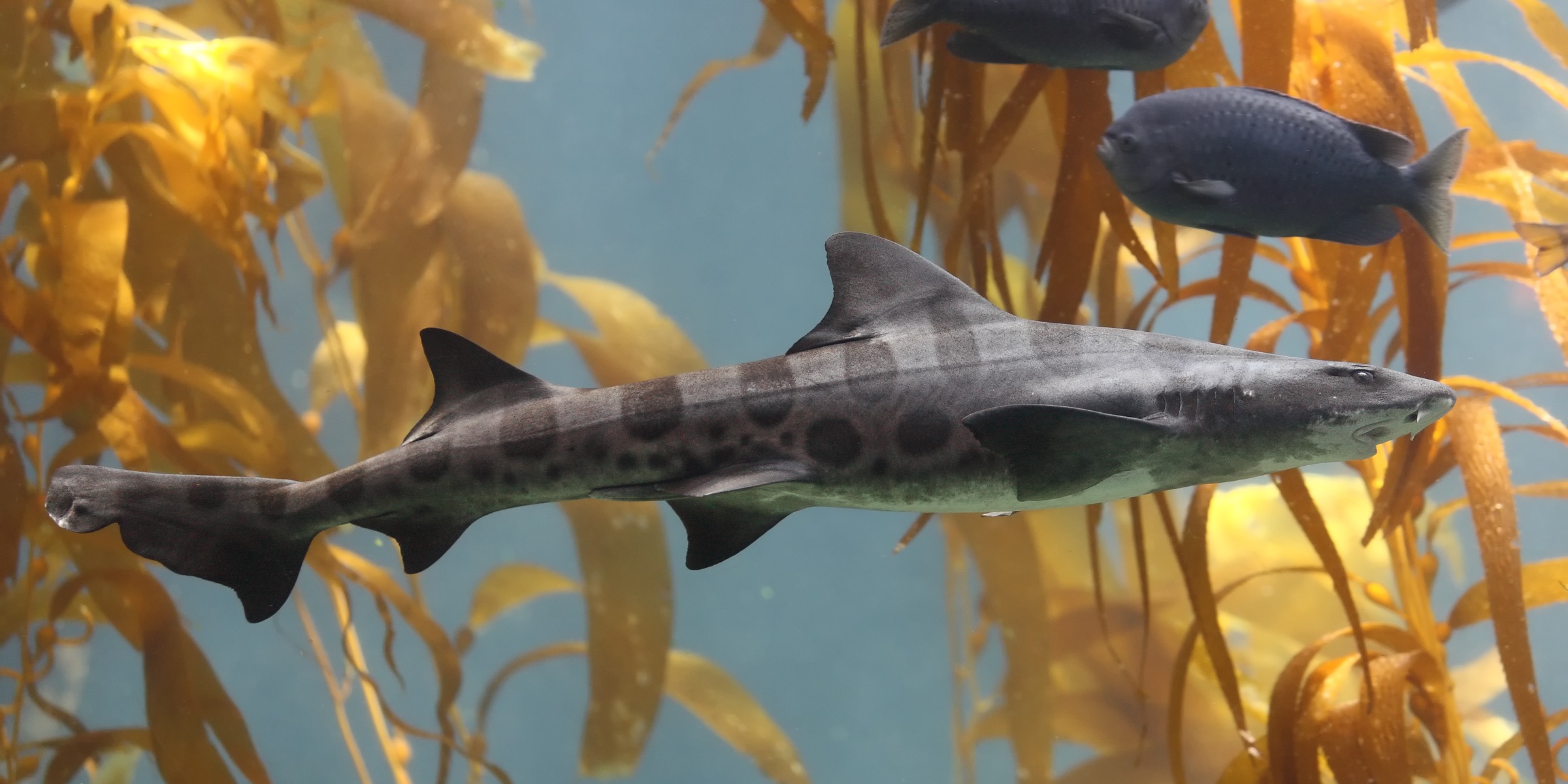
Body structure, features & anatomy
The leopard shark Triakis semifasciata is a slender houndshark in the family Triakidae. WoRMS treats the name as valid; on Haitauchen it is placed within Selachii, Galeomorphi, Carcharhiniformes and the genus Triakis.
Shark-References traces the original description to Girard in 1855. The scientific and common names fit the animal well: dark saddles, spots and dots lie across a grey to bronze-silver back, while the underside stays pale.
Pattern and body shape
The shark has a short rounded snout, a small mouth, broad pectoral fins and a long upper tail lobe. Large adults may approach two metres, but many animals seen by snorkellers and divers are smaller.
Identification should use the whole combination of shallow coastal habitat, slim body and leopard-like markings. It is a houndshark, not a small tiger shark, and its teeth are suited to small bottom prey rather than large animals.
Distribution & habitat
FishBase describes an eastern Pacific range from Oregon to the Gulf of California. On Haitauchen the species is therefore linked to the USA and Mexico, with many well-known encounters in California bays.
Leopard sharks use shallow sandy bays, lagoons, estuaries, eelgrass and kelp edges, mud flats and rocky reef margins. They can enter brackish water and often move with the tide between channels and feeding flats.
Shallow bays and kelp edges
Many sightings happen in only a few metres of water, even though deeper records exist. For divers and snorkellers, the important point is the right coastal setting rather than maximum depth.
No range map is inserted here. The text description is more useful for this public page because actual encounters depend strongly on local bays, seasons, visibility, temperature, tide and protected areas.
Life history, diet & reproduction
Leopard sharks are active but usually calm coastal sharks. California Sea Grant describes groups in shallow bays, tidal movements and aggregations that may sort by size or sex.
Their food comes mostly from the seafloor or just above it: crabs, shrimp, clams, worms, small bony fishes, fish eggs and other small animals. The mouth is built for picking, crushing and working small bottom prey.
Tidal foraging and live birth
The species is live-bearing without a placenta. Young develop inside the mother and are born free-swimming, with spring to early-summer births described in California and litter size varying with the female.
Females mature later than males and use shallow nursery areas for young. That slow, coastal life history makes healthy bays and quiet shallow-water refuges more important than the global status alone suggests.
Threats & conservation status
IUCN Red List lists Triakis semifasciata globally as Least Concern. That is a relatively reassuring status, but it should not be read as a guarantee that every local bay is stable.
The main conservation questions are local: recreational and commercial fishing, bycatch, disturbance of shallow aggregations, loss of eelgrass and estuary habitat, water quality and contaminants.
Local pressure matters
Leopard sharks are visible and reachable in places where many people also fish, boat, swim and snorkel. Repeated pressure on the same bays can matter even when the overall population is not considered threatened.
Useful protection is practical: sensible catch limits, careful release, respect for nursery areas, clean coastal water and visitor behaviour that does not chase or crowd resting or aggregating sharks.
Leopard shark & humans
For people, the leopard shark is a quiet and normally harmless coastal shark. The Florida Museum describes it as a familiar species for aquariums, research, observation and fisheries.
Its popularity comes from clear shallow encounters, especially where groups gather in warm bays. That accessibility is also the reason good behaviour matters: many observers can quickly turn a calm sighting into a disturbance.
Responsible observation
Divers and snorkellers should approach slowly, stay to the side, avoid blocking escape routes and never touch, chase, feed or circle the animals. Nursery areas and large aggregations deserve extra distance.
Food use also needs local caution because coastal sharks can accumulate contaminants. For Haitauchen, the leopard shark is best treated as a patient observation species rather than a staged attraction.
Profile
- First described:
- Max. size:
- Depth:
- Max. age:
- Max. weight:
- Water type:
- IUCN Status:
Taxonomy
- Kingdom:
- Phylum:
- Subphylum:
- Infraphylum:
- Parvphylum:
- Class:
- Subclass:
- Superorder:
- Order:
- Family:
- Genus:
News

Newsletter
Shark Alert in Your Inbox