


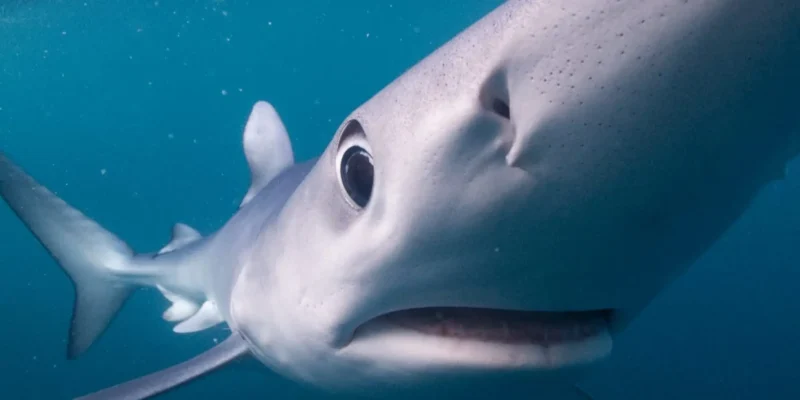
In the Azores, the same shark is valuable in two very different ways: alive as a wildlife encounter for divers and caught as a commodity of high-seas fishing. A new study in Marine Policy traces how this created a conflict over blue sharks and shortfin makos in the North Atlantic.
The result is more nuanced than the simple tourism versus fishing formula. With the shortfin makos, the authors recognize a clear signal that corresponds to the consequences of overfishing. For blue sharks the picture is changeable. They did not find any demonstrable economic downturn in the diving industry due to deep-sea fishing for the period from 2011 to 2022.
How the study investigates the conflict
Björn Eriksson from Uppsala University and Wendell Medeiros-Leal from the University of the Azores combined several types of evidence. They evaluated reported catches from 1993 to 2022, stock assessments and policy decisions. In addition, they reconstructed the development of shark diving on the islands using so-called Process Tracing.
In the summer of 2022, they held discussions with 11 diving companies: three on São Miguel and four each on Faial and Pico. There were also four specialist interviews with marine biologists and regional shark experts. The conversations lasted between 15 and 60 minutes and covered, among other things, sightings, economic importance and perceived threats to the sharks.
The work thus combines hard catch statistics with the experiences of people who regularly go to see the sharks. However, the two types of data answer different questions: catch amounts show pressure across the North Atlantic, while the interviews describe changes at individual dive sites.
Blue sharks: high catches, but no simple collapse
For blue sharks (Prionace glauca), reported North Atlantic catches rose sharply from 2004. For several years from 2010 onward they remained at roughly 38,000 to 40,000 tonnes; in 2016 they reached 43,622 tonnes, the highest value in the series examined. The Spanish fleet accounted for a large share during this period and reported just over 30,000 tonnes in 2016.
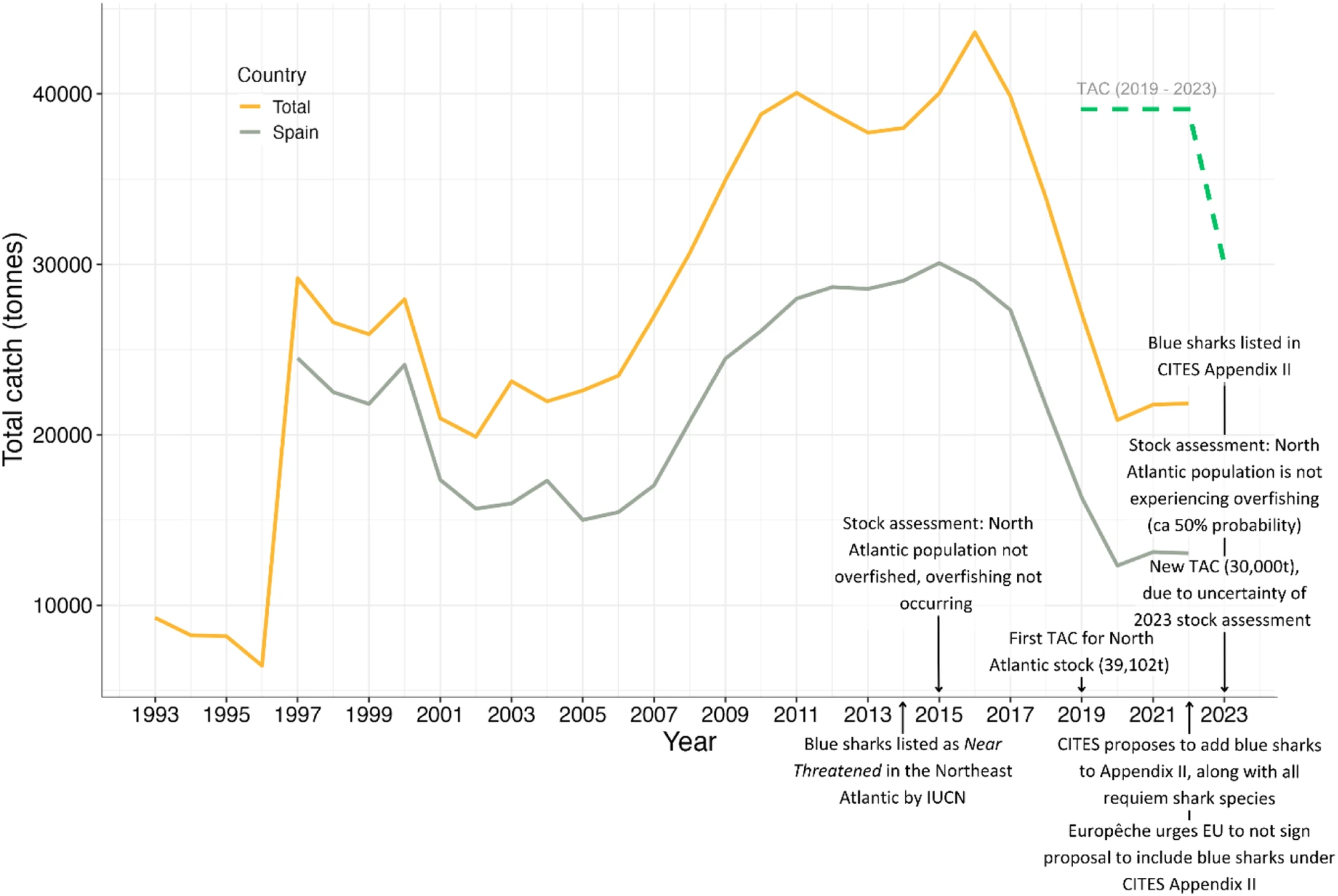
Despite this magnitude, the study does not describe a consistent decline for blue sharks off the Azores. Some diving operations remembered weak years and a later recovery, others saw a decline since around 2018. One dive operator reported that 10 to 15 blue sharks were common in 2015 and 2016; in 2022, eight to ten animals became rare and dives with no or only two to three animals became more common.
According to individual companies, the waiting time has also become longer. While around 30 minutes of baiting would have been enough at the beginning of shark diving, later two to three hours were sometimes necessary. Such recollections may indicate population pressure, but are not a standardized time series. The authors therefore assess the blue sharks overall as fluctuating and comparatively stable, not as clear evidence of a local population collapse.
Shortfin makos become the exception
The picture is clearer for shortfin makos (Isurus oxyrinchus). Reported North Atlantic catches were already high in the 1990s, rose again after 2000 and reached 4,760 tonnes in 2010. Later stock assessments classified the stock as overfished. A fishing ban adopted in 2021 was intended to begin its recovery.
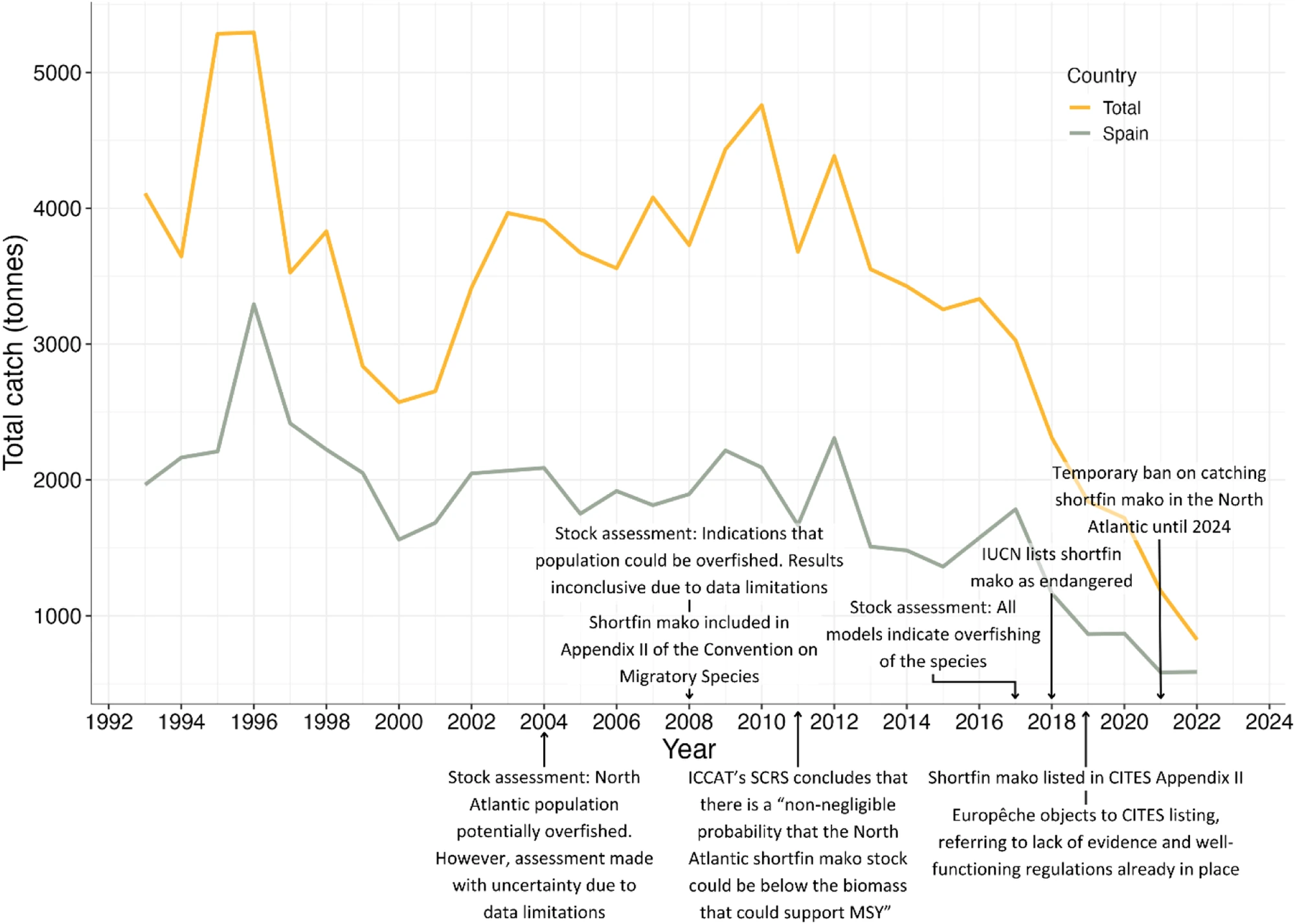
At the same time, shortfin makos were becoming increasingly rare at dive sites. At the beginning around 2012, a diving guide recalled successful encounters on about seven out of ten trips. Later, only four to five animals per guide came together per season. Other companies also reported a sharp decline.
Because this trend matches the stock assessments and protective measures, the authors see a much more plausible connection between fishing pressure and rare shortfin mako sightings off the Azores. Model calculations they cite expect a further decline in biomass by 2035 and a full recovery perhaps not until around 2070.
The dive industry grows—as operating costs rise
Shark diving developed in the Azores starting around 2011. Photos of sharks on a whale carcass attracted a foreign expert who trained companies in shark diving procedures. Another dive site, Pedra de Sousa, and international visibility on social media accelerated development. In 2022, four of the companies surveyed on Faial and two on Pico were actively offering shark diving.
According to the study, prices ranged from 165 to 195 euros per person per dive. For individual operators, shark diving made up a significant portion of their business. Nevertheless, the authors found no evidence for 2011 to 2022 that deep-sea fishing had slowed the economic growth of diving companies. Additional daily costs were more noticeable: more fuel, longer search times and more effort spent attracting sharks with bait.
Alive or caught: two values that cannot be compared directly
The study compares the price of a shark dive with the average landed value of blue-shark meat: US$1.90 per kilogram. These figures do not amount to a complete cost-benefit analysis. A kilogram of fish and a place on a dive boat measure different things, and costs, catch volumes and the number of repeat encounters would also have to be considered.
The contrast nevertheless makes the political question understandable: a live shark can repeatedly generate tourist value over years, while a captured shark is only sold once. For migratory species, the benefits are also geographically far apart. Fishing takes place on the high seas, while the diving companies in the Azores make a living from the incoming animals.
What the study cannot prove
The authors identify several limits. The information on sightings is based on memories because the companies did not keep uniform long-term statistics. The catch curves only include catches reported to ICCAT; the actual catch could be higher. In addition, both shark species migrate over long distances, so environmental conditions and other fleets can also influence encounters off the Azores.
For that reason, the study carefully distinguishes between a visible conflict of interests and proven economic harm. For shortfin makos, the evidence increasingly points to a link with overfishing. For blue sharks, the data are not yet sufficient. And for the dive industry, the result so far is primarily growing vulnerability—not economic collapse.
One shared stock, two economic models
The Azores have become a new stakeholder for pelagic sharks through shark diving. Decisions about fishing quotas in the open North Atlantic not only affect fishing operations and species protection, but also more distant, less extractive tourism offerings.
The central message is therefore not that one industry has already displaced the other. Both use the same migratory resource, but its value and risks become visible in different places. Systematic sighting data from dive operators could eventually show when this conflict of interests causes measurable economic harm—or whether sound fisheries management can prevent it.

