


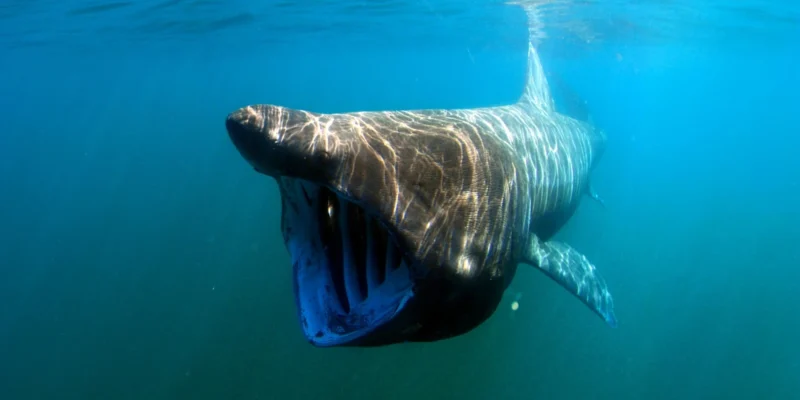
A new study by the Woods Hole Oceanographic Institution shows that basking sharks apparently do not simply live off stored energy reserves during their long winter migrations. The animals regularly dive deep into the mesopelagic “Twilight Zone” and probably search for food there.
The researchers analysed more than 8,000 tracking days from 37 basking sharks tagged near Cape Cod between 2004 and 2011. At the surface, basking sharks are often seen as peaceful filter feeders. During winter migration, however, the data showed a very different pattern: away from the shallow shelf and into a more offshore, depth-oriented way of using the ocean.
From surface filter feeder to deep-sea migrant
The use of the mesopelagic zone, roughly between 200 and 1,000 metres deep, was especially striking. WHOI reports that the sharks dived close to the lower boundary of this Twilight Zone, in some cases down to or beyond 1,000 metres. Such dives are physiologically demanding: down there it is cold, dark and low in oxygen.
The data suggest that basking sharks are not merely travelling through depth during this phase, but actively using feeding areas. The overlap with so-called Deep Scattering Layers is particularly interesting. These dense layers of small fish, crustaceans, squid and zooplankton become visible acoustically and form a huge but hard-to-access food web.
Why this discovery matters
Basking sharks are the second-largest fish in the world, and their slow, open-mouthed filter feeding can make them seem almost harmless. That is exactly why they are easily misunderstood as surface animals. The new study shows that their habitat is three-dimensional. Anyone who wants to protect basking sharks has to look not only at coasts, sighting areas and surface habitats, but also at the invisible depth zones they use during migration.
This is also relevant because the mesopelagic zone is becoming increasingly interesting commercially. If small fish, squid or other organisms from the Twilight Zone are harvested industrially in the future, that could alter food webs that also support large migrating marine animals.
A shark that only partly shows itself
For divers and nature watchers, basking sharks are known mainly from surface encounters: large dorsal fins, open mouths and calm gliding through plankton. The new work connects that visible side with a deep-sea world that is barely observable. An animal that seems easy to understand at the surface is apparently linked, during migration, to much more complex feeding spaces.
WHOI also stresses that surprisingly little is still known about the species’ reproduction. Where basking sharks mate or give birth remains unclear. Long migrations into offshore and deep-sea areas could also be connected to such still-hidden phases of their life cycle.
Shark protection has to think in three dimensions
The study’s most important message is therefore bigger than a single dive profile. Protected areas, fishing rules and marine spatial planning must not be imagined only as flat shapes on maps. For migratory species such as the basking shark, depth, season, prey distribution and distant offshore areas matter as well.
For Haitauchen, the story is powerful because it connects a familiar, peaceful filter feeder with an invisible deep-sea food web. Basking sharks are not only ambassadors for gentle surface encounters. They also show why real shark conservation remains incomplete without deep-sea protection.
