An open access study published on August 20, 2026 in the specialist journal Fishes brings together 5,596 georeferenced occurrence records from Greek and adjacent waters. After validation, the research team confirmed 62 species: 33 shark species, 28 ray species and one chimera species.
The number 5,596 does not indicate any counted animals or a current population estimate. Each data set represents a spatially located occurrence record. The study shows where species have been documented over the course of many decades – not how many sharks live in the Aegean or Ionian Sea today. The full article is also freely available as a PDF hosted directly by the publisher.
From historical reports to a georeferenced database
The researchers reviewed scientific and gray literature, research programs, biodiversity databases, citizen science projects as well as articles from mass and social media. The oldest modern evidence dates back to 1858. However, reports from 1942 onwards could only be used for spatial analysis because older information usually only mentioned fish markets or large regions. The maps cover the period 1942 to 2025.
Of the 5,596 data sets, 2,185 are from sharks, 3,287 from rays and 124 from chimeras. 54.8 percent comes from research programs, 30.5 percent from published research and 14.4 percent from previously unpublished citizen science data. In total, the team evaluated 268 scientific publications and conference papers.
All entries were checked for duplication and reliable species identification. Of the 67 species initially reported, the authors rated five as not sufficiently confirmed for Greek waters. 62 validated species remained. This distinction explains why older species lists and the new spatial database do not always give the same total numbers.
Small-spotted catshark, common smoothhound and blue shark recorded most often
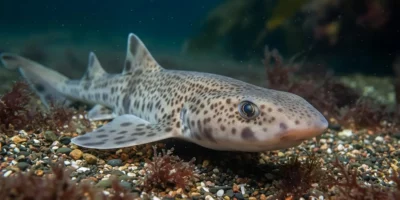
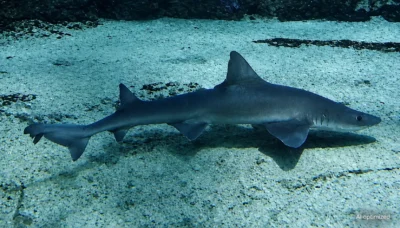
Among the sharks, Table A1 shows the most records for the small-spotted catshark (Scyliorhinus canicula): 361 records. This is followed by the common smoothhound (Mustelus mustelus) with 269 and the blue shark (Prionace glauca) with 188 records. These are the three most documented shark species in the combined database.
You are currently viewing a placeholder content from Facebook. To access the actual content, click the button below. Please note that doing so will share data with third-party providers.
More InformationThis order is not automatically a ranking of today’s stock sizes. Bottom-dwelling species appear frequently in trawling and fishing data, while pelagic species such as blue sharks are only selectively recorded in open ocean areas. Fishing gear, research priorities and the accessibility of a habitat therefore influence which species appear particularly often in the database.
Most records come from the Aegean Sea
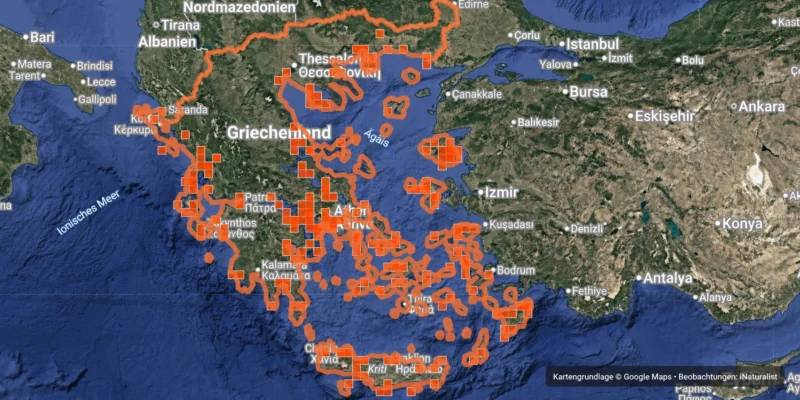
67.7 percent of all spatial evidence is in the Aegean Sea, 27.5 percent in the Ionian Sea and 4.4 percent in the waters around Crete. The Southern Adriatic and Levantine Sea each contribute less than one percent. The high density in the Aegean can sometimes be a real ecological signal: diverse habitats, current fronts and productive areas offer cartilaginous fish different feeding, growth and retreat areas.
At the same time, the Aegean Sea was studied much more intensively. In the Ionian Sea, extensive monitoring in the Ambracian Gulf also shapes the maps. Conversely, the low density of records off Crete and in the Levantine Sea does not mean that there are hardly any sharks or rays there. According to the authors’ assessment, it shows above all where targeted and standardized surveys are missing.
More reports do not mean more sharks
The number of stored evidence has increased significantly, especially since 2015. The study attributes this primarily to better data availability, growing scientific and public attention, and new opportunities for sharing observations. A time series from different sources cannot therefore be read like a standardized inventory survey.
The classification of the Greek Marine Protection Organization iSea matches this. There is no scientific evidence of an increase in shark populations in Greek waters. iSea explains that more sightings are becoming public today, especially with smartphones, drones and social media. Observations that would previously only have been known to local fishermen or residents can now spread nationwide within hours.
Sharks are also not a new phenomenon in this part of the Mediterranean. Aristotle already described several cartilaginous fish, including the blue shark. Individual sightings near the coast therefore indicate neither a recent arrival nor population growth caused by warm summers. Long-term surveys using consistent methods would be necessary for such statements.
Spatial data can support more targeted protected areas
More than half of the cartilaginous fish species in the Mediterranean are considered to be threatened with extinction. This is precisely why the new data basis is more important than a striking number of species. It can help develop distribution models, prioritize research gaps and identify areas in marine spatial planning that may be particularly relevant to threatened or data-poor species.
According to the authors, parts of the data collected have already been used in the identification of Important Shark and Ray Areas in Greek waters and in environmental studies for the designation of the Ionian National Park. However, the dot maps alone do not provide evidence of nurseries, breeding areas or population developments. Among other things, there is a lack of uniform information on depth and habitat as well as long-term, fishing-independent measurement series.
The real progress lies in a reliable spatial starting point: scattered observations were examined, de-duplicated and sorted according to consistent marine regions. The study does not conclusively answer how many sharks Greece’s seas harbor today. However, it shows much more precisely what is already known – and on which coasts and in which deep-sea areas the biggest gaps in knowledge lie.