


Small-spotted Catshark - Scyliorhinus canicula

Body shape, features & anatomy
Typical body shape and skin texture
The small-spotted catshark is a small and slender shark species, usually 60 to 80 centimetres long; occasionally, specimens of one metre are also observed. The body is wedge-shaped, elongated and excellently adapted to life on the seabed. The rough skin is striking; it feels like sandpaper due to tiny placoid scales and offers optimal protection. The upper side is grey, beige or brownish in colour and is characterised by numerous small, dark spots, which give the shark its German name. The underside, by contrast, remains light and is usually unspotted. Characteristic are the large, round eyes with a typical cat-like eyeliner, which give the shark its distinctive appearance.
Mouth area, fins and special features
The mouth is small, almost twice as wide as it is long, and sits on the underside of the head—ideal for locating prey animals on the bottom. The five gill slits are arranged laterally below the head and are barely noticeable when viewed. The first dorsal fin starts clearly behind the pelvic fins, and the second, smaller dorsal fin follows further back. The catshark has an asymmetrical tail fin, which provides strong propulsion. The teeth are bristle-like and are well suited to cracking shells and holding onto prey.
Sensory organs and adaptations
The small-spotted catshark has particularly well-developed sensory organs. Thousands of electroreceptors, the ampullae of Lorenzini, are located around the snout and help it detect prey even in poor visibility. In addition, these sharks have a keen sense of smell, enabling them to locate crustaceans, molluscs and small fish on the seabed with great precision. Their cartilaginous skeleton ensures high flexibility and low weight while swimming.
Differences between males and females
Adult males and females differ mainly in the development of certain reproductive organs. Males have two elongated claspers on the underside behind the pelvic fins, which serve as copulatory organs. Females lack these claspers, making them immediately distinguishable. On average, females are slightly larger and more robust than males, as they form egg cases and show a sturdier build during the breeding season. Colouration and spotting are the same in both sexes and serve as camouflage on the seabed.
Comparison with other shark species
Compared with other catshark species, the small-spotted catshark stands out for its particularly fine, dense dermal denticles, which give it a hard-wearing surface. The spots are smaller than in the closely related nursehound, the snout is shorter and broader, and the nasal flap slit runs particularly conspicuously to the mouth. Its slender body shape and large eyes mean it is often perceived as especially graceful.
Distribution & habitat
Geographical distribution
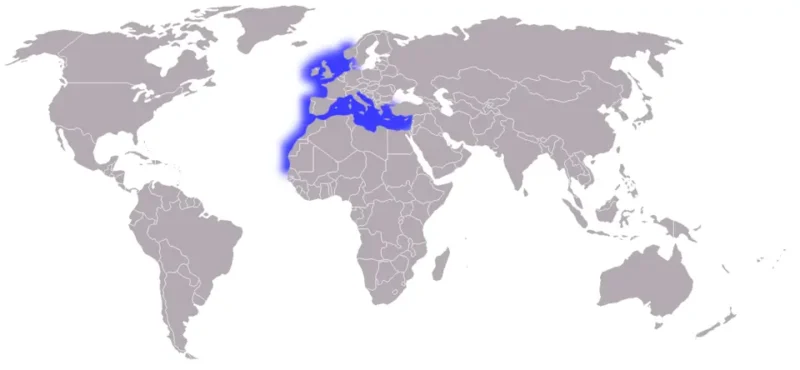
The lesser spotted catshark is one of the most common and widely distributed shark species along the coasts of Europe. Its range extends from the North-East Atlantic and the west coast of Africa up to Norway, around the British Isles and along the Spanish and French Atlantic coast. The species is particularly abundant throughout the Mediterranean and the North Sea. These sharks inhabit not only open sea areas, but are also found in shallow coastal waters and bays. Small populations even occur in the Black Sea.
Habitat: on the seabed and in coastal waters
The lesser spotted catshark is a typical bottom-dweller and prefers sandy, gravelly or muddy seabeds. It is often found in algal beds, seagrass meadows or reef areas. Depending on the region and water conditions, it ranges from very shallow water to depths of about 400 metres, and in exceptional cases even down to 800 metres. In cooler latitudes it tends to stay in shallower waters, whereas in the warmer Mediterranean it is more often encountered at greater depths. Juveniles usually seek out the sheltered, shallower parts of coastal areas.
Lifestyle, diet & reproduction
Lifestyle: bottom-dweller with a preference for structure
The small-spotted catshark leads a hidden life on the seabed and is mainly active at dusk and at night. During the day, females often stay in small groups hidden in rock crevices, caves or among seagrass, while males usually rest alone. In the dark, the sharks become active and prowl in search over the bottom, always on the hunt for prey. This shark species is very adaptable and can survive both in shallow coastal waters and at greater depths of up to 800 metres. Its typical movement is slow and smooth, but when threatened or hunting the catshark can strike in a flash.
Diet and hunting behaviour
The small-spotted catshark eats anything that is small and lives close to the seabed. This includes small fish, prawns, crustaceans, squid, octopus, snails and a wide variety of worms. It can locate its prey even in poor visibility, aided by an excellent sense of smell and fine electroreceptors that allow it to detect the weak electric fields produced by animals. When feeding, it uses its small, pointed teeth to crack shells or carapaces effectively. Its main hunting time is at night, when the shark proceeds with measured patience and snaps only at the last moment.
Reproduction and development
This shark species is an egg-laying bottom-dwelling shark. Reproduction usually takes place year-round, with a peak in early summer. The female lays up to 20 elongated, horn-like egg capsules per season, which are attached with tendrils to algae, stones or other firm surfaces. Inside each egg capsule, a pup develops, feeding on its yolk sac. Development can take between five and eleven months, depending on the water temperature. When they hatch, the young are eight to ten centimetres long and immediately independent. Sexual maturity is reached only at the age of three to five years, with females usually becoming slightly longer and larger than males. Life expectancy can be up to 13 years.
You are currently viewing a placeholder content from Facebook. To access the actual content, click the button below. Please note that doing so will share data with third-party providers.
Social structure and special characteristics
Unlike many larger sharks, small-spotted catsharks sometimes show group-oriented behaviour, especially females in shelters. Otherwise, the animals live solitarily. Their high adaptability to different habitats and flexible diet make this shark one of Europe’s most successful and most common bottom-dwelling sharks.
Protection status & threat situation
Current protection status
The small-spotted catshark is one of the most common shark species in European waters and is currently classified by the International Union for Conservation of Nature (IUCN) as “Least Concern”. Populations are considered stable throughout its range, and this ground shark is widespread in the coastal regions of the North-East Atlantic, the Mediterranean and parts of the Black Sea. In Germany, too, the species is listed on the Red List as not threatened. Nevertheless, local fluctuations in stocks are possible, which is why experts recommend regular monitoring.
Fishing and bycatch as a risk
The greatest threat to the small-spotted catshark is commercial fishing, in particular unintended bycatch in bottom trawl nets. Animals are also regularly caught in targeted fisheries for human consumption, for example off the Atlantic coast or in the Mediterranean. Further pressures include the loss of important egg-laying areas and declines in seagrass meadows and algal stocks, which are especially important for the development of juvenile sharks. Overall, the stock remains resilient, but excessively intense fishing pressure could lead to regional declines.
Regional differences and observations
In some marine regions, such as the Wadden Sea in the North Sea or parts of shallow-water zones, the small-spotted catshark has almost disappeared. The reasons are varied and range from the loss of suitable habitats due to offshore use to climatic changes. Especially in heavily frequented or industrially used waters, compliance with protective measures such as marine protected areas and trawl bans is urgently required in order to stabilise local populations.
Protective measures and outlook
Among the most important conservation strategies are the establishment of zones where trawling is prohibited, as well as the targeted promotion of natural spawning grounds. Research projects monitoring populations help to respond early to declines and to adapt conservation concepts. Sustainable fisheries management is crucial for the long-term protection of this shark species. Public education and recognition of the small-spotted catshark as an important part of the marine ecosystem also contribute to securing its populations.
Interaction with humans
Behaviour during encounters
The small-spotted catshark is a rather shy and calm resident of the seabed. Encounters with humans are rare and usually pass without conflict. Sharks of this species show hardly any aggressive tendencies towards divers or swimmers. Instead of seeking confrontation, they usually flee and retreat into hiding places. Studies have shown that the sharks’ body language is crucial for their reaction to humans. A calm demeanour and a respectful distance help to ensure a peaceful encounter.
Possible risks and protective behaviour
Attacks on humans by the small-spotted catshark are virtually unknown. The animals are too small and reserved to pose a danger. Risks can only arise if people harass the sharks or disturb them while they are foraging. In such situations, defensive behaviour can be triggered, but it rarely leads to serious injuries. Understanding the sharks’ signals and behaviours is crucial to avoid misunderstandings and risks.
Recommendations for behaviour during encounters
Anyone who comes into contact with the small-spotted catshark should remain calm, avoid sudden movements, and give the shark plenty of space. Underwater, slower, controlled movements can reduce the shark’s fear. If behavioural changes are observed, such as rapid tail beats or raised pectoral fins, it is sensible to retreat slowly. The aim is a safe and respectful coexistence without disturbance for either side.
Humans as the greatest threat
While the small-spotted catshark poses hardly any danger to humans, it is usually humans who threaten this shark species. Overfishing, bycatch and the destruction of habitats through changes in coastal areas put pressure on populations. It is therefore all the more important to behave responsibly in the water and to protect the natural habitat of these fascinating sharks.
Profile
- First described:
- Max. size:
- Depth:
- Max. age:
- Max. weight:
- Water type:
- IUCN Status:
Taxonomy
- Kingdom:
- Phylum:
- Subphylum:
- Infraphylum:
- Parvphylum:
- Class:
- Subclass:
- Superorder:
- Order:
- Family:
- Genus:

News

From egg to sea: how Sweden releases young catsharks and finds them again
Identical catshark twins discovered in a single egg case
Study maps 5,596 records of 33 shark species in Greece
Submarine cables have subtle effects on sharks and rays
The poisoned Mediterranean: Small-spotted catshark has high mercury levels


Newsletter
Shark Alert in Your Inbox