


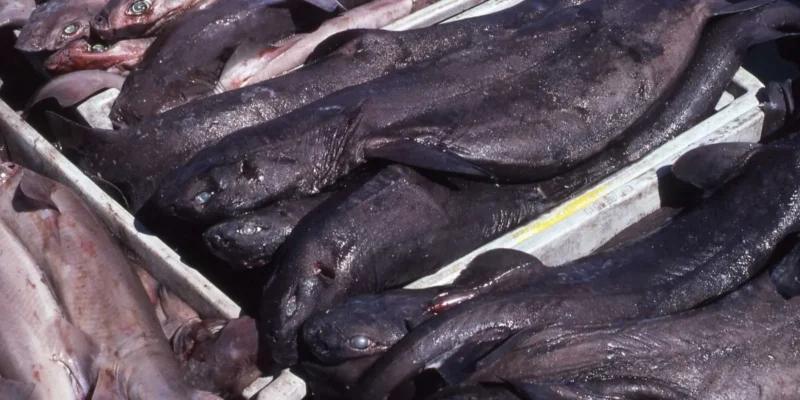
Most people will never encounter a kitefin shark. The animals live hundreds of meters deep, far below normal diving limits. In the fishery of the southern Indian Ocean Nevertheless, they regularly come to the surface as unintentional catches on deep-sea longlines. For the Sharks This route usually ends fatally: a new study puts their mortality on the fishing vessel at 90.7 percent.
The in Fisheries Research published investigation combines biological measurement data with the first electronic markers of this kind in the study area. The results also show a small but important opportunity: three animals that survived capture in good condition provided signals after release that were consistent with continued survival and active movement.
A rare deep-sea shark in the focus of fisheries research
The kitefin shark (Dalatias licha) is called Kitefin Shark in English. Its German name refers to the dark, brown color. The species is one of the Spiny dogfish species and lives on continental and island shelves as well as over deep-sea ridges. Because such habitats are difficult to access, basic information on growth, sexual maturity, distribution and migration is missing for many regions.
The study was carried out as part of a Research project of Southern Indian Ocean Fisheries Agreement (SIOFA). The project aimed to improve the scientific basis for deep-sea sharks caught in longline fisheries in the SIOFA area. Observers collected biological data aboard a commercial longliner; Eligible animals were tagged with electronic satellite tags and released.
The work thus examines two different sections of the same problem. Mortality on the ship describes how many sharks survive the catching and retrieving process alive until they are assessed on deck. The electronic tags then show what happens to individual animals after they are released. Both values must not be confused with each other.
Females apparently become sexually mature much later
From examining the gonads, the team calculated the mean ripening length L50. This is the body length at which, according to the model, half of the animals are sexually mature – not a hard threshold for each individual animal. For males the estimate was 112.1 centimeters and for females it was 134.8 centimeters.
This difference is relevant to fisheries management. Longer maturation lengths can mean that females in particular have to grow for a long time before reproducing. If many animals are caught beforehand, a smaller proportion of the population reaches the reproductive stage. However, the study neither calculates a stock size nor a sustainable catch amount from the maturity lengths.
The size distribution also changed with depth. Males and females differed significantly in their size structure; in both sexes, mean body length tended to decrease with increasing depth. This suggests spatial sorting according to size and gender. It is not possible to determine from the abstract of the work which biological or ecological processes are behind it.
90.7 percent mortality before release is possible
The most striking finding concerns the direct impact of fishing. 90.7 percent of the kitefin sharks recorded were already dead on the ship. This so-called at-vessel mortality includes exposure to hooks, fishing depth, retrieval time, pressure and temperature changes as well as handling up to the assessment on board. The study explicitly separates this value from subsequent mortality after release.
This is crucial for classification. A requirement to release all captured kitefin sharks alone does not prevent the majority of observed deaths. If almost nine out of ten animals do not reach the ship alive, protective measures must be taken earlier in the capture chain – for example in avoiding bycatch, in the fishing gear and location, in retrieval times or in handling as gently as possible. However, the study did not test which of these measures would be most effective in the SIOFA area.
Three tags show survival, local loyalty and a long migration
Only animals in good condition were eligible for electronic tagging. Three kitefin sharks received tags: two so-called benthic SPAT tags, which primarily provide evidence of survival after release, and one MiniPAT, which additionally recorded depth and movement data. This selection explains why a high survival rate of the tagged animals does not contradict the very high overall mortality on the ship.
Two sharks remained near the tagging area according to the tag data. Their recorded distance was less than 25 nautical miles, i.e. less than around 46 kilometers. A third animal, on the other hand, moved 326 nautical miles towards the southwest of Madagascar. That corresponds to a good 600 kilometers in a straight line. The distance actually swum may have been significantly longer because the start and end points do not represent a complete route.
These three different courses are already interesting. They suggest that kitefin sharks can both stay in one area for longer periods of time and travel greater distances between deep-sea habitats. However, the number of three marked animals is far too small to make any statements about typical migration patterns, seasons or differences between the sexes.
140 days between 211 and 939 meters depth
The MiniPAT recorded data from a shark for 140 days. During this period, the animal moved between 211 and 939 meters deep. The mean swimming depth was 592.8 meters, with a standard deviation of 150.2 meters. The animal did not use the habitat as a narrow depth zone, but rather repeatedly moved through several hundred meters of the water column.
The daily vertical range ranged from just a few meters to 590 meters. On 60 percent of the days or periods evaluated it remained at a maximum of 300 meters. During ascents and descents, estimated vertical speeds ranged from one to 25 meters per minute. However, most of the time the shark moved vertically at only about one meter per minute.
For fisheries, such depth profiles are more than just a biological curiosity. They help to estimate at what depths fishing gear and sharks overlap and whether spatial or temporal alternative measures are realistic. A single complete depth curve can provide hypotheses for this, but not a reliable rule for the entire population.
What the study shows – and what still remains to be seen
The work closes several data gaps: It provides regional estimates of sexual maturity, describes a size- and depth-dependent structure and, for the first time, documents electronically that well-preserved animals can continue to live and move actively after being caught. At the same time, the at-vessel mortality rate of 90.7 percent shows how rarely this opportunity even arises in the fishery examined.
The boundaries are equally important. The movement data comes from just three animals, and the detailed 140-day depth history even comes from a single shark. The results initially apply to the fishery and region examined in the southern Indian Ocean. They cannot be transferred to all kitefin sharks, fishing gear or marine areas without additional data. An inventory development was also not calculated.
This is precisely why the combination of observer data and tags is valuable. It shows where further research can have the greatest practical benefit: more tagged animals, more precise data on fishing duration and depth, and experiments with measures that bring sharks alive to release. Only then can an effective protection strategy be developed from the documented chance of survival.
Deep sea protection begins long before the water surface
The kitefin shark usually remains invisible to divers. Its average depths used are well beyond recreational diving. However, the study reminds us that shark protection does not only take place on reefs, coasts or well-known large shark spots. Even in the dark deep sea there are species whose biology is barely known and whose encounters with fishing gear can be fatal within a short period of time.
The three electronically tracked kitefin sharks show that releasing fit animals can make a real difference. However, the bigger task lies ahead: avoid bycatch as much as possible and change the conditions of the catch so that significantly more sharks end up back in the water alive.