


Kitefin shark - Dalatias licha

Body structure, features & anatomy
The kitefin shark Dalatias licha is a medium-sized, powerfully built deep-sea shark. Adults are usually around 1.2 meters long; the confirmed maximum length is 1.82 metres. The color ranges from dark brown to gray-brown to almost black. The belly and flanks are hardly contrasted, the rear edges of the fins can appear lighter or translucent.
The Shark Research Institute describes a cylindrical body, a short blunt snout, large eyes and noticeably thick, fringed lips. The two dorsal fins have no spines despite belonging to the spiny shark species. The second dorsal fin is slightly larger than the first; an anal fin is completely missing.
Teeth for gripping and cutting
The upper and lower jaws perform different tasks. At the top there are narrow, backward-facing teeth that hold prey in place. The significantly larger lower jaw teeth are triangular, serrated and interlocked to form an almost continuous cutting edge. This combination is suitable for cutting up fish and cephalopods and can also cut out larger pieces of meat from prey.
- Five short gill slits per side, the fifth lies above the base of the pectoral fin.
- Short, rounded pectoral fins and two small, spineless dorsal fins.
- No anal fin and only a poorly developed lower caudal fin lobe.
- Large, oil-rich liver makes an important contribution to buoyancy at depth.
- Dark skin with very small light organs between the placoid scales.
The largest known luminous vertebrate
One Frontiers study on bioluminescence experimentally demonstrated blue intrinsic luminosity for the first time in kitefin sharks from New Zealand. Thousands of tiny photophores are located particularly close to the ventral side; The flanks, back and both dorsal fins can also glow faintly. With a body length of up to 1.82 meters applies Dalatias licha making it the largest bioluminescent vertebrate known to date.
The photophores each consist of a single light-producing cell, pigmented sheath cells and lens-like cells. Their activity is hormonally controlled. The study discusses counter-illumination as the most likely function: the light could camouflage the shark’s silhouette in the remaining light of the twilight zone and help it to approach prey inconspicuously. However, direct behavioral observations under natural conditions are still missing.
Distribution & habitat
FishBase describes the kitefin shark as a deep-sea species that is widespread almost worldwide but with patchy distribution. Evidence is from the Atlantic, dem Indian Ocean, dem Pacific and that Mediterranean before. The area consists of separate regional occurrences and does not mean that the species is common everywhere between these areas.
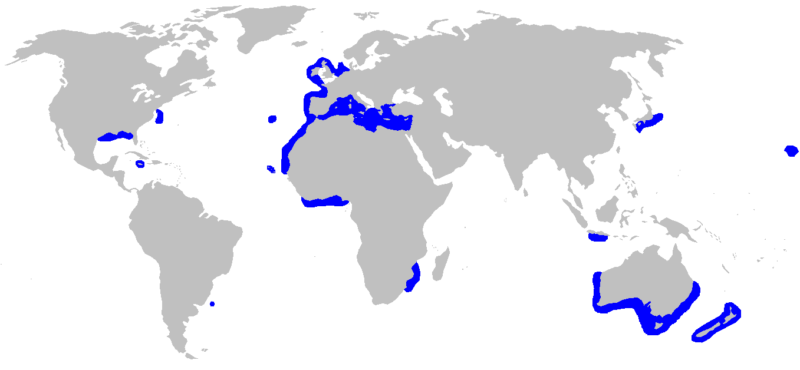
In the western Atlantic, the known occurrence extends from Georges Bank and Florida to the northern Gulf of Mexico and the Bahamas. In the eastern Atlantic, the species is reported from northern European waters via the Azores, Madeira and West Africa to South Africa. Other stocks live in the southwest Indian Ocean as well as in the western and central Pacific, including off Japan, Australia, New Zealand and Hawaii.
Outer shelf, continental slope and deep sea ridge
kitefin sharks live bathydemersally to benthopelagically: mostly close to the seabed, but not permanently directly on it. Typical are the outer continental shelf, island slopes, upper continental slopes, deep sea ridges and seamounts in warm temperate to tropical seas. The documented depth range ranges from 37 to 1,800 meters; The species is particularly frequently mentioned between around 200 and 600 meters.
The FAO identification guide for deep-sea cartilaginous fishes for the Indian Ocean Dalatias licha as widespread, but only occurring irregularly. It is precisely this combination that makes population statements difficult: catch data from one region can describe a local occurrence, but say little about other distant sub-populations.
Movements through several hundred meters of water column
Electronic tags show that the species does not remain at a fixed depth. An animal tracked in the southern Indian Ocean used depths between 211 and 939 meters for 140 days and covered vertical distances of up to 590 meters in one day. Other tagged animals stayed close to the capture area or moved several hundred kilometers. The few tags so far are not enough for a general migration model.
The large, fragmented distribution framework can only be meaningfully interpreted together with regional data. Evidence in the northeast Atlantic neither proves an exchange with animals in the Indo-Pacific nor does it indicate that the population density is the same everywhere. Regional catch series, age structure and gender distribution remain crucial for protection and fisheries management.
Life history, diet & reproduction
The kitefin shark Dalatias licha is a solitary predator and scavenger of the deep sea. Its large, oil-rich liver generates buoyancy, allowing it to hover above the ground with little energy expenditure. Measured continuous speeds are low; However, the strong muscles and the prey in the stomach indicate that short, quick attacks are possible.
Fish, sharks and invertebrates as prey
One Mediterranean Biology and Nutrition Study examined 78 animals from the Ligurian Sea. The stomachs were dominated by bony fish, especially grenadier fish, as well as smaller sharks such as spotted sharks and lantern sharks. There were also cephalopods and crustaceans. The broad diet matches the specialized jaws: the shark can swallow smaller prey whole, hold it and cut it up, or release flesh from larger animals.
The study also found parasites and individual pieces of plastic in the digestive tract. It does not follow that plastic forms a large proportion of normal food. Rather, the finding shows that even predators come into contact with human waste at depths of several hundred meters.
Live birth without placenta
According to the summary in Animal Diversity Web the species is aplacental viviparous. The embryos develop in the mother and are nourished through her yolk sac. A litter usually contains 10 to 16 young animals, which are approximately 30 centimeters long at birth. There is no known care after birth.
kitefin sharks grow slowly and reach sexual maturity comparatively late. Maturity lengths differ significantly between genders and regions. Mediterranean studies found smaller mature males than studies from the Atlantic or Indian Oceans. This may indicate regional growth conditions and spatial segregation by size and gender; a uniform global threshold would therefore be misleading.
The estimated generation length is around 29 years. It cannot be equated with a safe maximum age, but it does illustrate the slow pace of the life cycle. Losses of large, reproductive animals cannot therefore be compensated for in just a few years.
Threats & conservation status
The IUCN Red List carries the kitefin shark Dalatias licha global as at risk (vulnerable). The regional assessment is also included for European waters and the Mediterranean Endangered even more serious. The wide distribution does not automatically protect the species because regional sub-populations are fished to varying degrees and are only slowly rebuilt.
Bycatch and historical target fisheries
kitefin sharks get caught in deep-sea longlines, bottom trawls, gillnets and other bottom-level fisheries. They were also specifically caught regionally for their meat, their skin and especially their liver, which is rich in squalene. Slow growth, late maturity and small to moderate litters limit the ability of stocks to compensate for high withdrawals.
An open one Inventory study from the Azores reconstructed the intensive use since the 1970s. After the end of industrial fishing, the stock showed signs of recovery, but the modeled biomass remained only about 56 percent of the value expected for a sustainable stock. This is a regional Azores estimate and should not be read as a global population value.
Many animals die before they can be released
One Study from the southern Indian Ocean reports 90.7 percent mortality already on the fishing vessel for a commercial longline fishery. In contrast, three animals that were tagged and released in good condition provided signals of survival after release. This shows that gentle release can help individual fit sharks, but only reaches those animals that survive capture and retrieval alive.
- Avoid bycatch, instead of shifting protection solely to release on deck.
- Document catches according to species and do not list them under collective names for deep-sea sharks.
- Test fishing depth, retrieval time, hook type and handling as possible adjustment screws.
- Evaluate regional stocks separately because a globally large area can mask local collapses.
- Treat large females and other reproductive animals with particular precaution.
The key protection need therefore lies in fishing: better data, fewer encounters with fishing gear and procedures that increase the chance of survival before and after retrieval. For a deep-sea species with little data, a precautionary approach is more robust than assuming that its large area automatically compensates for losses.
Kitefin shark & humans
The kitefin shark poses no known danger to swimmers and scuba divers. The species usually lives at depths of several hundred meters and is therefore encountered by people almost exclusively through fishing, in scientific samples, on deep-sea cameras or during rare observations from submersible boats and remote-controlled vehicles.
The Florida Museum evaluated Dalatias licha because of its lifestyle and body size it is considered harmless to humans. This does not mean that a caught animal should be touched or underestimated: the large serrated lower jaw teeth can cause serious injuries during defensive movements. On board, distance, suitable tools and short, gentle handling are therefore part of occupational safety and animal welfare.
Use of liver, meat and skin
Historically, the large, oil-rich liver was particularly valuable economically. The squalene contained was used, among other things, technically, pharmaceutically and cosmetically. Depending on the region, meat and fishmeal were also marketed; the rough skin served as shagreen or abrasive material. Today the kitefin shark is more of a bycatch than a target species in many places, but past use explains some large regional declines.
kitefin shark is not Dark Shark
The English name Black Shark is sometimes rendered literally as Dark Shark. In German this easily leads to confusion with the dark shark Carcharhinus obscurus, a large requiem shark from shallower and open ocean areas. For Dalatias licha kitefin shark is the clearer German name; Kitefin Shark is the common English name.
Observing without the promise of the deep sea
- Normal recreational dives are almost always above the typical habitat.
- Deep sea photography and scientific sightings are more valuable than lure attempts or capture for a photo.
- In the event of a rare sighting, keep your distance, do not touch it and leave a clear path back into the depths.
- Document photos with location, depth, date and method because verifiable evidence for this species is rare.
For Haitauchen, the kitefin shark expands the view beyond well-known reef and oceanic sharks. Its bioluminescence, slow life history and extreme depth make it fascinating – but not a predictable diving species. Responsible mediation explains this distance instead of promising encounters that are hardly biologically realistic.
Profile
- First described:
- Max. size:
- Depth:
- Max. age:
- Max. weight:
- Water type:
- IUCN Status:
Taxonomy
- Kingdom:
- Phylum:
- Subphylum:
- Infraphylum:
- Parvphylum:
- Class:
- Subclass:
- Superorder:
- Order:
- Family:
- Genus:
Newsletter
Shark Alert in Your Inbox