


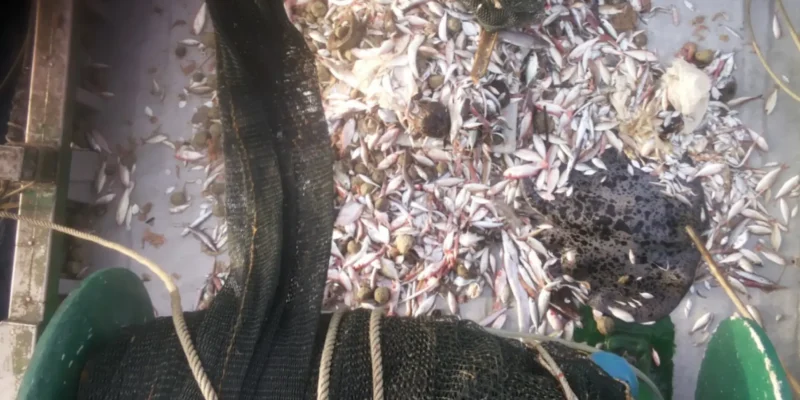
Trawlers off Sabah do not bring only their target catch on deck. Sharks and rays also end up in the nets, including threatened species and many juveniles. A new study now shows in unusually fine spatial detail where this bycatch is concentrated.
SharkCam photographed each haul
The Marine Research Foundation team used an electronic monitoring system called SharkCam. Mounted above the working deck, it photographed the catch every five seconds, while timestamps and GPS data linked each record to a place and time.
From September 2019 to February 2023, 39 trawlers operating from Kota Kinabalu, Sandakan, Kudat, Lahad Datu, Tawau and Semporna were monitored. The dataset covered 3,537 fishing days and 5,573 hauls over 42 months.
More than 9,400 sharks and rays
The cameras recorded more than 9,400 sharks and rays from 60 species: 22 shark species and 38 ray species. Fifty-one of those species, or 85 percent of the species diversity, were considered endangered, threatened or protected. By individual animals, the ETP share was 34 percent.
Rays were more common than sharks. That fits their bottom-dwelling life: many rays live close to the seafloor and therefore overlap strongly with bottom trawls.
Three areas stand out
The analysis found dense bycatch areas north of Kudat, east of Tun Mustapha Park and near Beluran. Shark catches were especially concentrated east of Tun Mustapha Park, while rays were caught across a wider area.
The study also calculated bycatch per 100 trawling hours. Milk sharks reached 26.2 animals per 100 hours in the highest-catch district. For the Indonesian sharpnose ray Telatrygon biasa, the peak value was 202.3 animals per 100 hours.
Many juveniles, but no nursery proof yet
Milk sharks, hammerheads and Maculabatis whiprays were often dominated by newborn or immature animals. The authors caution, however, that this alone does not prove nursery areas. That would require repeated evidence that juveniles remain, return or occur there more often than elsewhere.
Management needs to follow the map
Several hotspots overlapped marine protected areas or their edges. In Tun Mustapha Park, the legal situation depends on zoning; in Sugud Islands Marine Conservation Area, commercial fishing is prohibited. The study therefore points to targeted time-area closures, gear changes and better handling of live bycatch rather than a single blanket rule.
The cameras do not map all sharks and rays in Sabah. They map the bycatch of the monitored fleet. Still, that is exactly the kind of practical information managers need when limited measures must protect as many animals as possible.