


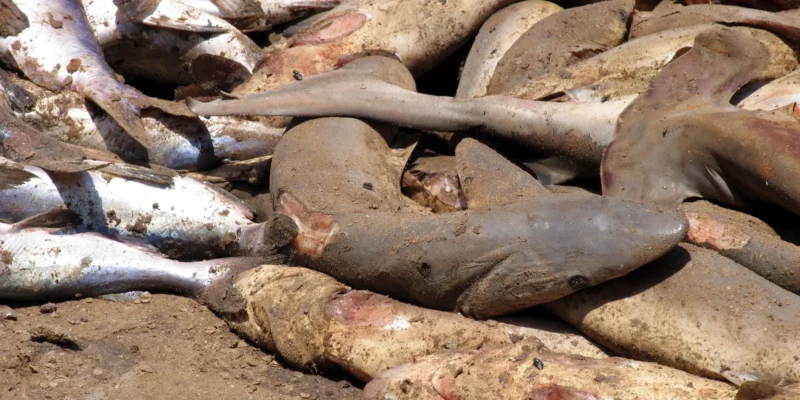
The European shark fin trade shrank in 2025, but it is still a sizeable export business. New Eurostat figures put extra-EU exports at about 2,700 tonnes worth €44.8 million.
Compared with 2024, export volume fell by 15.2 percent and export value by 31.3 percent. That drop follows an unusually high year, so it is not proof on its own that shark catches have fallen or that the market has permanently changed.
A fall after a record year
In 2024, the EU exported around 3,100 tonnes of shark fins worth €65.3 million. The volume had more than doubled from 1,500 tonnes in 2023, while value rose by 91 percent from €34.2 million.
The 2025 figure therefore sits below the 2024 peak but still clearly above 2023. Eurostat links part of the previous decline from 2019 to 2023 to Covid-era disruptions in both EU supply and Asian demand.
Blue shark dominates the reported trade
Frozen shark fins accounted for 89.9 percent of export value, or €40.3 million. In that category, 97.2 percent of trade involved blue shark, with the rest recorded as shortfin mako. Among smoked, dried, salted or brined fins, blue shark made up 81.7 percent and shortfin mako 18.2 percent.
Those figures show which species dominate the statistically visible EU fin trade. They do not prove that any particular stock is being fished sustainably; that requires origin, fishery, catch and population data.
Singapore and China led demand
Almost all exports went to Asia. By value, Singapore took 41.5 percent, China 40.9 percent, Hong Kong 12.8 percent, Japan 2.5 percent and Vietnam 1.1 percent. Together those five markets represented 98.8 percent of the export value.
EU imports were much smaller: 20.2 tonnes worth €300,000 in 2025, down from 66.9 tonnes and €1.2 million in 2023.
CITES controls trade but does not ban it
Many additional shark species have been subject to stricter international trade controls since 25 November 2023. Eurostat says 60 shark species were added at that point. Listing under CITES Appendix II is not a blanket trade ban, but exports require evidence that products were legally obtained and that trade will not threaten the species in the wild.
Since January 2025, the EU has also used 13 new customs and statistical codes for sharks and shark products. That makes species such as blue shark and shortfin mako more visible, but it also creates a break in the time series.
What the decline means for shark protection
Lower export volume can reduce pressure only if it reflects lower demand and lower catch. The figures alone cannot show that. Trade can shift because of stocks in storage, market routes, product forms, documentation rules or prices, while illegal or unreported goods never appear in the statistics.
The clearest gain is transparency. Better species-level trade data can help authorities compare permits, catches and stock assessments. It is not a substitute for sustainable fishing, but it makes part of the supply chain harder to hide.

