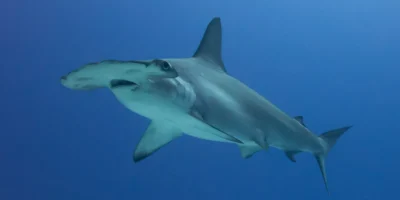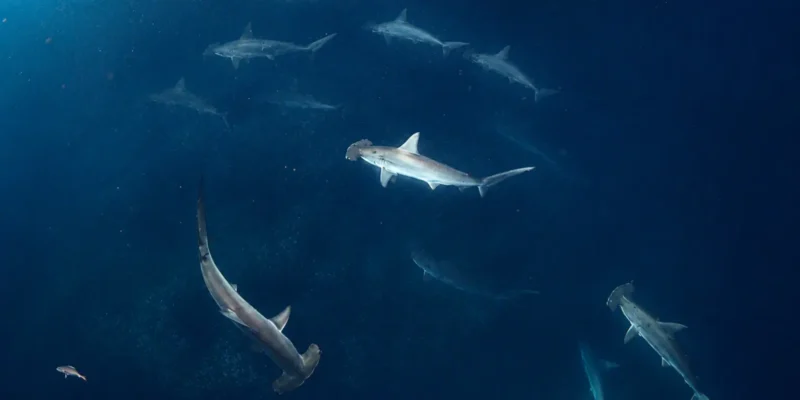
On the north coast of Puerto Rico, a small section of coast could become significantly more important for scalloped hammerheads. Scientists and fishermen promote a new shark refuge at Boca Vieja in Cataño. The aim is to stop fishing in an area that is described as a nursery for young hammerhead sharks.
That reports El Nuevo Día in a post by Melanie Ortiz Álvarez from July 12, 2026. Accordingly, the proposed refuge is on a reef near Villa Pesquera. scalloped hammerheads (Sphyrna lewini) on. The initiative is aimed at overfishing and is awaiting political decision-making.
A refuge instead of just a fishing spot
The crucial point is the function of the place. A reef where young hammerhead sharks regularly grow up is not just another fishing spot. It is part of the life cycle of an endangered species. If adults or young animals are taken from there, it not only affects individual sharks, but possibly the offspring of a local use of the area.
The demand from the report is therefore clearly defined: fishing for sharks in the nursery area should be suspended. Such a step would not be a general ban on all coastal use, but rather a spatially focused measure at a sensitive point. It is precisely this spatial sharpness that may be more effective for slow-reproducing sharks than broad but imprecise appeals.
Why scalloped hammerheads are vulnerable
NOAA Fisheries lists the scalloped hammerhead as a globally distributed species of warm coastal and tropical seas. For the western Atlantic, the distribution area extends from the US east coast to Brazil, including the Caribbean and the Gulf of Mexico. The species is threatened primarily by bycatch, overfishing and the shark fin trade.
The protection status is broken down regionally. Under the US Endangered Species Act, some population segments are listed as endangered and others as threatened; For the rest of the Caribbean, the species is also listed in SPAW Appendix III. This classification fits a local conservation issue in Puerto Rico: Even if the species is widespread, individual nurseries may be disproportionately important to regional populations.
Nurseries need peace and quiet
Young hammerhead sharks use shallower, offshore areas because food, cover and more favorable conditions can come together there. However, such areas are often easily accessible: for boats, fishing and other uses. This makes them valuable and vulnerable at the same time.
A refuge at Boca Vieja would tie the issue of protection to the place where it practically arises. Instead of just talking about the general status of the species, the proposal would focus on a specific reef. This is helpful for management and control: boundaries, rules and monitoring can be formulated more clearly on a known stretch of coast.
Fischer as part of the solution
What is noteworthy is that the proposal is supported by scientists and fishermen, according to El Nuevo Día. This is more than just a nice detail for marine conservation. Fishing rules work best where local users understand the reasons, know the limits and have an interest in ensuring that a stock does not disappear.
This collaboration is particularly crucial when it comes to sharks. Many protection rules fail not because of biology, but because of a lack of implementation on the water. When fishermen, researchers and authorities name the same nursery, a better basis is created for voluntary reporting, targeted controls and later adjustments to the rules.
What divers can learn from this
For divers and snorkelers, the news is a reminder that important shark locations do not always have to be spectacular large animal spots. From the perspective of young sharks, a shallow reef area next to a fishing settlement can be a starting point in life. Such places are often more ecologically valuable than they appear on a tourist map.
The refuge is still a suggestion. That’s exactly why it’s worth reading the story soberly: it’s not about a new diving attraction, but about a local decision to protect an endangered hammerhead shark species. If Puerto Rico takes Boca Vieja seriously as a nursery, it could become a small but very concrete example of Caribbean shark conservation.