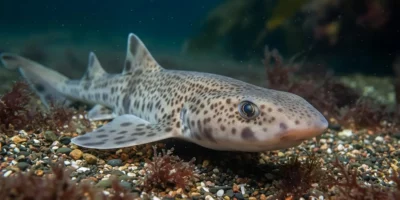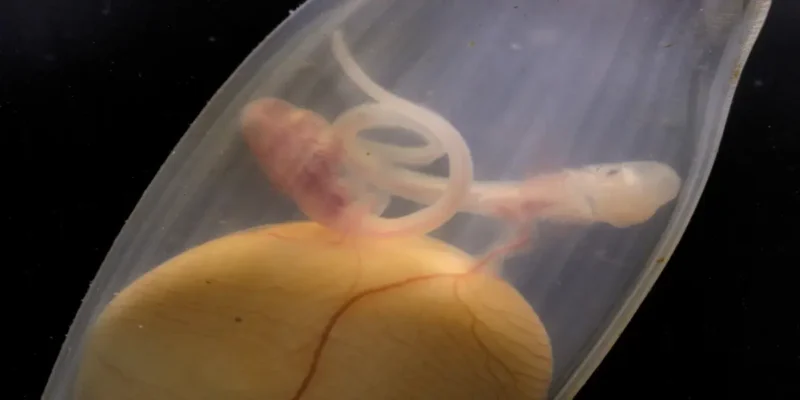
In an egg laid by a small-spotted catshark (Scyliorhinus canicula), researchers discovered two embryos that shared a single yolk sac. The case reported by Discover Wildlife is the first confirmed documentation of identical twins in this species. Both embryos initially developed normally, but did not survive to hatch.
The starting point was not a targeted catch for the experiment. On February 7, 2024, Sharklab ADRIA examined 216 dead small-spotted catsharks that were landed as bycatch by a commercial trawler operating from Vlorë in Albania at a depth of 150 to 200 meters. There were 31 adult females among the animals. Developed egg capsules were collected and further incubated under controlled conditions.
Two embryos sharing one yolk sac
On March 11, 2024, the team noticed two embryos inside an egg case. Each was connected to the same yolk sac via its own yolk stalk. Both moved independently of each other and initially corresponded to the species’ usual developmental stages. The team monitored the temperature, salinity and oxygen concentration of the tanks several times a day.
By the end of March, both embryos had developed visible external gill filaments, fin primordia and blood vessels on the yolk sac. However, there were differences: one twin was redder in color and had a significantly thinner yolk vessel. By April 1, this embryo was already moving slower than its sibling.
On April 3, the first embryo stopped moving and was declared dead after five hours without any apparent breathing. The second initially remained active, but was also found dead on April 4th. The study thus documents not only identical twins, but also their complete development until death.
Oxygen exchange was probably the bottleneck
The original study in Journal of Fish Biology does not simply attribute death to too little food. At the time of death, significant yolk reserves were still present. It is more likely that the combined oxygen demand exceeded the capacity of the egg capsule designed for a single embryo. At this stage of development, a phase with low oxygen supply occurs within the capsule anyway.
The researchers cite oxidative stress, the accumulation of carbon dioxide and metabolic products, and hyperacidification as possible consequences. After the first twin died, additional nitrogen compounds and other decomposition products may have worsened conditions for the second embryo. These are physiological explanations of the study, not a single directly measured cause of death.
Not the first twins, but the first confirmed identical case
The phrase “first twins” needs an important caveat. Already in 2019, two embryos inside an egg case were genetically examined in small-spotted catsharks. These animals came from different fathers and were therefore dizygotic. The new case differs in the common yolk sac and the inferred monozygotic origin.
The new work does not describe a genetic identity test of the two embryos. The researchers base the classification as monozygotic on the anatomical connection of both embryos with a single yolk sac and on the observed developmental course. They therefore describe the finding as strong evidence of monozygotic twinning.
A rare developmental abnormality with limited implications
A single case does not allow us to say how frequently identical twins occur in small-spotted catsharks in the Mediterranean or elsewhere in their range. However, it shows what physiological limits can arise when two embryos share an egg capsule and its supply structures.
For research, the find is therefore primarily a rare window into the reproductive biology of egg-laying sharks. At the same time, the origin of the egg capsules reminds us that the observation was only possible because the mother animals died as bycatch. Other egg capsules recovered from the animals developed successfully, according to Discover Wildlife; after hatching, young animals were prepared for later release into the wild.