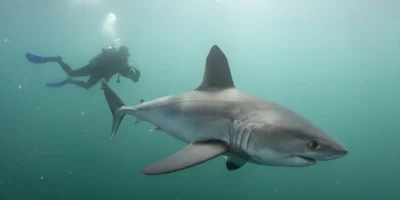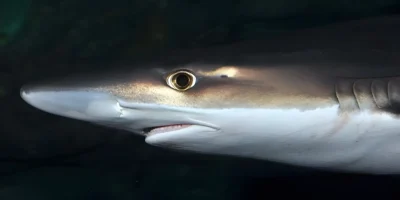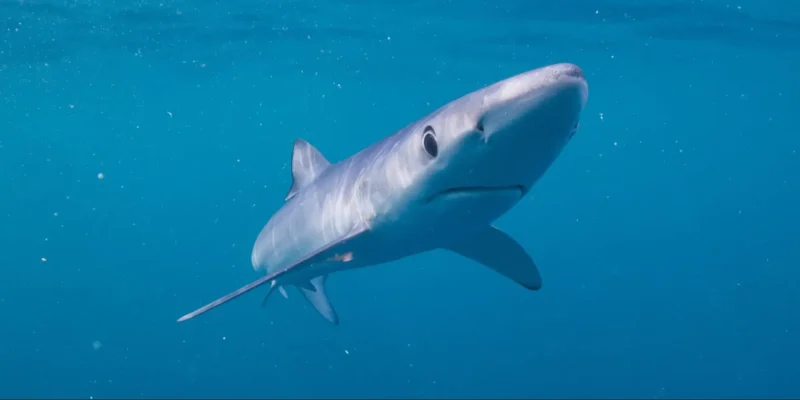
The University of Exeter has received £939,434 from Natural England for a new shark conservation project. Over three years, the team will investigate how three particularly vulnerable species move through English waters, where they reproduce and which areas are crucial to their populations.
The focus is on three very different sharks: the Blue shark (Prionace glauca), the Porbeagle (Lamna nasus) and the Tope shark (Galeorhinus galeus). All three are found in British marine areas, but there are still large gaps in our knowledge about their seasonal routes, whereabouts and breeding areas.
The project will run from July 2026 to March 2029 and is funded by Natural England through its Species Recovery Programme. The programme supports targeted action for more than 350 threatened species in England. For the sharks, this is not about a single protected area; the first task is to build the evidence needed for effective decisions.
75 electronic tags will reveal hidden movements
The project is led by Dr. Matthew Witt and Dr. Lucy Hawkes at the University of Exeter. Working with the Angling Trust, the Marine Biological Association and the Pat Smith Database, the team will combine modern animal tracking with the long-standing knowledge of British sea anglers.
A total of 75 electronic tags will be used. These include long-term satellite transmitters that can track individual sharks for up to two years. The data will show which routes the animals take, whether they use certain regions for longer and when they return to English waters.
Such information is particularly important for highly migratory sharks. A sighting or a capture point is always just a snapshot. Only a longer period of electronic monitoring can reveal whether an area is merely on a transit route or serves as a regular habitat, mating or young animal habitat.
Ultrasound in the search for nursery grounds
Alongside tracking, the team will use non-invasive ultrasound scans. These can identify pregnant female sharks without the need for blood samples. If those animals are then followed with tags, potential pupping and nursery grounds may become visible.
These habitats in particular are crucial for protection. Areas where pregnant sharks regularly appear or juveniles spend their first months can be far more important to a population than their size suggests. However, without precise location and time data, such focal points easily go unnoticed.
The three species have different needs. Blue sharks travel enormous distances across the open ocean. Porbeagles are also pelagic and face particularly severe pressure in Europe. Tope sharks more often use coastal shelf waters and can form regional groups. A joint project can therefore show which conservation tools must be tailored to each species.
Anglers’ knowledge becomes part of the research
A second focus is working with recreational anglers. At least 45 of them will contribute their knowledge in workshops and structured interviews. Meetings are planned at important fishing locations such as Looe, Falmouth and Brightlingsea.
Historical catch records and observations over many years can fill gaps that a time-limited research project alone would not cover. Combined with existing databases and the new transmitter data, this will create the most comprehensive picture to date of the distribution of Blue shark, Porbeagle and Tope shark in English waters.
Involving anglers has another practical advantage: all three species can be caught while sea fishing. Anyone who is regularly on the water can not only provide observations, but also help develop gentle processes for marking, measuring and releasing.
What happens after capture
The tags are intended to document more than movements. The team also wants to investigate how sharks respond to capture and release. A shark returned to the water alive has not necessarily survived the experience unharmed. Exhaustion, injuries and prolonged handling can affect survival after release.
The findings will therefore be used to develop best-practice guidance for anglers. The aim is to provide practical recommendations that reduce stress and injury and improve survival. In this way, the project connects fundamental research with measures that can be applied directly on boats and at angling sites.
Updated Red Lists as a basis for conservation
The data will also feed into updated Red List assessments for England. According to the University of Exeter, the tope shark is classified as Vulnerable in Europe and the porbeagle as Critically Endangered. Reliable regional assessments need more than global population trends: they require evidence on occurrence, abundance, age structure and the use of particular marine areas.
The funding is therefore an important step for shark conservation. Nearly one million pounds sounds like a large sum, but it is spread across three years, several partners, 75 tags, fieldwork at different coasts and the analysis of extensive datasets. The project’s value will ultimately depend on whether the evidence leads to clear priorities.
This view beneath the surface also matters to divers. Large sharks are often seen only briefly and infrequently in English waters. The new tracking data may show that such encounters reflect recurring migrations and possibly vital habitats. Individual sightings can then become a robust picture—and that picture can support targeted conservation.