


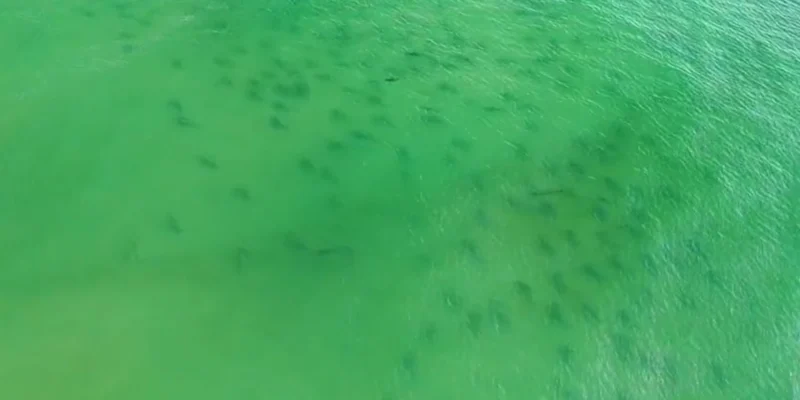
A drone recording off Masonboro Island in North Carolina shows an unusually large number of sharks just below the surface. According to a report by television station WECT, viewer Adam Pflum filmed the scene on the morning of 15 August 2026. The station reports hundreds, possibly even thousands, of animals.
What the footage proves
The footage clearly shows a broad aggregation of streamlined animals in shallow coastal water. The camera captures only a shifting section, however, so neither an exact count nor a reliable species identification is possible. Pflum estimated their length at about four to five feet, roughly 1.2 to 1.5 metres. A large ray also appears at the end of the video, but its species remains uncertain.
The images do not reveal why the animals gathered. A school of prey fish, favourable currents or a shared migration route are plausible explanations. The footage does not establish hunting, mating, use of a nursery area or a sudden increase in the regional shark population.
Which shark species might they be?
According to species information from NC Sea Grant, the size, season and habitat are consistent with several possibilities, including the Blacktip shark, Atlantic sharpnose shark, Spinner shark and Sandbar shark. Similar small coastal sharks are difficult to distinguish from above; close views of diagnostic features or an expert examination on site would be needed.
Why coastal sharks gather temporarily
The coast of the Atlantic Ocean lies along the seasonal routes of several shark species. Their ranges shift with water temperature and the availability of prey fish: blacktip sharks regularly occur off North and South Carolina in summer before many move farther south in autumn. Schools of menhaden and mullet can also concentrate migrating sharks in particular places.
Masonboro Island provides a productive coastal environment. According to the North Carolina Department of Environmental Quality, the roughly 8.4-mile island is the largest largely undisturbed barrier island in the southern part of the state. Beaches, dunes, salt marshes and tidal flats between the ocean and Masonboro Sound provide habitat for many juvenile fish, creating favourable conditions for larger predators.
What this means for people on the coast
Drones reveal animals that would be difficult to see from a beach or boat; waves, turbid water and greater depth can quickly obscure the same view. No attack or specific threat to swimmers was reported in connection with the footage. Anyone who notices schools of fish or many sharks should nevertheless keep their distance, leave the water and follow instructions from local authorities.