


Blacktip shark - Carcharhinus limbatus

Body structure, characteristics & anatomy
Body structure
The small blacktip shark is a medium-sized, slender requiem shark clearly adapted for fast swimming in open water. The body shape is streamlined. The body is long and cylindrical. The maximum scientifically documented total length is about 280 centimetres. However, most adult individuals measure between 150 and 200 centimetres. Body weight varies by region and sex. Large individuals reach over 100 kilograms. The hydrodynamic build reduces drag and allows rapid changes of direction.
Head and snout shape
The head is relatively short. The snout is long, narrow and pointed. Its length is approximately equal to the mouth width. From above it appears wedge-shaped. This feature is important for distinguishing it from similar species such as Carcharhinus brevipinna.
The nostrils are located ventrally at the tip of the snout. Small skin flaps channel the inflow of water to the olfactory organs.
Eyes and nictitating membrane
The eyes are medium-sized and oval. A pronounced nictitating membrane is present. This transparent protective membrane is drawn over the eye during rapid movements or when capturing prey. It protects the cornea from mechanical stress.
The lateral position of the eyes allows a wide field of view. An overlapping visual area in front of the snout permits limited binocular vision.
Fin anatomy and hydrodynamic function
The fin structure is characteristic and taxonomically relevant.
First dorsal fin
The first dorsal fin is tall and falcate. It originates slightly posterior to the base of the pectoral fins. The tip is distinctly black. This marking gives it its name.
Second dorsal fin
The second dorsal fin is noticeably smaller. Here too a dark tip is often present. A pronounced interdorsal keel is absent. This feature is diagnostic within the genus Carcharhinus.
Pectoral fins
The pectoral fins are long, narrow and sickle-shaped. They attach low on the body. Their shape generates hydrodynamic lift. In combination with the oil-rich liver they stabilise the swimming posture.
Tail fin
The caudal fin is strongly heterocercal. The upper lobe is elongated and has a subterminal notch. The caudal axis runs slightly upwards. This configuration produces powerful thrust with high efficiency.
Also the tail tip is usually black. Black markings are usually found on
- the first dorsal fin
- the second dorsal fin
- the pectoral fins
- the lower lobe of the caudal fin
The anal fin bears no dark tip. This detail aids reliable identification.
Skin structure and dermal denticles
The skin is covered with densely spaced dermal denticles. These placoid scales have a central cusp with lateral edges. The surface is finely grooved.
Microscopic analyses show that the denticles overlap like roof tiles. Their orientation reduces turbulence in boundary layers. Hydrodynamic studies demonstrate a measurable reduction in frictional resistance for comparable surface structures.
The skin feels rough towards the head; in the opposite direction it feels smooth.
Skeleton and supporting structures
Like all modern sharks, Carcharhinus limbatus has a completely cartilaginous endoskeleton. The cartilage is lighter than bone tissue. Heavily stressed regions such as the jaws and vertebral column are partially reinforced by calcium salts.
Spine
The vertebral column consists of numerous amphicentric vertebrae. These doubly concave vertebrae allow flexible lateral movements. Propulsion is generated by lateral trunk movements, which are converted into thrust by the caudal fin.
Jaw apparatus and dentition
The jaws are strongly developed. The upper jaw is not fused to the skull. This hyostyly allows protrusion during biting.
The teeth in the upper jaw are broad, triangular and heavily serrated. The lower jaw teeth are narrower and also serrated. Several functional tooth rows lie in series. Tooth loss is continuously compensated.
Adult animals typically have 15 tooth rows per half of the upper jaw and 15 in the lower jaw, plus symphysial teeth.
Buoyancy system
Carcharhinus limbatus lacks a swim bladder. Static buoyancy is produced by a large, oil-rich liver. This contains high concentrations of squalene. The body’s specific weight is thereby reduced.
Dynamic lift is generated by forward movement and fin orientation. The combination of liver-derived buoyancy and hydrodynamic lift stabilises the swimming position.
Sense organs as an anatomical specialisation
Lateral line organ
The lateral line runs clearly along the flank. It detects pressure waves and vibrations in the water. Neuromasts in the canals respond to minimal water movements.
Ampullae of Lorenzini
The snout has a high density of electroreceptive pores. These ampullae are gel-filled canals that can detect electric fields in the microvolt range. Muscle contractions of other animals generate such fields.
Sense of smell
The olfactory organs consist of lamellar folds inside the nasal capsules. The surface area is greatly increased. Experimental studies on related species show a high sensitivity to amino acids in the water.
Distribution & Habitat
Distribution of the Blacktip Shark
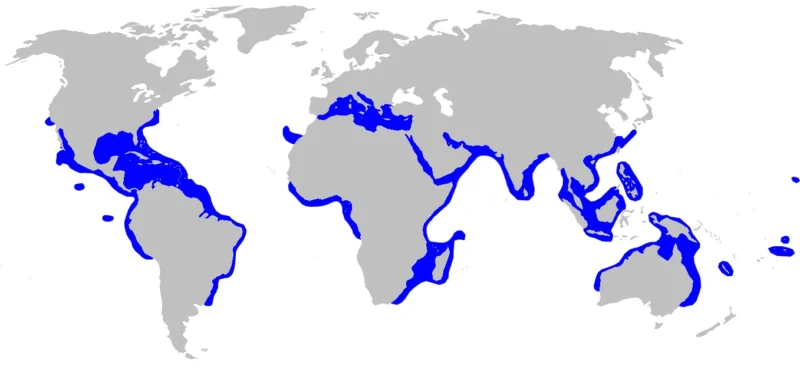
The Blacktip Shark (Carcharhinus limbatus) is found worldwide in tropical and warm-temperate marine regions. The species occupies coastal zones of the Atlantic, the Indian Ocean and the Pacific. Its distribution is widespread but regionally structured.
Atlantic
In the western Atlantic, the distribution range extends from the east coast of the United States across the Gulf of Mexico and the Caribbean to southern Brazil. Particularly dense populations have been documented for Florida and the northern Gulf of Mexico. Long-term tagging programmes show recurring seasonal migrations along the coast here.
In the eastern Atlantic, the species occurs off the west African coast. Records extend from Senegal to Angola. Some populations utilise nearshore island regions.
Indian Ocean
In the Indian Ocean, Carcharhinus limbatus inhabits the coasts of East Africa, the Red Sea, the Persian Gulf and the waters off India and Sri Lanka. The species is also regularly recorded off northwestern Australia. Coastal surveys indicate that it primarily utilises shallow shelf areas.
Pacific
In the western Pacific, the occurrence extends from South China across Southeast Asia to northern Australia. In the eastern Pacific, the distribution ranges from Southern California through Central America to Peru. Regional differences in population structure indicate limited genetic exchange between ocean basins.
Habitat of the Blacktip Shark
Carcharhinus limbatus is a distinctly coastal shark species. Its habitat is predominantly on the continental shelf in shallow waters.
Water depth and coastal association
Most observations come from depths of less than 30 metres. Individual animals have been recorded down to about 100 metres. Juveniles often occur in extremely shallow areas with less than 2 metres of water depth.
They prefer sandy or muddy substrates. Typical habitats are bays, lagoons and river mouths. Mangrove areas also play a central role as structurally rich coastal habitats.
Temperature and salinity
The blacktip shark lives in warm waters with temperatures of approximately 20 to 30 degrees Celsius. In the fringes of its range it undertakes seasonal coastal migrations to warmer regions. Telemetry data from the north-west Atlantic document regular north-south movements along the coast.
The species tolerates brackish conditions and enters estuaries. Permanent residence in pure freshwater has not been documented. Use of transitional zones between sea and river increases the species’ ecological flexibility.
Nurseries in shallow-water zones
Sheltered coastal areas serve as nurseries. Studies in the Gulf of Mexico show that newborn individuals preferentially use shallow bays with low currents. Such areas provide stable environmental conditions and reduce encounters with larger predators.
Juveniles exhibit a high degree of site fidelity. Tagging studies document repeated returns to the same coastal areas during the first months of life. Only as they grow do they expand their habitat into deeper shelf regions.
Ecological significance of nearshore habitats
The close association with productive coastal ecosystems shapes the ecological profile of Carcharhinus limbatus. Shallow shelf seas, estuaries and mangroves are among the most biologically active habitats in the oceans. The species uses these areas as both permanent habitat and nursery grounds.
Coastal regions are subject to intense human use. Changes from development, pollution and fisheries directly affect the available habitat. Due to its pronounced coastal affinity, the blacktip shark responds sensitively to structural changes in these habitats.
Threats & protection status
- Global status: IUCN Vulnerable (VU), population trend declining; assumed decline over three generations: 30–49%.
- Regional contrasts: In the USA, assessed units (Atlantic/Gulf) are considered not overfished and there is no overfishing.
- Trade: As a requiem shark (family Carcharhinidae) the species falls under CITES Appendix II (listing of requiem sharks; entry into force 25.11.2023).
- Key levers: (1) reduce fishery mortality (target & bycatch), (2) protect coastal nurseries, (3) improve data quality on catch/trade, (4) strengthen CITES implementation (NDFs, species identification, enforcement).
Global status and legal framework
IUCN Red List (global)
The small blacktip shark is globally assessed as Vulnerable (VU) (criteria: A2bd),
assessment date: 18.11.2020, publication: 2021. The global trend is reported as decreasing.
CITES (trade regulation)
Since 25.11.2023 CITES obligations apply to international trade in requiem sharks (Carcharhinidae spp., Appendix II).
Exports require in practice, among other things, robust Non-Detriment Findings (NDF) and effective national implementation.
Europe / Mediterranean (regional)
For Europe the species is listed in regional overviews partly as Data Deficient (DD) – an indication of insufficient data
and limited robust trend information in the European context.
Life history and vulnerability
The small blacktip shark preferentially uses coastal shallow waters (e.g. estuaries, bays, mangroves, lagoons).
This nursery use increases vulnerability to coastal fisheries and habitat degradation.
Maturity and generation length
- Generation length: about 9–16 years (regionally variable).
- Sexual maturity: varies by region (examples range from approx. 5–7 years or higher).
Reproduction
The species is viviparous (placental vivipary). Litter sizes are typically in the single digits; documented ranges extend to 1–11 juveniles.
These parameters indicate that recovery is possible, but high sustained removal pressure is difficult to compensate for without management.
Regional stock status and assessments
The data situation is heterogeneous worldwide: formal assessments exist in well-managed regions, while data gaps dominate in many other areas.
| Großregion | Bewertung / Beispiel | Trendbild (Einordnung) | Evidenzqualität |
|---|---|---|---|
| NW Atlantic / Caribbean | USA (Atlantic): not overfished, no overfishing | More stable in US waters; Caribbean overall heterogeneous and data-poor | High (USA), low–medium (Caribbean overall) |
| Gulf of Mexico / Gulf of America | USA (Gulf): not overfished, no overfishing | Management-supported stability; landings fluctuate | High (USA) |
| Eastern Atlantic (Europe) | Regionally partly data deficient (DD) | No robust trend signal; data gaps dominate | Niedrig |
| Mediterranean | Regionally partly data deficient (DD) | Peripheral/rare occurrences; status uncertain | Low |
| West Africa | Nursery records; few robust stock assessments | Precautionary approach warranted (bycatch + coastal pressure) | Low–mittel |
| Indian Ocean | Global syntheses indicate regionalised pressure | Probable decline in data-poor regions | Medium (indicator-based) |
| Western Pacific (Australia as an example) | Multiple stocks: partly “sustainable”, partly “undefined” | Australia largely more favourable; elsewhere often data gaps | High (AU), otherwise low–medium |
Management signal: The contrast between global threat status and regionally stable US/AU assessments shows how strongly effective management can influence population status.
Threats and pressure pathways
1) Fisheries (targeted removals & bycatch)
The main driver of the global decline is fishing pressure – both from targeted removal (meat, fins)
and from bycatch in coastal and high-seas fisheries. Additionally, post-release mortality (e.g. after net capture) can be relevant.
2) Habitat degradation & coastal development
Because juveniles often develop in coastal nurseries, the loss or degradation of these habitats
(e.g. through development, pollution, or alterations to estuaries/mangroves) has a particularly strong impact on recruitment.
3) Pollution (well documented locally, patchy globally)
For some regions there is evidence of contaminant exposure (e.g. mercury) in nurseries.
However, globally harmonised monitoring programmes are often lacking to quantify the significance on a broad scale.
4) Climate change (distribution & management boundaries)
Temperature and environmental changes can shift distributions, migrations and the spatial overlap with fisheries.
This can put existing management boundaries and seasonal rules under pressure and require adaptive management.
Fisheries and trade data
Trade (fins/meat) & traceability
Fins can be traded internationally; at the same time catch and trade statistics are often not species-specific.
This is exactly where CITES Appendix II comes in – but it will only be effective with accurate species identification, documentation and enforcement.
Management, protection and effectiveness
USA as a reference case
In the USA, formal status determinations (Atlantic/Gulf) show that stocks can be managed stably or sustainably under strict regulatory architecture (assessments, quota logic, retention limits, closures, monitoring).
Australia (example Western Pacific)
Australian stock report cards classify several stocks as sustainable, while also pointing to risks from fishing pressure and habitat degradation. The international comparison emphasises: global risks become particularly large where data and management are weak.
Role of CITES – and limits without enforcement
CITES Appendix II creates obligations (including NDFs) and can improve traceability. Without adequate controls, capacity and data, however, effectiveness remains limited.
Life history, Diet & Reproduction
The blacktip shark is a widely distributed coastal shark of tropical to warm‑temperate seas worldwide. It utilises nearshore shallow‑water areas (including brackish and estuarine zones) as well as shelf habitats. In some regions it is strongly migratory and can form large schools or seasonal mass aggregations.
From a dietary perspective the species is predominantly piscivorous: main prey are schooling and other bony fishes; cephalopods and crustaceans are taken additionally depending on region and age. Combined stomach‑content and isotope studies suggest that blacktip sharks often occupy a high trophic position (regionally described as tertiary consumers).
Reproductively the species is placental viviparous (yolk‑sac placenta). Several populations tend towards biennial reproduction, with a gestation period of about 10–12 months and litter sizes that vary regionally.
Life history
Seasonal migrations and aggregations
For western Atlantic stocks, seasonal coastal migrations are well described: over the course of the year animals shift along the coast, with winter aggregations in very shallow water in certain “bottleneck” sections of the migration route. Aerial and transect surveys show that these winter aggregations can reach exceptional magnitudes and are strongly linked to water temperature (high densities in cooler water).
Daily activity patterns and social behaviour
For juveniles in nursery areas, day–night cycles are well documented: a core habitat is used during the day, with expansion into other parts of the bay at night. For adults, daily patterns are often inferred indirectly from sighting or count data (e.g. drone surveys), with the caveat that detectability is influenced by visibility and behaviour.
Social behaviour is characterised by flexible aggregation: the species can occur in groups, sometimes forming very large seasonal aggregations. Classical territoriality (defended territories) is not described as a dominant pattern in the core sources consulted here.
Philopatry (site fidelity)
Genetic evidence points to pronounced population structure and is consistent with maternal philopatry (females returning to natal/pupping areas). This is relevant for management because local removals are not necessarily compensated by immigration.
Diet
The prey spectrum is generally dominated by fish, but varies taxonomically depending on region, habitat and ontogeny. Schooling fish are frequently reported; cephalopods and crustaceans also occur.
Stomach contents & stable isotopes (example: Gulf of Mexico)
Combined analyses often show a very strong dominance of teleosts in short-term feeding (stomach contents) and isotopic signatures that support more pelagic-influenced feeding pathways. Ontogenetic shifts have also been described (isotope values increase with body size), indicating changes in prey composition and/or trophic position with age.
Analytical interpretation
The combination of a teleost-dominated diet and high trophic positions suggests that the Kleine Schwarzspitzenhai acts in many coastal systems as an ‘upper mesopredator’: trophically high-ranked, but not necessarily an ‘apex predator’ without enemies.
Reproduction
The small blacktip shark is placentally viviparous (matrotrophic). Depending on the population, 10–12 months’ gestation are reported; litter sizes vary considerably. In several regions a biennial (two‑year) reproductive cycle has been described.
Example: southeast coast of the USA
- Cycle: biennial; gestation approximately 1 year
- Mating/Ovulation: described regionally in late spring/early summer
- Birth: in shallow coastal nurseries; juveniles initially remain in very shallow water
Example: Gulf of Mexico
- Seasonality: mating and birth with peaks reported in spring
- Gestation: about 12 months
- Litter size: regionally on average smaller than in some African reports
Example: West/North Africa
- Birth sizes: often reported in the literature as around 61–65 cm (TL)
- Litter size: sometimes reported as 6–8
- Cycle: described in some studies as possibly biennial
Key uncertainties in comparison
- Length measurements: TL (total length) vs. FL (fork length) are not always used consistently.
- Regional divergences: differences in litter size/maturity parameters may be biologically real, but can also result from sampling and methodological effects.
- Taxonomic confusion: In Australia, delineation from closely related species/hybrids is a known stumbling block.
Profile
- First described:
- Max. size:
- Depth:
- Max. age:
- Max. weight:
- Water type:
- IUCN Status:
Taxonomy
- Kingdom:
- Phylum:
- Subphylum:
- Infraphylum:
- Parvphylum:
- Class:
- Subclass:
- Superorder:
- Order:
- Family:
- Genus:
Dive Centres




News

Hilo Bay: nursery for young blacktip sharks
From shark fishing to ecotourism: How a Brazilian community plans to protect its shark nursery
Rio de Janeiro: Six pregnant sharks point to a reproductive hotspot
How city light is changing the biology of sharks
Rare find off Florida: Almost-white shark causes a stir



Newsletter
Shark Alert in Your Inbox