


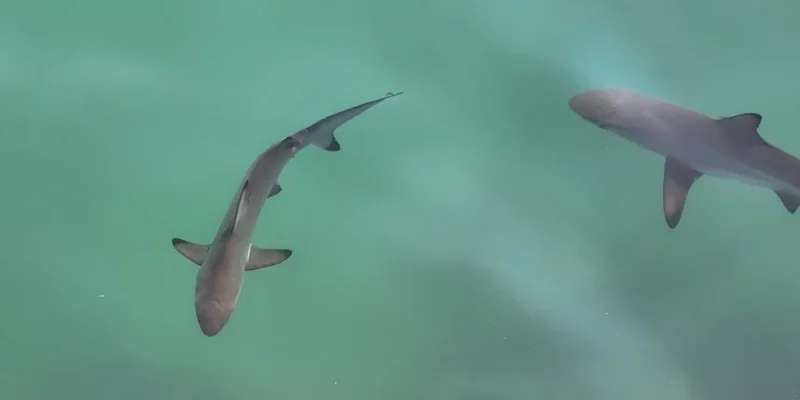
Hawaii‘s Hilo Bay appears to be more than a sheltered coastal area with regular shark sightings. A new study in Frontiers in Marine Science describes the bay as the first known nursery for blacktip sharks in Hawaiian waters.
Twenty-nine young sharks with acoustic tags
For the study, researchers caught and tagged 29 juvenile blacktip sharks (Carcharhinus limbatus) in Hilo Bay. The animals received acoustic transmitters. Between July 2022 and January 2024, the bay was systematically surveyed every two to five weeks.
The team used 44 stations across the bay. With a receiver and omnidirectional hydrophone, they checked where and when the tagged sharks were detected. This was not about isolated chance sightings, but about repeated presence patterns over a year and a half.
Present in the bay year-round
The central result: young blacktip sharks were detectable in Hilo Bay throughout the year. The highest monthly residency values occurred from March to August, at 41.3 to 50.0 percent. The lowest values were recorded from October to January, at 24.1 to 30.1 percent.
Such values matter for identifying a nursery. A nursery is not simply a place where one young shark is seen once. Repeated use, a protective function and importance across early life years are decisive. The Hilo Bay data now provide a strong pattern for exactly that.
More often by day, deeper at night
Within the bay, tagged sharks were detected more often during the day than at night. At night, however, detections occurred more often in deeper areas. The authors interpret this as a sign that young blacktip sharks move into deeper zones at night, probably in connection with stronger nocturnal foraging.
The bay therefore does not look like a single fixed holding area. It apparently offers different subareas: shallower places where juveniles find protection during the day, and deeper areas that can be used more strongly at night. For management, this fine-scale resolution is especially valuable.
Oxygen, not temperature, as a limit
Temperature and salinity did not differ enough between stations to explain habitat use. Dissolved oxygen was different. Low oxygen levels appeared to limit daytime use of parts of the bay.
The seasonal relationship is especially revealing: the lowest oxygen concentrations occurred in the same months when the fewest sharks were detected. That suggests oxygen demand and water quality can directly influence the availability of suitable nursery areas.
Why a nursery needs protection
Blacktip sharks are widespread coastal sharks, but their early life stages are often poorly documented regionally. Juveniles use shallow, sheltered coastal areas because food, cover and lower predation pressure can come together there. If such areas are disturbed, built over or less well oxygenated, a particularly vulnerable life stage is affected.
For Hawaii, the finding is therefore more than a local shark note. Until now, no blacktip shark nursery had been described there. The study gives Hilo Bay a concrete biological value: the bay is not only a transit area, but apparently a place where young sharks spend their first years.
A clear first record
The study does not prove that Hilo Bay is the only important place for young blacktip sharks in Hawaii. But it shows that this bay convincingly meets the criteria for a nursery and that environmental changes can shift the usability of such habitats.
That is the strength of the work: it translates acoustic tag data into a concrete conservation question. If young blacktip sharks remain mostly in Hilo Bay over years, then the bay is part of their life cycle. Anyone who wants to protect coastal sharks has to know, monitor and include such early-life habitats.