


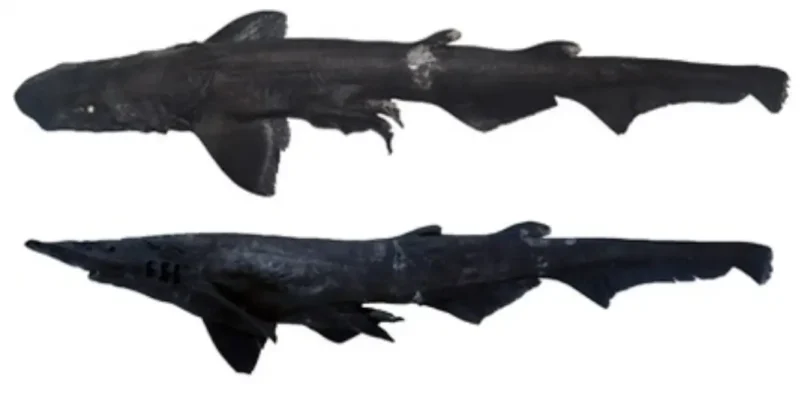
Two new names from the deep sea show how incomplete the known diversity of cartilaginous fish still is: Off Kerala, the catshark Apristurus drona was described; off Costa Rica’s Pacific coast, the long-nosed chimaera Rhinochimaera costaricana was described. Both species come from depths where research often only gains insight when bycatch, museum material and genetic analyses come together.
According to a report by The New Indian Express were the copies of Apristurus drona recovered as bycatch from deep-sea shrimp trawlers and landed in the harbor of Sakthikulangara. The formal description appeared on June 9, 2026 Zootaxa; the article bears the DOI 10.11646/zootaxa.5828.2.6.
The second paper was also published on June 10, 2026 Zootaxa published and described Rhinochimaera costaricana from the eastern Pacific. Marine & Océans picked up the discovery on July 4, 2026. The DOI of the study is 10.11646/zootaxa.5828.3.7.
Apristurus drona off Kerala
The new catshark from India was described by Sweta Beura, Bineesh K.K. and Dhriti Banerjee from Zoological Survey of India. The species name honors Drona, the son of the second author Bineesh K.K. The English name is given in the reporting as “Arabian slender catshark”; An established common name has not yet been introduced in German.
The description is based on four animals, two males and two females. They were 439 to 473 millimeters long and came from 400 to 650 meters depth along the Kollam-Schelfhangs in the southeastern Arabian Sea. That sounds small for a shark, for the species Apristurus But it fits well: many of these deep-sea catsharks remain slim, dark and inconspicuous.
Why DNA-Barcoding was important
The research team used a combination of classical anatomy and DNA-Barcoding. Morphologically falls Apristurus drona Among other things, it has a slim body that tapers towards the back, certain proportions of the nose opening, mouth and eye region, lip furrows of different lengths and a smaller first dorsal fin.
The researchers also compared sequences of the mitochondrial COI gene. The new species formed its own line and, according to the report, was genetically 5.5 to 5.7 percent away from the closest known relative. Such values do not replace good taxonomy, but they provide a strong second signal when the body characteristics are also cleanly separated.
Apristurus drona will be in the Apristurus brunneusgroup classified. What’s interesting is that the closest molecular comparison species don’t live right next door: are named Apristurus nakayai from the southwest Pacific, Apristurus macrorhynchus from the northwestern Pacific and Apristurus exsanguis from New Zealand.
The new species appears to have only very limited knowledge of the region itself. The sources name the Kollam-Schelfhang and the area around the Wadge Bank as possible distribution. Commercially, the small shark has no apparent significance; This is precisely why it can easily remain invisible in fishing statistics and public debates.
Rhinochimaera costaricana before Costa Rica
The second new species is not a shark in the strict sense, but a chimera. Chimeras, often called chimaeras, belong to the cartilaginous fish like sharks and rays, but they separated from actual sharks very early in evolution. This distinction is important for a shark portal: closely related, but not just another shark species.

The Zootaxa description of Rhinochimaera costaricana is based on three males with a total length of 775 to 830 millimeters. They were recorded between 2000 and 2023 off Costa Rica’s Pacific coast at depths of 390 to 787 meters. The animals were compared with measurement data from 90 other specimens of the three recognized so far Rhinochimaera-species.
Diagnostically, the authors mention, among other things, a shorter snout, a larger and higher spine of the first dorsal fin, a higher first dorsal fin, a wider distance between the dorsal fins and fewer caudal humps. Here too, molecular evidence supports the distinction: COI sequences showed 3.9 percent divergence Rhinochimaera africana, 4.5 percent Rhinochimaera atlantica and 4.7 percent Rhinochimaera pacifica.
Marine & Océans quotes Costa Rican researcher Arturo Angulo Sibaja as saying that this form is the only known long-nosed chimera on the Central American coast. At the same time, the distribution remains open: similar animals have been observed near Peru and Chile, so further comparisons will have to show whether the species occurs along larger parts of the Pacific coast of Central and South America.
What connects both discoveries
The two cases are far apart but tell the same basic story. In the deep sea, new cartilaginous fish are not always visible through spectacular expeditions. Often it is a few animals, clean measurements, museum and comparison material as well as DNA data that turn an inconspicuous find into a reliably described species.
When it comes to protection, this is more than name work. Deep-sea sharks and chimeras often grow slowly, live in habitats that are difficult to access and are often only marginally recorded in fisheries. For newly described species, population data, life history and risk assessment are almost completely missing. This is no reason to panic, but a clear indication of caution.
An animal that appears worthless to the market can be very valuable for taxonomy, biodiversity research, and subsequent conservation decisions. When ports, fisheries, museums and research work together, chance finds become data that can later explain which species live in an area and what pressures they encounter.
The deep sea remains an open map
For Haitauchen are Apristurus drona and Rhinochimaera costaricana above all, a reminder of the invisible half of the cartilaginous fish world. Many species live where no recreational diver can reach, where there is a lack of light and where a single, well-documented find can reveal more about the species list than years of observation on the surface.
The fact that new species are being described off heavily used coasts only seems paradoxical at first glance. Kerala and Costa Rica are not unknown points on the map. In many respects, their deeper habitats still are. These two descriptions make the map a little more accurate.