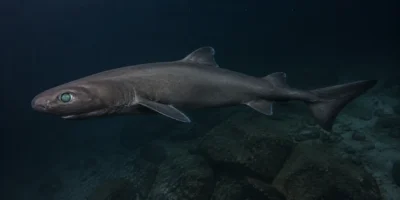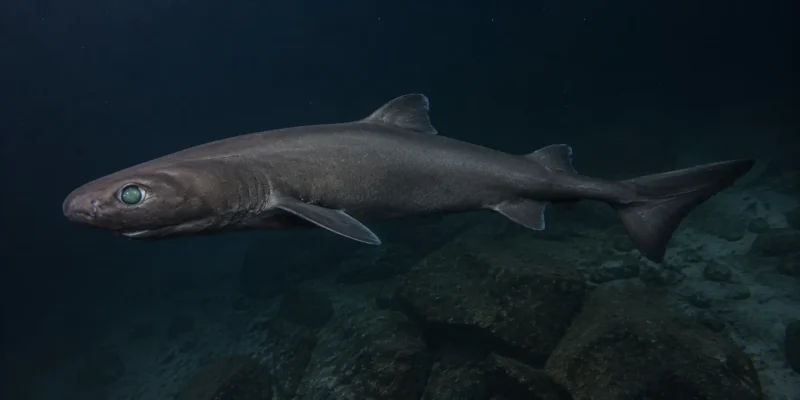
The Kitefin shark can hide its silhouette with blue-green light – but it may not be camouflage itself from predators, but from its prey. A new study in iScience shows that its belly light matches the weak daylight at a depth of around 500 meters in terms of intensity and color. At the same time, it shines much wider on the sides than with classic counter illuminators.
The authors interpret this combination as a possible hunting aid. The shark could make itself invisible when sneaking up from below and use light from the side to search the seabed for prey. This behavior was not directly observed. The work provides physical and ecological evidence for the hypothesis, not behavioral evidence.
Camouflage with backlight
In the twilight zone of the ocean, a faint remnant of daylight still shines in from above. An animal viewed from below, on the other hand, appears as a dark silhouette. Many fish, squid and crabs solve this problem with counter-lighting: light organs on the underside of the body imitate the light from above and make the contour disappear.
For this camouflage, the brightness, color and beam angle must match the ambient light as well as possible. For small, free-swimming deep-sea animals, protection from predators is the main function. This explanation is less convincing for the kitefin shark: it grows up to around 1.8 meters long, lives mainly near the bottom and no natural predators have been documented for adult animals.
Eight glowing sharks from the Chatham Rise
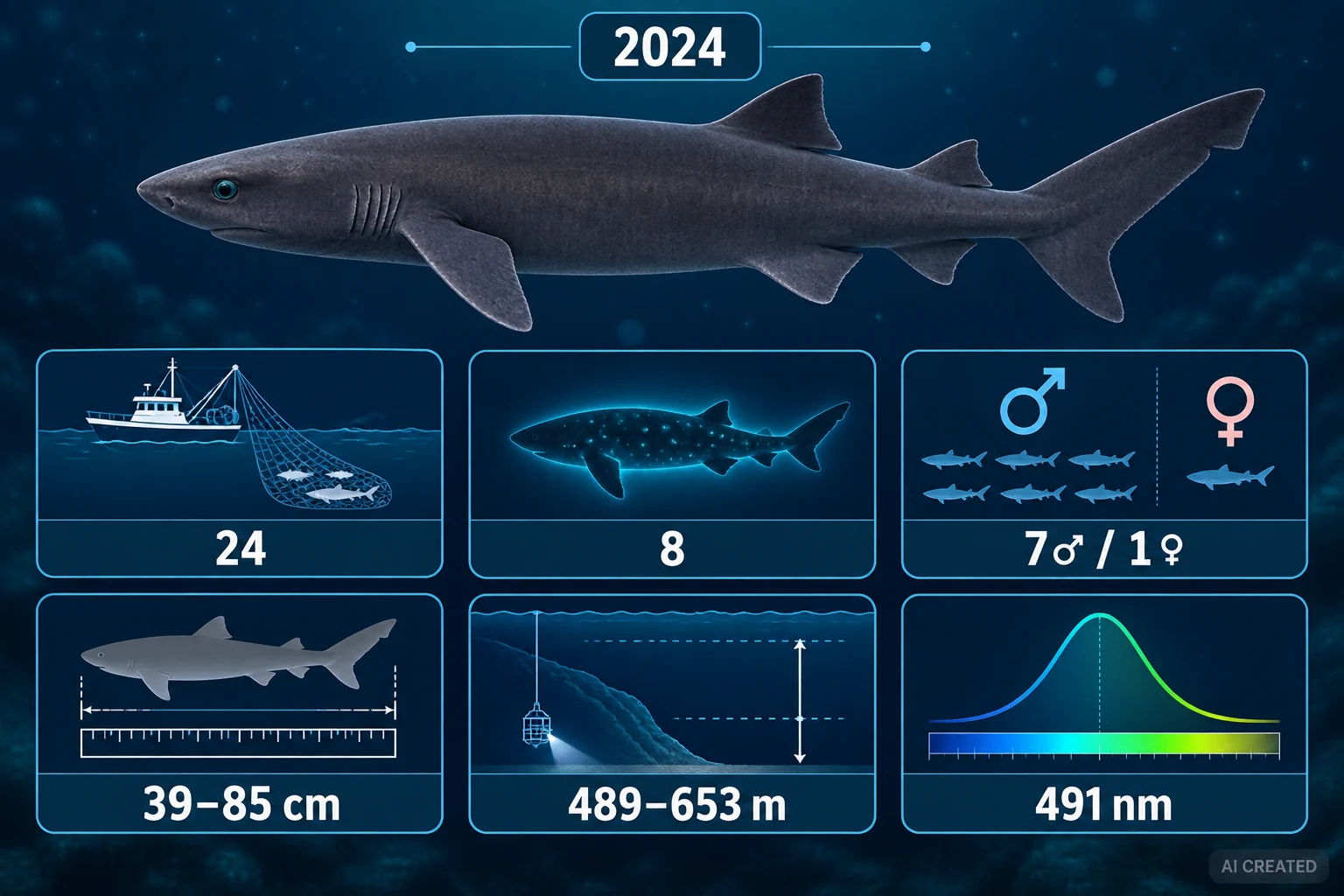
The team examined animals found in January 2024 during a population survey at Chatham Rise, east of New Zealand in the Pacific Ocean were caught in a bottom trawl net as bycatch. Of 24 kitefin sharks, eight were alive and exhibited stable spontaneous glow in darkened tanks. Only these eight animals were included in the measurements.
The sample consisted of seven males and one female with body lengths between 39 and 85 centimeters. The catches came from depths of 489 to 653 meters. For the short measurements, the sharks were placed in a supine position; They then recovered in the aerated sea water.
The selection of only stable glowing animals made sense from a methodological point of view, but limits the conclusions. It is unknown why other surviving bycatch did not glow or only shone diminishingly. This could be due to stress of catching and surfacing, an adaptation to the much brighter light on the surface or another physiological reason.
Belly light fits 480 to 540 meters depth
The spontaneous emission reached its maximum at 491 nanometers and was therefore in the blue-green range. The researchers found no significant difference in brightness between the examined zones on the underside of the body. This meant that more than 95 percent of the silhouette visible from below, including the fins, appeared to be a uniform surface of light.
From the measured radiation, the team calculated at what depth it would correspond to daylight from above. The result was between 480 and 540 meters and therefore within the actual fishing range. Brightness and spectrum therefore meet the physical conditions for counterlighting.
However, the calculation uses a general model for clear ocean water. The light immediately above the ground of the Chatham Rise was not measured in situ. Suspended matter and particles containing chlorophyll could shift the light color towards green. This explanation for the unusually long wavelength remains testable, but has not yet been confirmed.
Unusually wide light instead of perfect camouflage cones
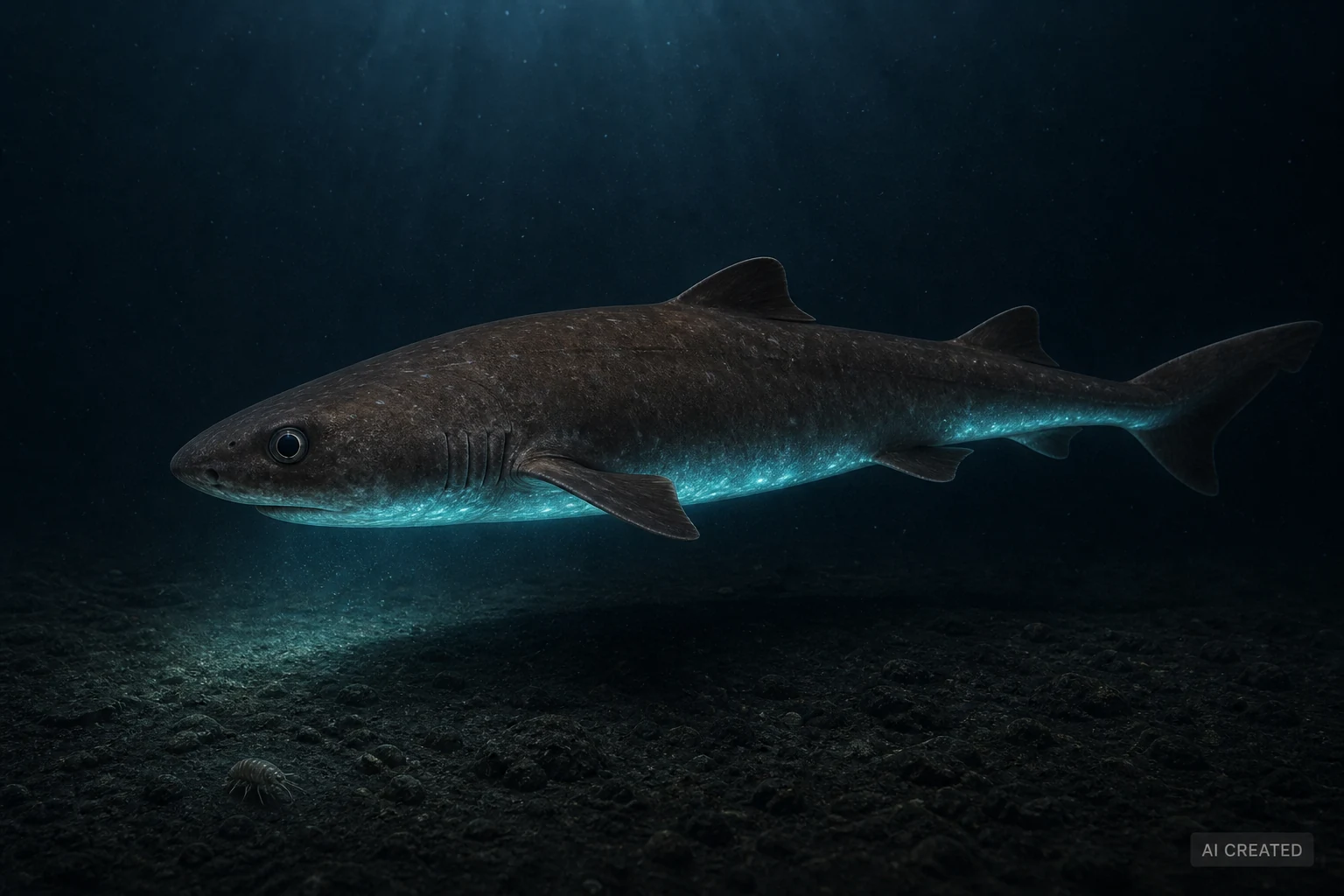
The crucial difference was in the beam angle. Classic counter illuminators focus their light so that it corresponds to the daylight coming in from above from as many angles as possible. The kitefin shark, on the other hand, radiated significantly further to the side in all measured body regions. This profile was exceptional among the bright sharks, bony fish and crustaceans compared so far.
The emission was particularly broad on the snout, lower jaw and in the pectoral fin area. Exactly there, light from the side could brighten the surroundings in the field of vision of the large, side-seated eyes. The authors carefully compare the principle to a biological searchlight: prey on the dark seabed could become visible without the shark losing its camouflage to an animal directly below it.
A second possibility complements this picture. If the shark swims towards prey near the ground from above or from the side, the appropriately bright underside can disguise its approach. For a slow-swimming predator capable of short, rapid advances, an unnoticed final approach would be a possible advantage.
Bright dorsal fins stand out
The dorsal fins also produced light. It was about an order of magnitude weaker than the belly glow, but exceeded the ambient light reflected from below by about two orders of magnitude. Against the dark background, the fins would therefore be more conspicuous than camouflaged.
The study brings a signaling effect into play. Luminous dorsal fins could provide other species with information about position or body orientation. It is not possible to determine from the eight animals which receivers see the signal, whether there are differences between the sexes and in what behavior it is used.
The 2021 study provided the basis
Already the first experimental study of 2021 was the first to document the glow of living kitefin sharks. At that time, animals from a research trip in January 2020 were examined at Chatham Rise. Next to Dalatias licha included the black-bellied lanternshark (Etmopterus lucifer) and the southern lanternshark (Etmopterus granulosus) for investigation.
Histological analyzes revealed millions of tiny light-emitting organs, called photophores, in the skin. In the kitefin shark, such an organ contains a single glowing cell in a pigmented structure with overlying lens cells. Unusually, light production in sharks is controlled primarily by hormones rather than by fast nerve impulses.
The 2021 work already formulated two hunting ideas: the shark could illuminate the ground or use backlight to sneak up on faster prey. The new study is now testing brightness, spectrum and angular distribution in this ecological context for the first time. It strengthens both ideas, but does not yet separate their respective contributions.
Strong evidence, no hunting attempt observed yet
The measured values convincingly show that the kitefin shark can provide physical counter-illumination. The step from this ability to a concrete hunting strategy remains an interpretation. To date, there has been no field recording of a glowing kitefin shark using its belly light to search for or approach prey.
In addition, there are eight animals from just one trip and one season, a highly unbalanced sex ratio and little comparative data for other species. The light model has not been verified by seabed measurements. The authors therefore cite observations of free-swimming animals as the crucial next test.
Such research is closely linked to fisheries data because live deep-sea sharks are rarely available. At the same time, the scientific benefit must not obscure the risk: another study already showed a very high one high bycatch mortality of the kitefin shark. Gentle capture methods, rapid release and non-invasive camera systems therefore remain important if the hunt of the largest luminous vertebrate is to one day be directly observed.